
There have been several rounds of slum clearance in Southampton’s history, notably when the area around Simnel Street was cleared in the 1890’s after the discovery of the body of Ellen Wren. I’ve written about Ellen and her unfortunate demise before, so I won’t repeat myself, but details can be found here if you missed it. More slums were demolished in the 1930s, mostly in a piecemeal fashion under rules brought about by the Housing Act of 1930. Others were not knocked down until the 1960s. Included in the latter were the houses of Northam Street, where my father-in-law, Albert Keates, was born. Seventh Daughter, the third book in my series, is set there. The book will probably be released at the end of the summer. In the meantime, I thought I’d share some of my research into the area.
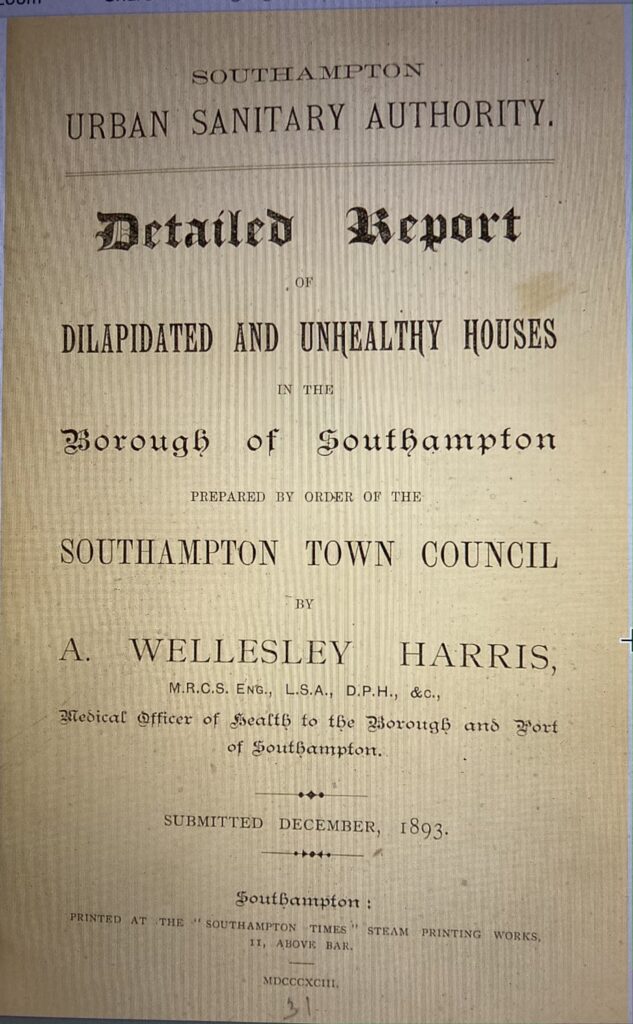
The discovery of Ellen Wren’s body and the horrific conditions she’d been living in prompted a knee jerk reaction amongst the powers that be. It was clear that Simnel Street wasn’t the only slum in the town. A report was made, the Dilapidated Buildings Report of 1893. It totalled a hundred pages, mentioned twenty-six different areas that needed attention and had a two-page list of houses unfit for habitation. Perhaps the intentions were pure, but it could also have been a case of being seen to be doing something because of the public outrage. Either way, some of the worst slums were demolished, but many survived into the 1930s.
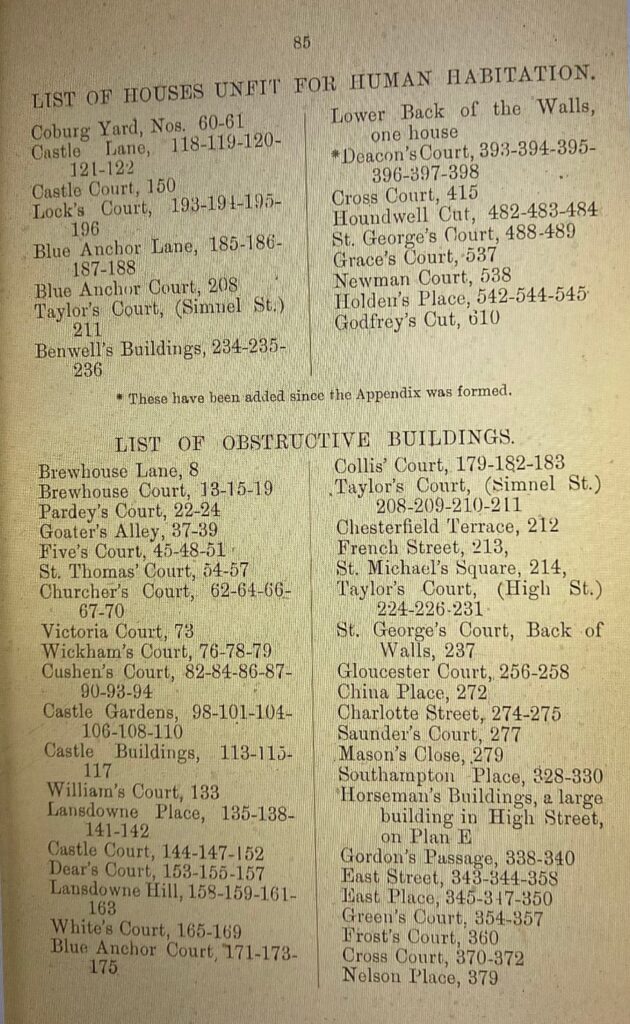
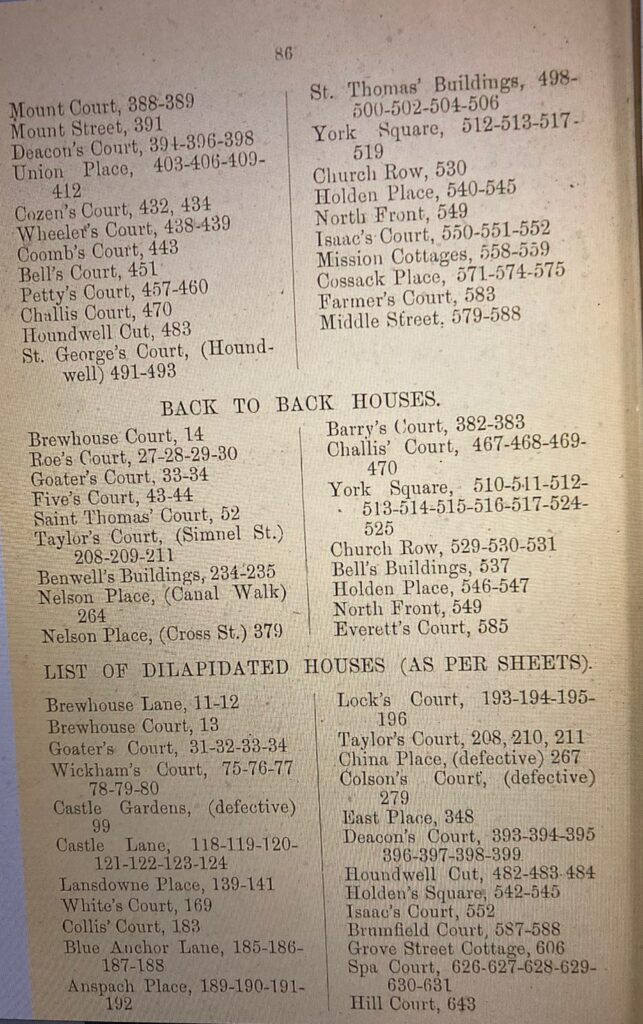
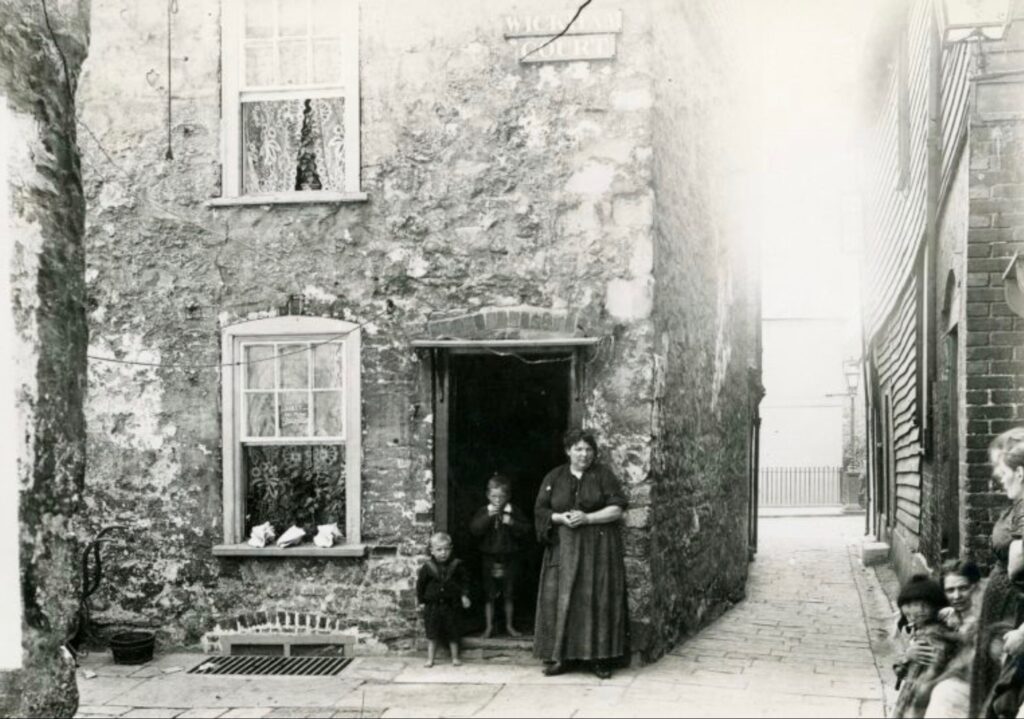
One of the areas that appears to have survived was Wickham Court, an early Victoria court on the south side of Vyse Lane. I stumbled upon a report about it, in Hansard (the official report of all Parliamentary debates) dated 19 June 1934. Mrs J Neale of Hove owned the houses in question. In 1932, she was ordered to demolish 1, 2, 3 and 4 Victoria Court and 1 and 2 Vyse Court, all in the Wickham Court clearance area. The cost (£85 10s for the Victoria Court houses alone) was more than she could afford. The council didn’t want to buy the site from her, and she was not allowed to sell it for building purposes. Although the area was well overdue for being cleared. This seemed a little unfair, but there was little sympathy from the Minister of Health, who simply pointed out her right to appeal and said it was a matter between her and the council. Exactly what happened to Mrs Neal isn’t clear, but the houses were demolished at some time during the 1930s.
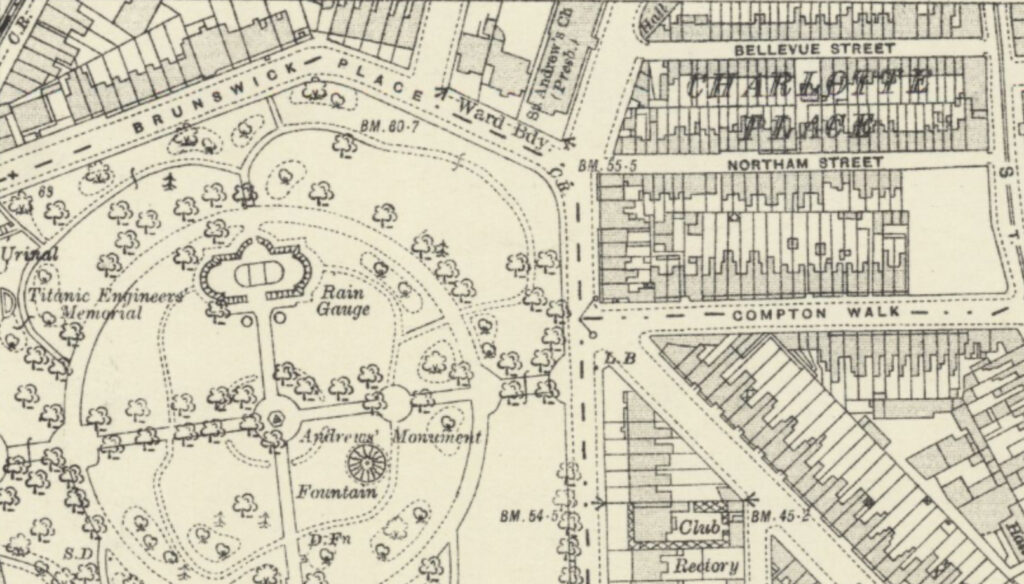
The last round of slum clearance took place in the 1960s. Many of these were in bomb-damaged areas, although the houses in question were undoubtedly slums long before the bombs dropped. Northam Street was amongst them. It was one of three streets covering the area where the Jury’s Inn now stands. It ran from the top corner of East Park, between East Park Terrace and St Mary’s Road and was sandwiched between Compton Walk and Bellevue Street. The houses were built in the 1820s. They were humble two up two down terraces with doors opening onto the street, no inside running water and toilets at the bottom of the back yards. My father in Law, Albert, was born at number 5 Northam Street.
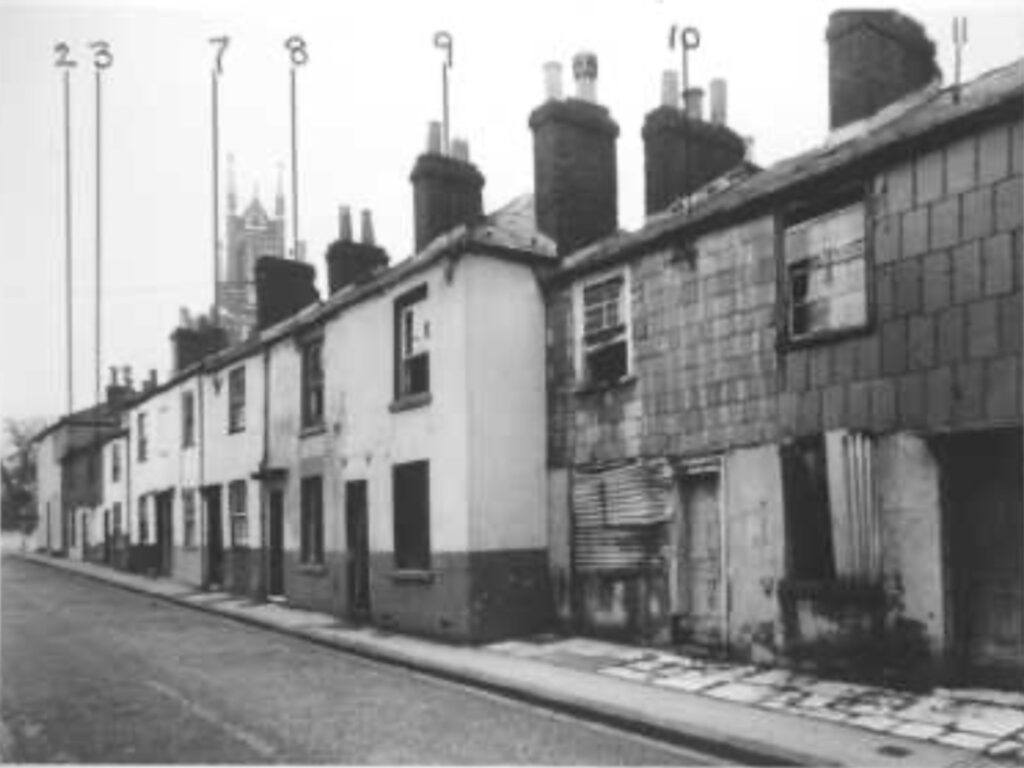
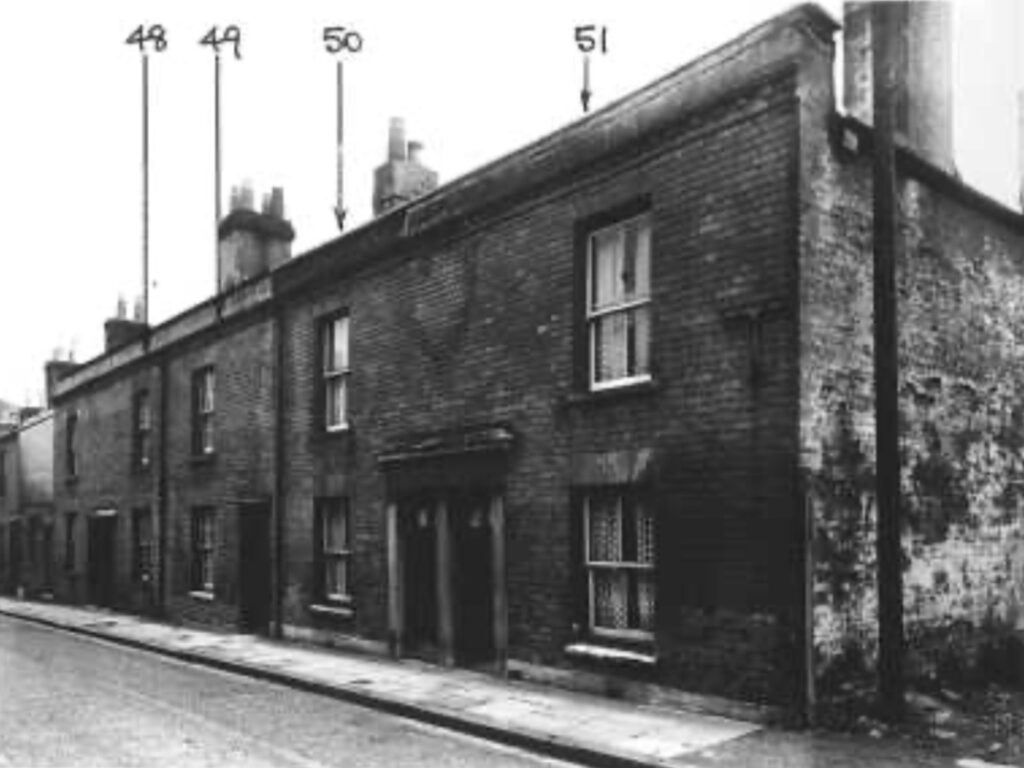
In his memoirs, Albert described it — “The house, 5 Northam Street Southampton, was a typical terraced cottage with two rooms on the first floor and one ground floor front room reserved for ‘occasions,’ such as funerals. The remaining ground floor room was the kitchen, also used as a living, cooking, ironing, eating and everything else space. It had a black leaded coal fired range serving as the only heat source for cooking, water heating and space heating. The remaining ground floor consisted of a small scullery (a room traditionally used for washing up dishes and laundering clothes) with a brick built copper (wash boiler) for boiling whites. Water was provided by a tap affixed to the outside wall of the scullery. A stand alone, brick built W.C. was situated at the end of the garden back to back with the one on the neighbouring property. This was known as the dunny or dunnykin in South Hampshire vernacular.” Number 5 was on the north side of Northam street. In the photograph I found on the Southampton City Council Spydus website, the spires of St Andrews Church can clearly be seen in the background. These photos were taken in the 1960s, just prior to demolition, but they do give a feel for what the houses must have been like in the 1930s.
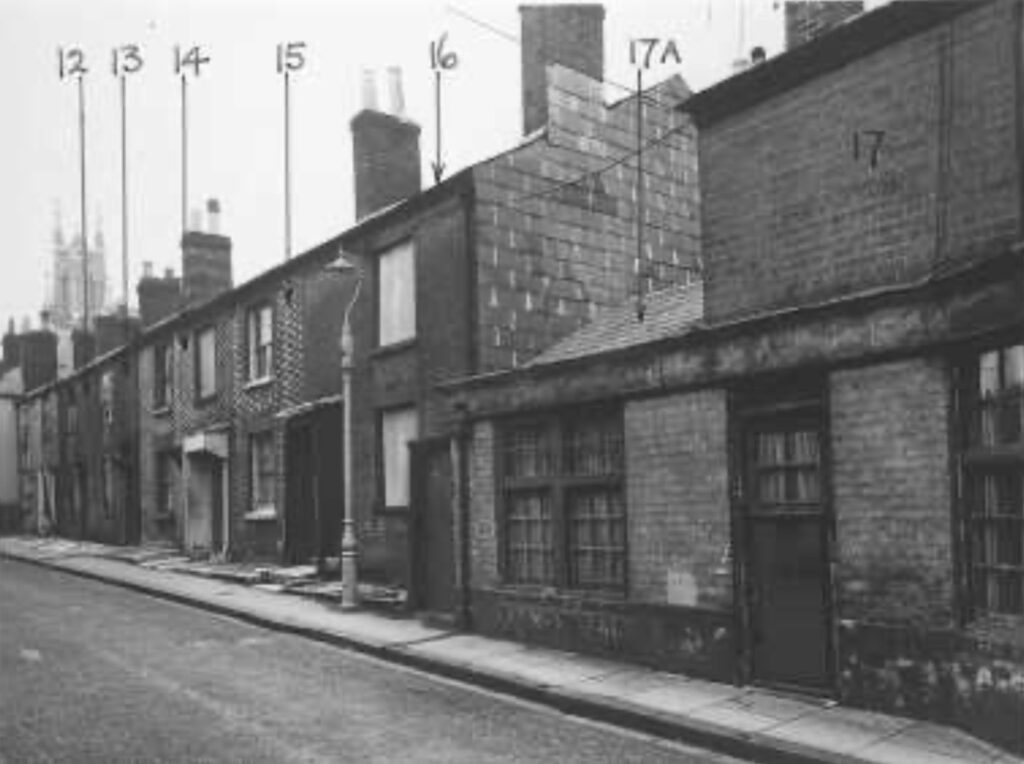
Number 17 Northam Street, in the middle of the north side, was a pub, The Charlotte Inn. It was originally owned by Scrase’s Star Brewery, a Southampton brewery established by Henry Scrase behind the Star Hotel at Upper Back of the Walls, 29 High Street, in 1829. In 1927 the brewery was taken over by Strong & Co, of Romsey. The Landlady in 1931 was Mrs Fanny Kneller. It doesn’t appear to have been the nicest of establishments, but I suppose it was somewhere for the local men to have a drink at the end of a hard working day. In 1932, it was bad enough that it was refused a licence and closed down. It then became a private house. What became of Fanny Kneller isn’t clear, but there was a Mrs M Kneller living in Bellevue Street in 1935, and someone called William Vickery was living at 17 Northam Street.
So far, I’ve painted a picture of a horrible slum, but Northam Street was probably no worse than a great deal of Southampton’s lower working class housing back in the 1930s, and it did have things to recommend it. The location, with East Park and St Andrews Church at one end and the shops of St Mary’s Road, with a school, fire station and the Royal South Hants Hospital at the other, must have been a boon for residents. It was a close-knit community too, brought together by shared poverty. For Albert’s mother, Daisy, there was family nearby to help. She was born at number 52 Northam Street. Sadly, I haven’t been able to find a photo of her parents’ house, but, looking at the old Kelly’s Directories and the old maps, I believe her parents, Walter and Florence Woodman, lived opposite number 5.
Walter Frederick and Florence Woodman had nine children — seven of them were girls. Daisy was the youngest, the seventh daughter. It must have been very overcrowded in their little two-up-two-down house. Surprisingly, all but two of the children survived to adulthood. The eldest daughter, Florence, died as a baby, and the first born son, Walter, died before his third birthday. The houses may have been small, but most were equally crowded. A look at the old censuses shows that Northam Street families were large. Daisy’s surviving brother, also called Walter, married Daisy Vass, who lived at number 13 Northam Street with her parents and seven siblings.
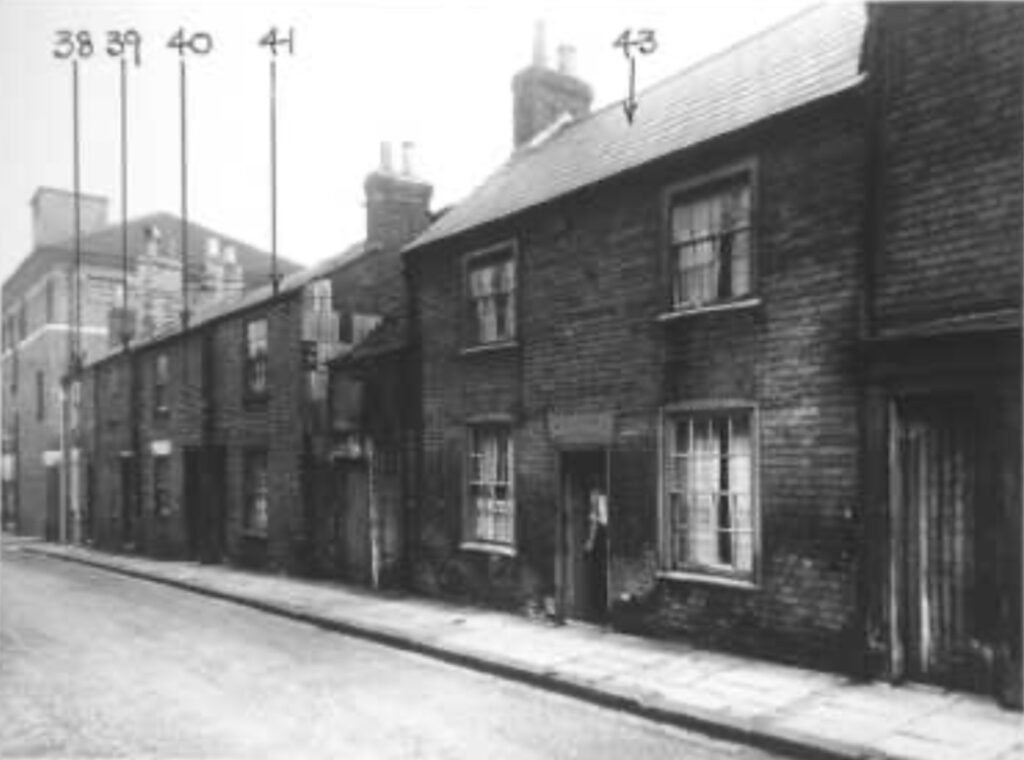

The old Kelly’s directories show that many families lived in Northam Street all their lives. The same names appear again and again, and often children married and moved to other houses in the street. In 1934, when Walter Frederick Woodman died, his fifth daughter Lilian stayed at 52 Northam Street. She married Leslie Lewis in 1935, and they carried on living in the house where she and all her siblings had been born. Albert and Daisy Keates, along with their young son Albert, moved to 9 Utility Flats Canute Road in the early 1930s, but they were back in Northam Street by 1939, now at number 55. Something must have kept them there or drawn them back, and I think it was probably the sense of community.
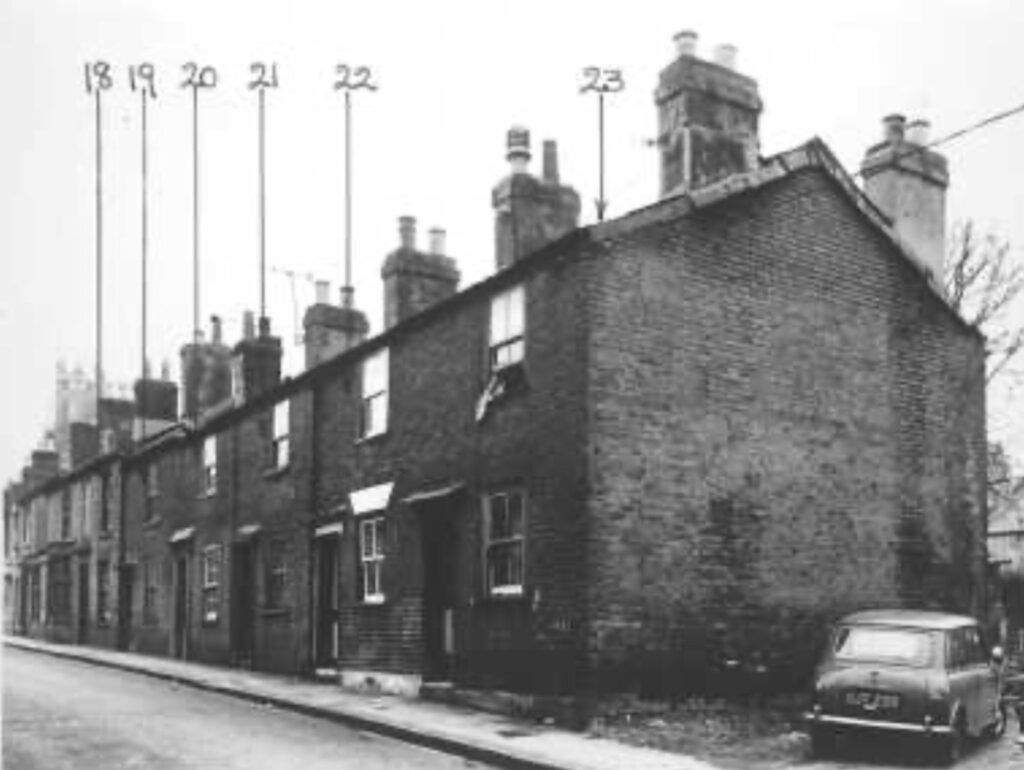
Like much of Southampton, Northam Street suffered during the air raids of 1940 and 41. Albert’s memoirs tell of one very close call – “I had been playing in the parks with my friend Eric when the alert siren sounded. We each went back to our respective homes. It was then I discovered the effect of machine gun rounds as they kicked up dirt at the roadside. Yah Boo, missed me! The ensuing raid was quite heavy and I recall being terrified, crouching at the end of the passage as the front door was blown off its hinges. After the raiders past siren, I emerged. I passed the broken door to find a section of tramlines outside weighing probably two hundredweight or more, blown from St Mary’s Road. With the casual nonchalance of youth I went out to continue playing with Eric only to find a crater of a size to accommodate a small bus where Eric’s home had been.” The houses may have been damaged, but none of the Northam Street residents were killed. Bomb damage prompted many moves, but Albert’s family returned again and again to Northam Street.
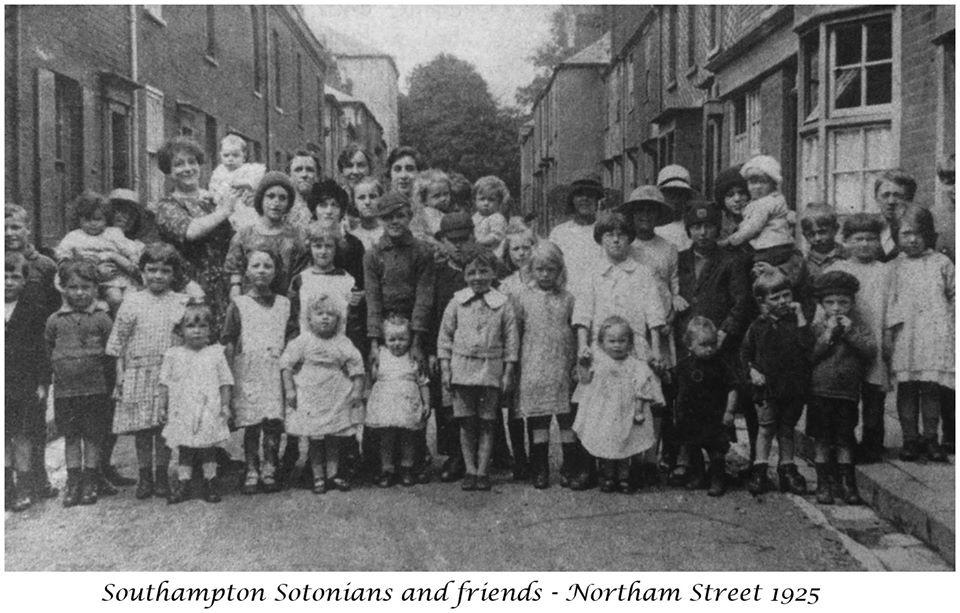
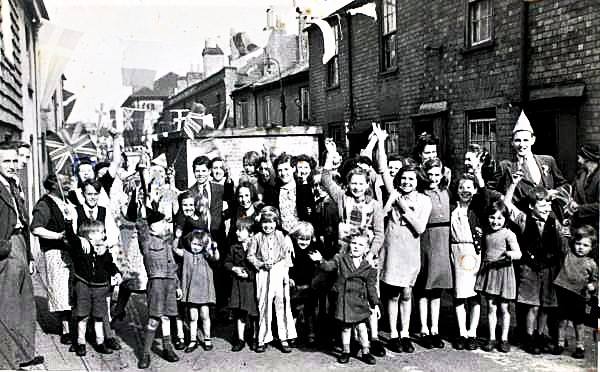
The community spirt is something I’ve tried to capture in Seventh Daughter, along with the grinding poverty. Like other similar lower working class streets in Southampton, the people there looked after their own. They had very little, but what they did have, they shared. Sadly, that spirit seems to have disappeared, along with the slums of Southampton. As Albert said in his memoirs, “Although we were all as poor as church mice community spirit was at a level no longer with us, regrettably.”
If you like what I write, and you’re interested in my novels are available now on Amazon in paperback, on Kindle and via Kindle Unlimited. Check out my Amazon page here and my Goodreads page here. If you would like to help me keep writing, you can now buy me a virtual coffee by clicking on the little orange coffee cup at the bottom right.
Hi there, another interesting article, I used to know Northam Street and as a child used to walk up it from St. Mary’s Road to Dorset Street. I think that a slight error has somehow crept in when you say that Northam Street was between Craven Street and Bellevue Street. As the map shows it was between Compton Walk and Bellevue Street. Craven Street is off of St. Mary Street.
Thank you. I don’t know how I managed to let that slip past. Updating now.
This is fascinating, thank you so much for writing this piece. My family have a close affinity with Northam Street. My mother was born in Northam Street in 1930, one of six children born to Irish immigrant parents. Her mother was an alcoholic and her father a Stevedore who was killed in accident loading a ship. Had it not been for the breakout of WW2 and their evacuation to Dorset and Somerset, I suspect they would not have survived the slums. My mother recalled her time in Somerset as the best of her childhood and they certainly didn’t want to return home at the end of the war. Their family name was Bowen, the childrens names were – Mary, Lilian, James, Kathleen, John and Margaret. All passed sadly.
My father in law was born in Northam Street and bombed out several times. His father, Albert Keates was also a stevedore. They may well have known each other. Sadly my father in law, Albert (after his father) is gone now, too.