
On 18 April, Commando decided he wanted to visit Portsdown Hill for some strange reason. In his youth, he said, he used to ride out there on his motorbike all the time. He was surprised to discover I’d never been there because he used to go with all his mates from the pub where we first met. He talked about a pub they used to go to and how there was a car park with a burger van where they’d sit and look at the lights of Portsmouth. It sounded quite nice, and I was a little miffed that I’d never been invited along.
So we got in the car and drove out there. Forty-odd years is a long time. It wasn’t long before Commando had to admit that he couldn’t quite remember where the pub or the car park were. We were on the hill, but nothing looked familiar to him. There was a lot of driving around. We went in a big circle around the hill without finding either pub or car park, but I did spot an ice cream van and some parked cars. It wasn’t the car park he remembered, but it was somewhere we could stop, so we did.
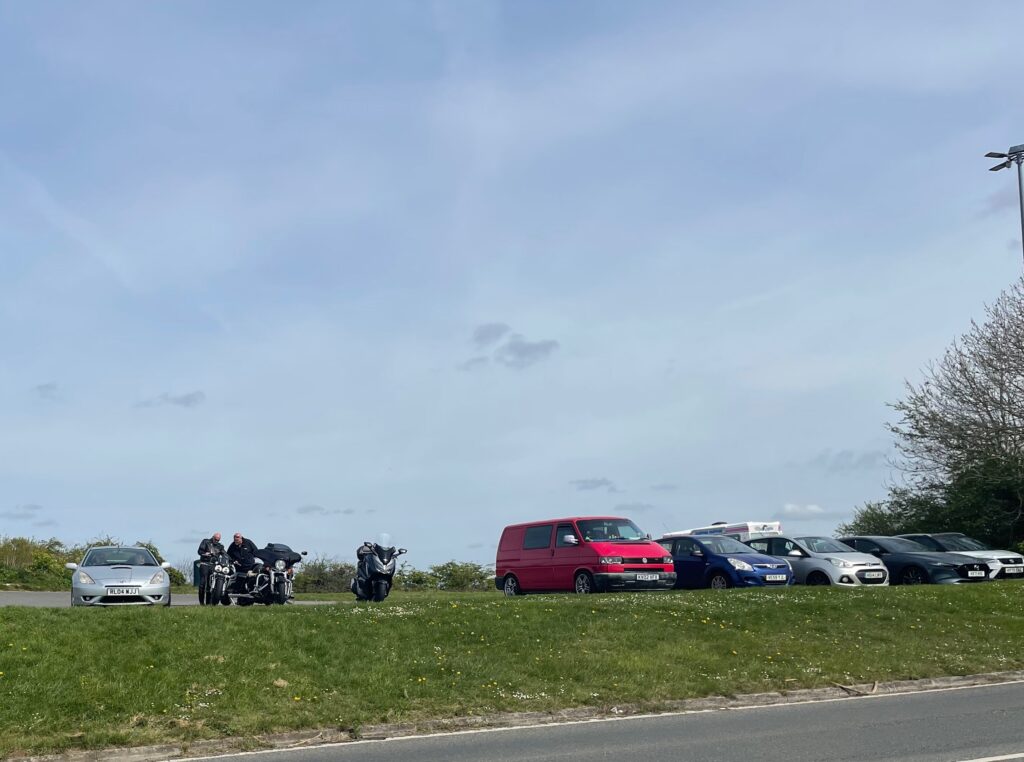
It wasn’t the nicest car park, and the ice creams were a bit expensive, so we didn’t indulge. The views were somewhat spoiled by the road and the hedgerows, but we could see a wooden gate on the other side of the road, so we went to investigate. That was when we found the views he remembered. Portsmouth was spread out before us. We spent quite a while trying to pick out landmarks, like the Spinnaker Tower and Lakeside, where there is a parkrun and regular races. We could see the sea, and the clouds were small, fluffy things in a baby blue sky. The hedgerow sheltered us from the wind, more or less. It was all rather pleasant if you ignored the huge electricity pylons.


There’s quite a bit of history behind Portsdown Hill. Royalist forces were involved in several skirmishes with Parliamentarians on the hill during the English Civil War, and it was used to defend Portsmouth and its dockyard against attack. We’d passed one of the hill forts, built as part of the 1859 Royal Commission, on our rather rambling drive. The idea was that invaders, most likely Napoleon III of France and his men, might land elsewhere on the coast and circle around the hill to bombard the city, making the Hilsea Lines at the bottom of the ridge useless. Six forts were built, Fareham, Wellington, Southwick, Widley, Purbrook and Nelson, the one we’d passed. The forts had only just been finished in 1870 when the French Empire was overthrown, and Napoleon III was exiled to England, so they became known as Palmerston’s Follies. They did prove useful as anti-aircraft gun emplacements in World War II, though. Close to the north side of the hill is Southwick House, which was used as the headquarters for U.S. General Dwight D Eisenhower during the D-Day invasions. The generals prayed together in a church on the hill, Christ Church Portsdown.

Although it’s called Portsdown Hill, it’s actually a long chalk ridge around 131 meters above sea level at its highest point. When we’d had our fill of the views, we walked along the ridge for a while. The camber didn’t make for the easiest walk, but it was a nice day, and we were in no hurry. As we walked, I thought about the tunnels beneath our feet. Exactly how many tunnels there are and where they are is a mystery, but there are certainly some beneath Fort Widley. They have ghost walks in them.

Apparently, there’s a spiral staircase beneath the parade ground leading to four tunnels. Amongst the ghostly tunnel residents, there’s a sergeant-major who whistles as he haunts. Ghostly footsteps and banging noises are often heard in the keep — some say it’s the ghost of a former prisoner, or maybe a guard. Another of the regular ghosts is a small boy who can be heard running along the tunnels. He’s known to play tricks on visitors. The story is, he was a drummer boy who was being chased along the parade ground by an officer and fell to his death down the spiral staircase. A man with a lantern has been seen, and a woman, said to be the ghost of one of the soldier’s wives, or maybe a prostitute, who was murdered there. The ghost walks sound like fun — if you don’t mind being underground in the dark.

After a while, we came to another gate, and we decided to turn back, as we didn’t really know what was ahead and whether it was worth seeing. Besides, the lop siding walking was beginning to get a tad wearing on the legs. When we got back to the car park, Commando noticed a strange looking building across the fields. Later, we discovered it was BAE Systems Maritime Integration and Support Centre — a facility that replicates real-life ship conditions to test combat systems before they are installed on ships. It looked interesting, and there seemed to be a footpath, of sorts, heading towards it, so we decided to have a look.

We went through the gate. I was a little concerned when I saw a rather large cowpat and some cows in the field ahead, especially as the gate was open. The cows looked docile enough at first, but when we went through the second gate, they came towards us. We didn’t get any further. I didn’t fancy being trapped in a field with a load of cows, docile or not.

As it happens, the cows are part of a plan to regenerate the chalk grassland habitat. Until the early 1950s this was all grazing land, but when the grazing stopped, the land was slowly invaded by scrub, mostly dogwood, hawthorn and wild privet. Because of the change to the habitat, several species of butterfly became extinct, including the Adonis Blue, Silver-studded Blue, Dingy Skipper, and Dark Green Fritillary and others, like the Chalkhill Blue and Small Blue, were on the brink of extinction. In 1995, Portsmouth City Council began an intensive restoration programme funded by the Countryside Commission. They cleared large areas of scrub using machines. Now horses and cows are once again allowed to graze so the natural flowers and grasses can regenerate. Due to this, the hill now has the largest population of Small Blue butterflies in the UK. I may not be overly fond of cows, but it seems they do have their uses.

If you like what I write, and you’re interested in my novels are available now on Amazon in paperback, on Kindle and via Kindle Unlimited. Check out my Amazon page here and my Goodreads page here. If you would like to help me keep writing, you can now buy me a virtual coffee by clicking on the little orange coffee cup at the bottom right.
You’ve not mentioned it & perhaps you or Commando had no knowledge of it, but there was once a grounded and rusting German submarine on the shoreline below which you could clearly see from the top of Portsdown Hill. I recall seeing it often as a kid. It was there for many years and not removed until long after WWII, probably in the mid sixties. No doubt we can all do an online check for more info. As I recall that it was on ocean reconnaissance, ran aground and the crew were captured.
Thank you for that. Neither of us knew that. I wish I’d seen it.
I too remember the submarine. Its silhouette was unmistakable as you approached Portsmouth. I never found out what it was, but it was gone by 1983 when I made my last visit to Portsmouth.
Thank you. I do wish I’d seen it.