
Back in February 2014 I published the second of Commando Senior’s memoirs. It was written when my wonderful father in law was still in good health, dashing about all over the place and appearing out of the blue on our doorstep with a cry of “it’s only me,” bearing gifts of his delicious home made cakes. Little did we know that in less than two months he’d be in hospital with a broken hip or that this would begin a decline that he never recovered from. This instalment is set during World War II. It is hard to imagine living through such a time as an adult but for a child it must have been both bewildering and frightening. Imagine waking each day to a landscape changed beyond belief, familiar landmarks replaced by smoking craters.
1939 to 1941
At the outbreak of war, the so called phoney period, I was packed off to the wilds of Bishopstoke for safety from the expected bombs. Notwithstanding being within one mile of a strategic railway works and two miles from an airfield. Some wishful thinking perhaps. I stayed with Aunt Et and Uncle Joe and shared a bed with cousin Roy, some six months younger than myself.
It was after my return that things started getting hairy. The day after my ninth birthday seeing the heaviest raid Southampton suffered. I well remember walking through the parks and along London Road and Above Bar seeing smouldering bolts of cloth alongside the road whilst firemen were still hosing down the ruined buildings.


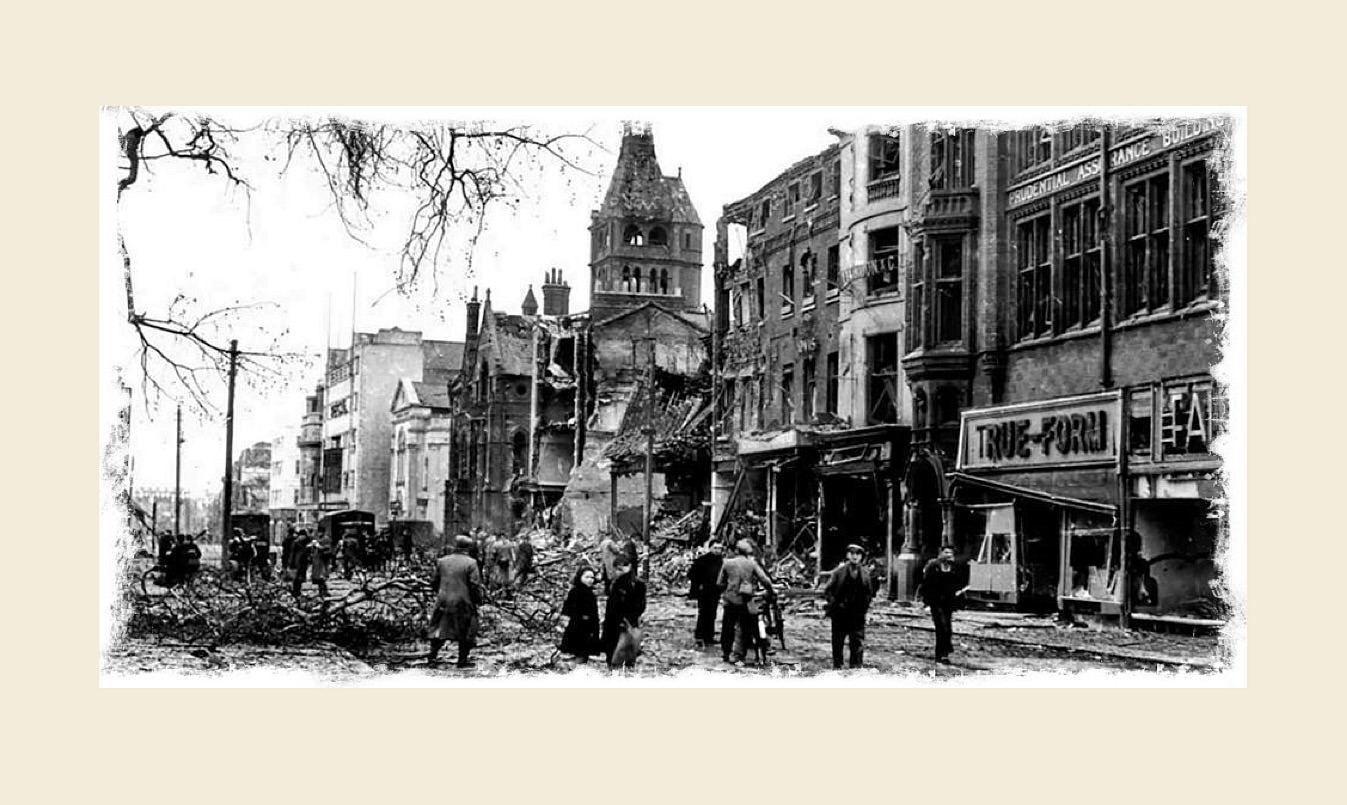
Because blast damage rendered the house uninhabitable we, Mum, Alan and me, temporarily relocated to Swanwick with Mum’s cousin Flo and her husband Bart, returning some weeks later after war damage repairs. Dad, by this time, was working as directed in any port, Bristol, Hull, Liverpool etc., wherever his stevedoring skills were most needed and only coming home quite infrequently.
Not too long after returning to Northam Street I suffered my first encounter. I had been playing in the parks with my friend Eric when the alert siren sounded. We each went back to our respective homes. It was then I discovered the effect of machine gun rounds as they kicked up dirt at the roadside. Yah Boo, missed me! The ensuing raid was quite heavy and I recall being terrified, crouching at the end of the passage as the front door was blown off its hinges.
After the raiders past siren, I emerged. I passed the broken door to find a section of tramlines outside weighing probably two hundredweight or more, blown from St Mary’s Road. With the casual nonchalance of youth I went out to continue playing with Eric only to find a crater of a size to accommodate a small bus where Eric’s home had been. Some of this has been with me ever since, although it now has fancy names, PTSD.

My shock and disbelief were tempered by the thought that I, at least, appeared unscathed. Over the past 73 years or so I have occasionally revisited the occasion pondering ‘what if’ and ‘there by the grace of God,’ until my written memories triggered a curiosity to find more. I found Eric, whose surname was Piekaar, had an older brother, Louis, unknown to me, who died at the same time. I had always thought the whole family perished. With a little thought I should have realised the adults, certainly the father, would have been at work.
During this period, chores permitting, we youngsters were quite free to do whatever we wished although briefed to always carry our gas masks and immediately seek shelter on hearing the alert siren. The home of the Piekaar family was 15 East Park Terrace. Approximately half way between Northam Road and the Jury’s Inn gyratory, opposite East (Andrews) Park it is now a part of the Southampton Solent University campus. I feel the official Commonwealth Graves Commission entry shows all the relevant facts with the reverence due to Eric.

We also moved to Upper Shirley for a time at 2 Queens Road, where I recall witnessing a frantic Battle of Britain skirmish whilst sat on a garden wall, albeit getting much aggro from Mum. After our time in Shirley, we moved again to Northam Street, this time to number 8 where David was born. because Aunt Lil would only look after me, Alan was taken into care. During this time he developed a kind of dysentery. Return home was not allowed until Dad threatened, forcibly, to come and get him. On return Alan was found to be very traumatised and it took quite a long time to restore him fully to the family. Later, with Bill on the way and sleeping every night in the Anderson Shelter in the garden, the accommodation was deemed unsuitable. Mum was taken to the maternity unit of Southampton Borough Hospital for the delivery.
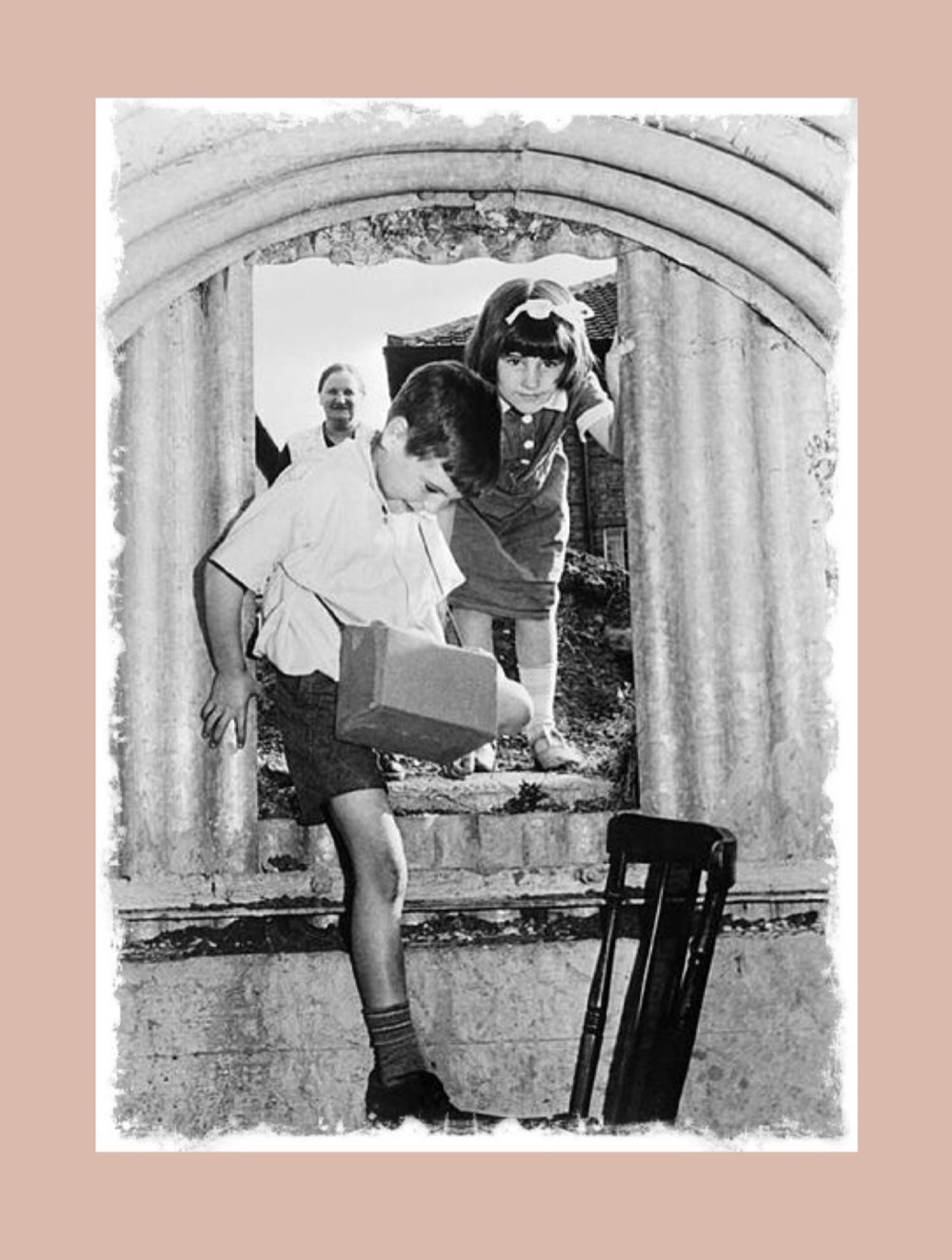
In little over a year we were rehoused to 7 Queens Walk, Lime Street when Aunt Vi moved from there to number 17. Not palatial but a vast improvement until the summer. We woke to find hundreds of fleas necessitating de-infestation by the council. When Aunt Vi moved to Bassett Green, we took her flat, number 17, which eventually was renamed as 18 Threefield House.

I hope you’ve enjoyed learning how different life was during World War II as much as I enjoyed reading and researching to find photographs. It has certainly given me an insight into what it must have been like growing up in such troubled times. The next instalment will come soon…
Very interesting.
He was a very interesting man!
And we whine about how tough we have it!
I think there are a lot of people today who could do to visit the past for a little while to put their problems into perspective.
I feel a little bad about “liking” an account of such traumatic experiences, but I’m very grateful that you’re sharing this important piece of history. It really does put most modern problems into perspective!
I’m just glad my Father In Law wrote his memoirs, even if there were not as many as we’d have liked.
Very interesting. I too lived as a child during that period and it was pretty grim but I now think how awful it must have been for our parents my Dad worked all day and out most nights from 6.30pm usually when the siren started as an ARP Warden and we never saw him till the morning, then he’d go to work and how our Mum’s managed to put meals on the table each day and then you got bombed out and they had to worry about where you were going to live, it must have been a nightmare for them.
It must have been a really horrific time for the adults. My dad was in the airforce and was away in France and Mother was alone at home with my sister who was born in 1942. She told tales of air raids, doodle bugs with their whining engines and bombers who’d dropped all their bombs machine gunning the streets. I wasn’t born until 1960 so I can’t begin to imagine what it must have been like but I think the children took it more in their stride than the adults. They didn’t know any different I suppose.
hi,….I am 99% sure that the two brothers were related to me, as in their mother was my”auntie floss”,.can tell you more if you are interested
sincerely e.l.j. piekaar
Hi Eric. It sounds as if you are related to the boys my father in law spoke about. I would definitely be interested to learn more. I will send you a private email.