
The final Friday of February took me on another Eastleigh wander. This time there was no mist, so I risked the Monks Brook Meadows route. This meant I could walk off-road for most of the journey once I’d left the centre of Eastleigh behind. In no time at all, I’d reached Lakeside Country Park. Instead of skirting the edge as I’d done on my last misty walk, I crossed the tracks of the Lakeside Steam Railway and headed across the centre of the park. At this time of year, the little steam trains only run at weekends, so crossing the track was perfectly safe. If you want to see them, they run daily between 31 May and 1 October, and if you’re wondering what they look like, here’s a post I wrote back in 2017.
Looking at the lakes, you’d never know they were once gravel pits. The dual gauge steam railway arrived in 1992, and the Parkway and Monks Brook Halt stations opened in 1999. There is even a tunnel, built in 2003, and the track is 1 1/4 miles long, so it makes an enjoyable ride for the children who flock here in the summer.

The first fields I came to are sometimes used to graze cattle. I’m not too keen on cows, even when they’re fenced in like they are here, so I was relieved to see empty fields. As I crossed them, I spotted a new installation. At least, I think it’s new. Maybe it has been here all along and I’ve been too worried about the cows to notice. I like the rusted iron and the information about Jack Snipes. In fact, it tempted me to wander around the lakes to see if I could spot any more similar installations. In the end, the idea flew out of my head when I spotted sails on the boating lake. The model boaters were out in force, and it looked as if a race was about to begin. Tempting as it was to stand and watch, I had a long walk ahead of me.

In 2016, they built a new visitor centre. I had high hopes when I first saw the plans, imagining somewhere to stop for a coffee and a bite to eat. So far, such delights have not materialised, although there are toilets, and coffee is available at the old visitor centre near the railway sheds. The loos are very nice, so I’m not complaining. If I see a loo, I always use it because you never know when you’ll see another one. This day was no exception.


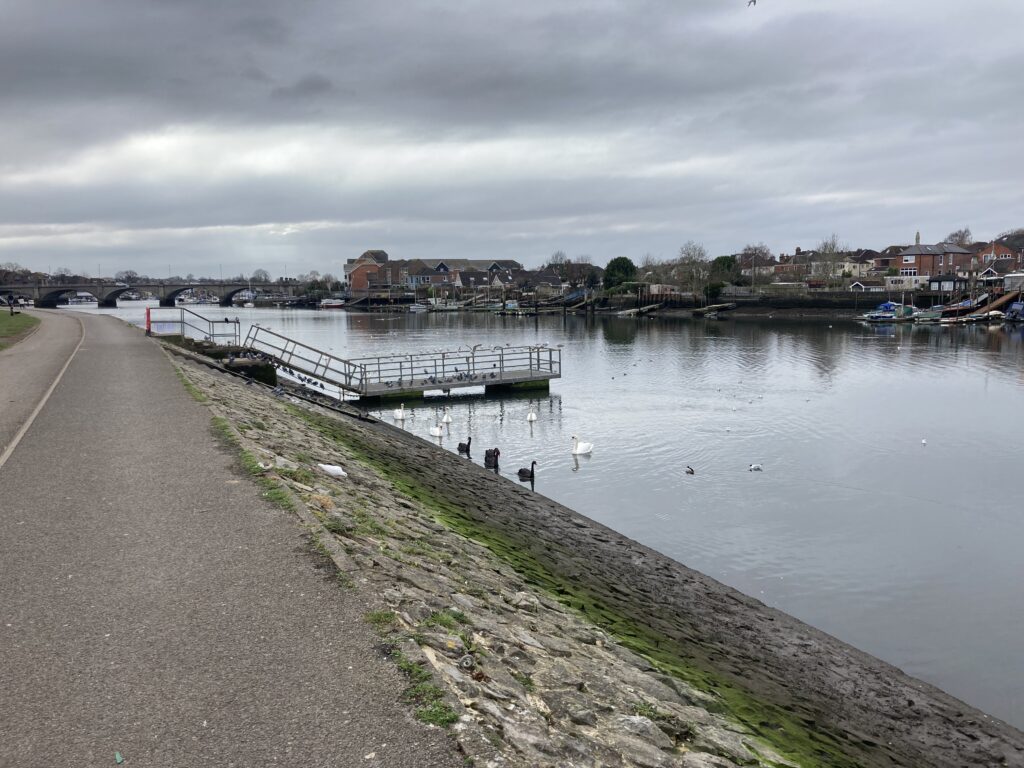
It was too early in the year to see any ducklings or cygnets, but I stopped for a look as I passed the lake with the island, anyway. The island is one of the most likely places for the swans to nest, but I saw no signs of swans at all.

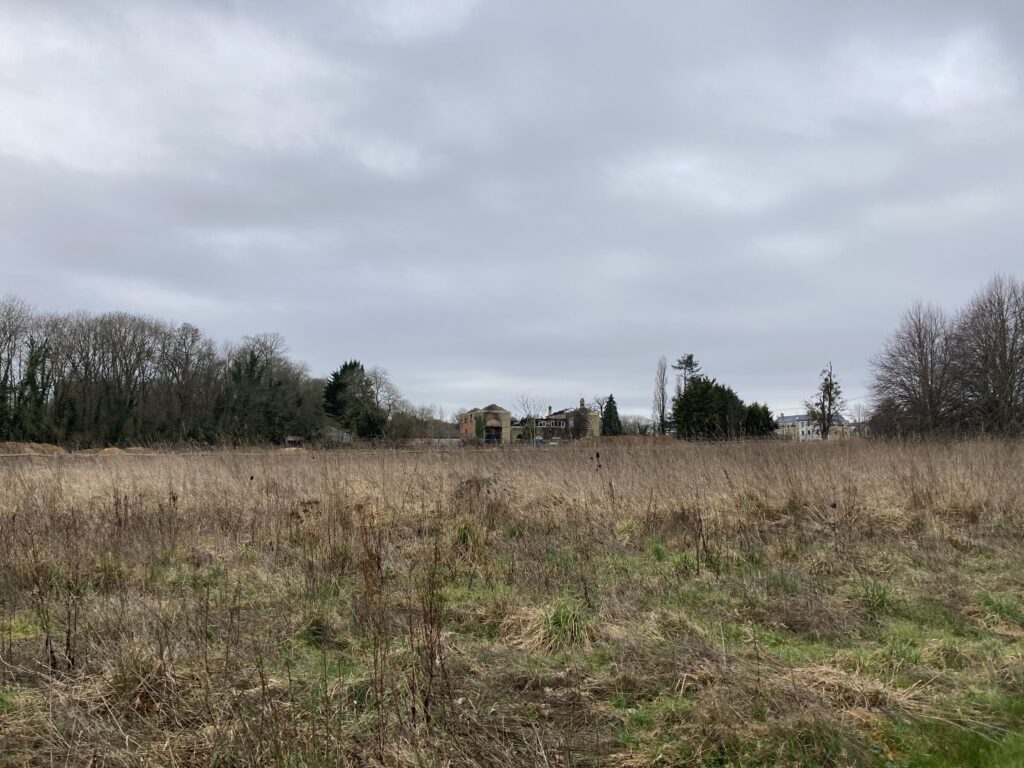
Soon I’d crossed Stoneham Lane and left Lakeside behind. There have been huge changes here in the last few years, and I still feel disoriented whenever I come this way. They have built hundreds of new houses on the fields where cows once grazed. A roundabout and a new road, Highwood Avenue, now serve this modern village, and the bottom end of Stoneham Lane has been closed to traffic. There used to be an old farm and a style to climb over, along with a whole lot of mud — if you’d like to see what it looked like with all the cows, here is a post with lots of photos. This was where North Stoneham House, the home of the Fleming family, once stood surrounded by gardens designed by Capability Brown. Now, it’s all gone, and even the farm is a shell of its former self. It’s a mystery where all those cows went.

In August 2020, the old farm caught fire. Over forty firefighters tried to put the fire out, but the building was gutted. Later, the police arrested a man for arson. Today, it remains a burnt-out shell, and I can’t help wondering what became of the family who once lived there and the horses that used to graze in the fields. While I don’t approve of building on greenfield sites like this one, there is an upside of sorts. This end of Stoneham Lane had no footpaths, making it a difficult and dangerous place to navigate on a walk, especially as there was a blind bend at the Lakeside end. It always felt like I took my life in my hands walking this way. Now the closed-off-road is a joy, and once you get past the church, there is a footpath all the way to Bassett, should you wish to walk that way.
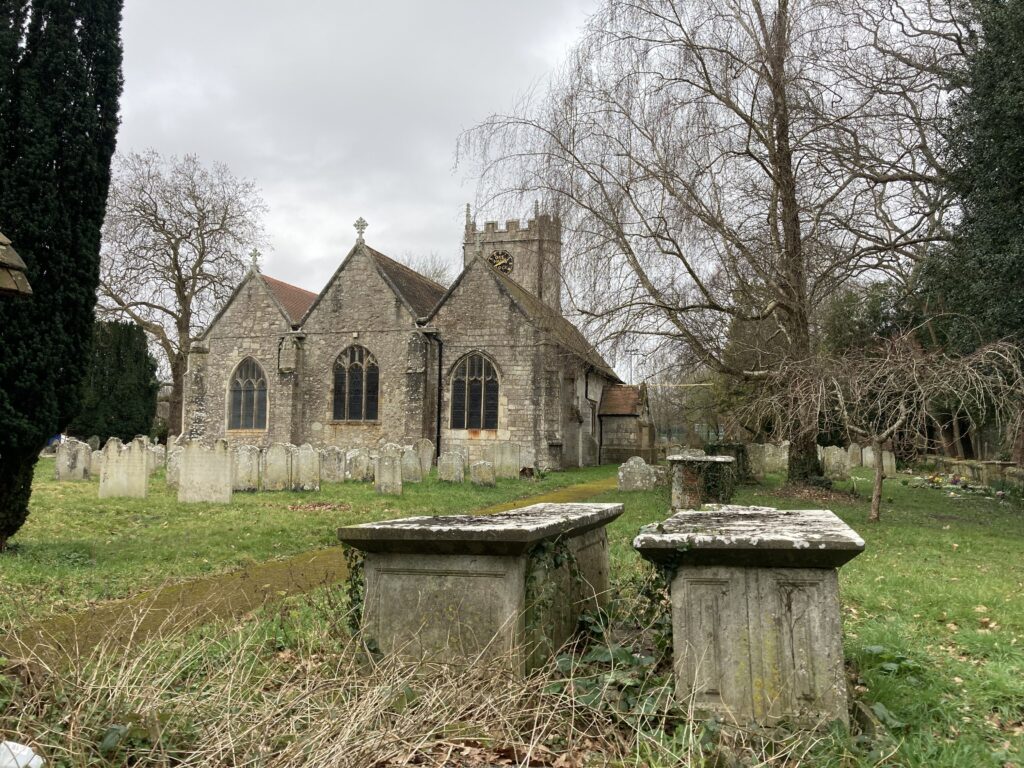
Earlier, I’d resisted the temptation to walk around the lakes, and to stop and watch the boats. Now I was tempted to wander in the churchyard and explore the fascinating graves, and maybe see if I could get into the church to look at the monument to Sir Thomas Fleming. So far, the door has always been firmly closed when I’ve visited. Tempted as I was to see if it was open today, I was keen to keep moving, so in the end, I contented myself with a couple of photos of the famous one-handed clock. A clock with only one hand is a quirky thing. This one dates from the early seventeenth century. William Monk of Berwick St John and Donhead St Mary made the internal workings. It lacks a minute hand because ‘time was counted in hours, not minutes,’ back then. Sometimes it feels as if my life is a little like that these days, and I kind of like it that way.

In no time at all, I’d walked under the motorway bridge and reached the next stage of my journey. My first experience of this footpath across Monks Brook Meadows and playing fields dates to the spring of 2015, when a local councillor invited me on a history and nature walk. It was a privilege to take part in the walk, and it opened up a whole new walking route for me. A lot has changed in the years between then and now, though.
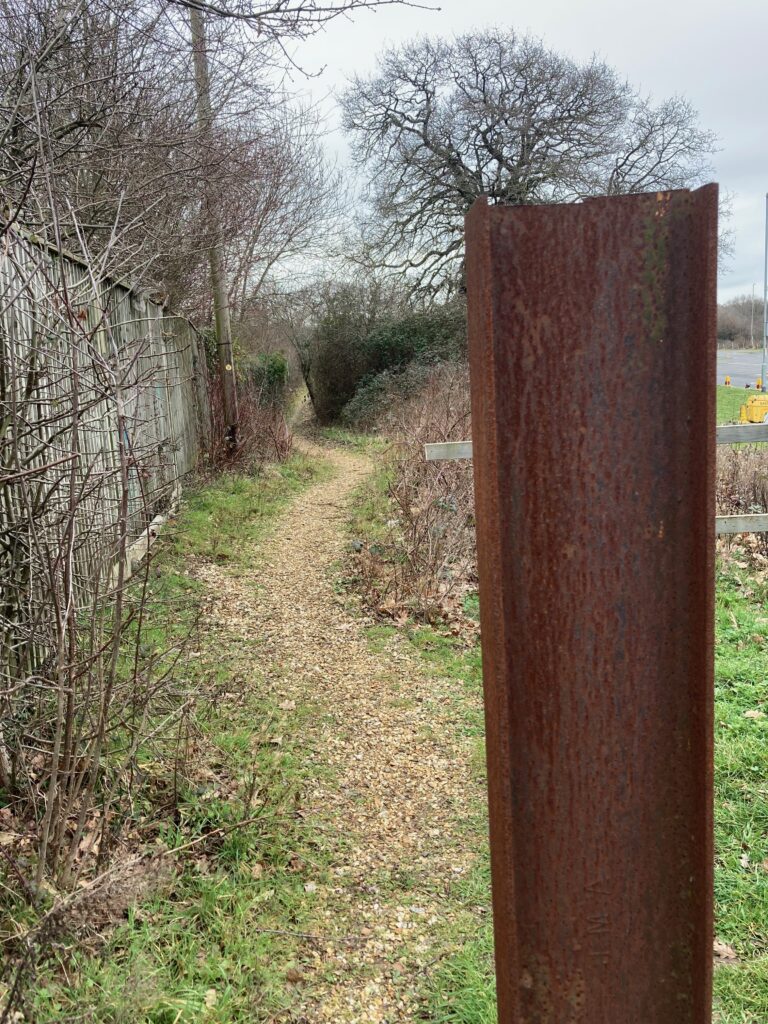
The playing fields have now been turned into a football complex, with enclosed pitches (of astroturf, if I’m not mistaken). Now there’s a car park and lots of tarmac, where once there were trees and low bushes. Personally, I’m not sure it is an improvement, but at least they didn’t close the footpath, so I thank heaven for small mercies.

At the other end of the playing field, I had another tunnel to pass through. This one took me under Stoneham Way, near the slip roads for the motorway. Last summer, I had to turn back because the path near the brook was too boggy. Now, as I crossed the meadows, I had my fingers crossed that things would have dried out. These meadows once caused a controversy. In the early 1990s, this was where Southampton Football Club hoped to build their new stadium. After years of wrangling, the plans were declined, and the new stadium finally opened in St Mary’s, Southampton in 2001. In the end, I think this was the best decision. I’m glad they saved the meadows and that the football stadium ended up close to its roots, near the church where the club started back in 1885.
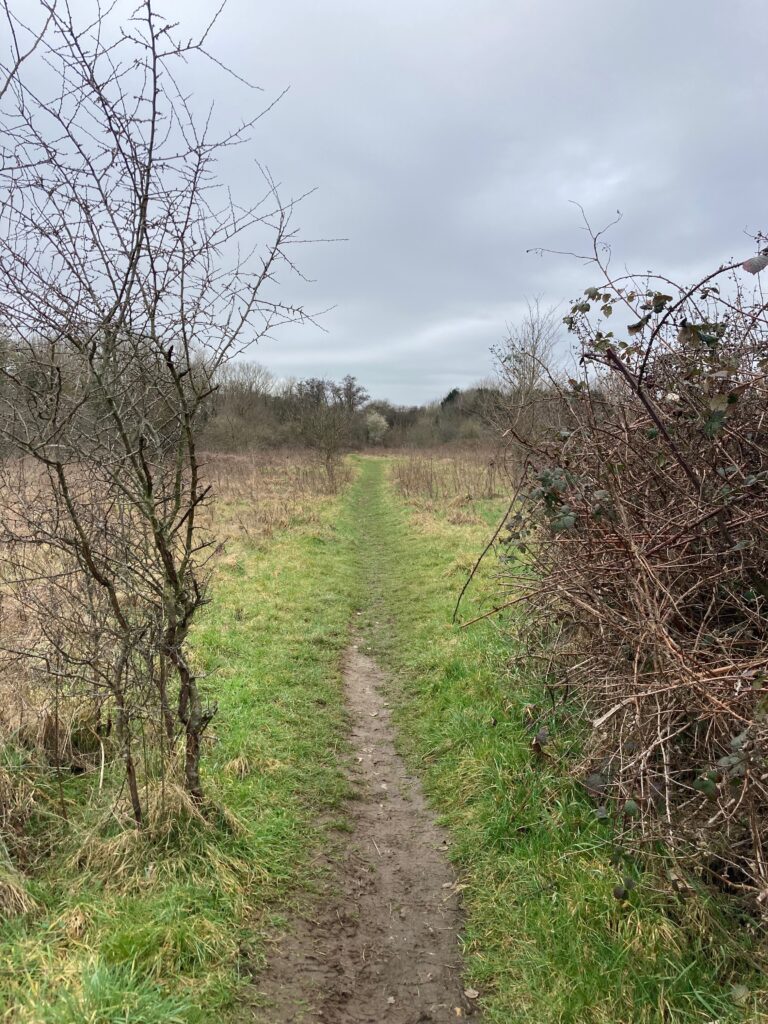
Thankfully, the trail beside the brook was less boggy than my previous visit, meaning I wouldn’t have to turn back and find another route home. This came as something of a relief, especially as one of the possible alternative routes was very much off the table.
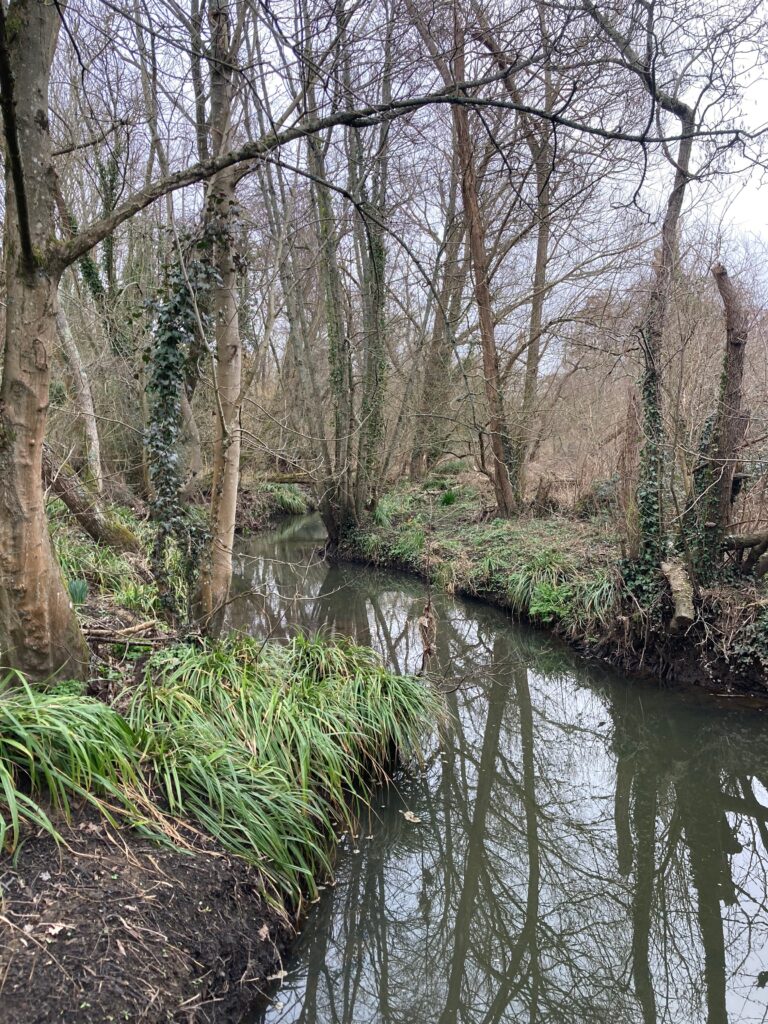
Close to the meadows where the trail crosses the bridge over Monks Brook, there used to be a side path leading to Wide Lane. I’d passed it from both ends (on Wide Lane and on the Monks Brook trail) many times, but I’d never used it. In the back of my mind, it had always been an escape route if I needed to leave the Monks Brook trail in a hurry. Now that option is gone. They have erected a fence across the trail, and a notice pinned to it tells me the closure is permanent. Now I wish I’d walked the trail at least once so I would know what was being lost.


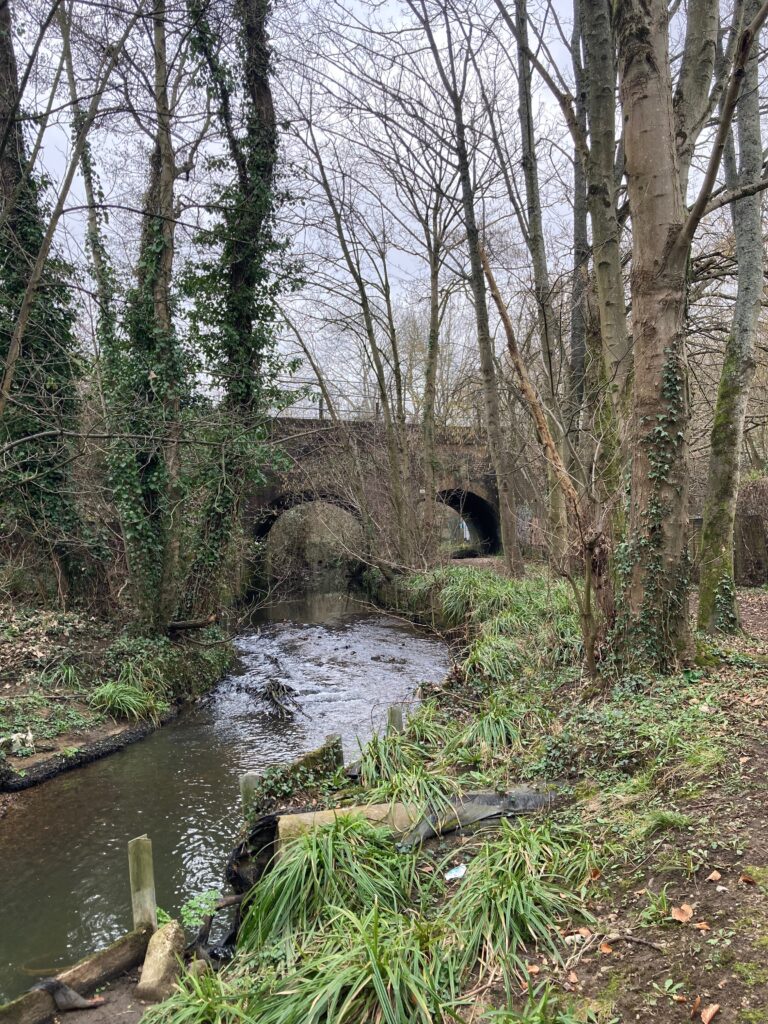
The side path crossed the railway line, although I’m not sure if it was via a level crossing or some kind of bridge. The latter I’d have been happy to use, the former not so much. A little further on, the main trail crosses the railway line under a splendid double-arched bridge — one arch over the brook and the other over the path. These old Victorian bridges are pleasing to the eye, and they’ve certainly stood the test of time.


At the other end of the trail, I crossed the road near another old Victorian railway arch. This one, the Swaythling Arch, crosses Wide Lane at its junction with Stoneham Way and Bassett Green Road. Right next to it is a pub, the Fleming Arms. The pub opened in around 1850, in a house that had once belonged to a doctor. It is named after the Fleming Family, who once owned much of Swaythling, including North Stoneham House and South Stoneham House. It is now a listed building. The Swaythling railway arch has been the scene of a few minor disasters. They built it in the days of horses and carts, and despite all the warning signs, lorry drivers get their vehicles stuck under the bridge with monotonous regularity.
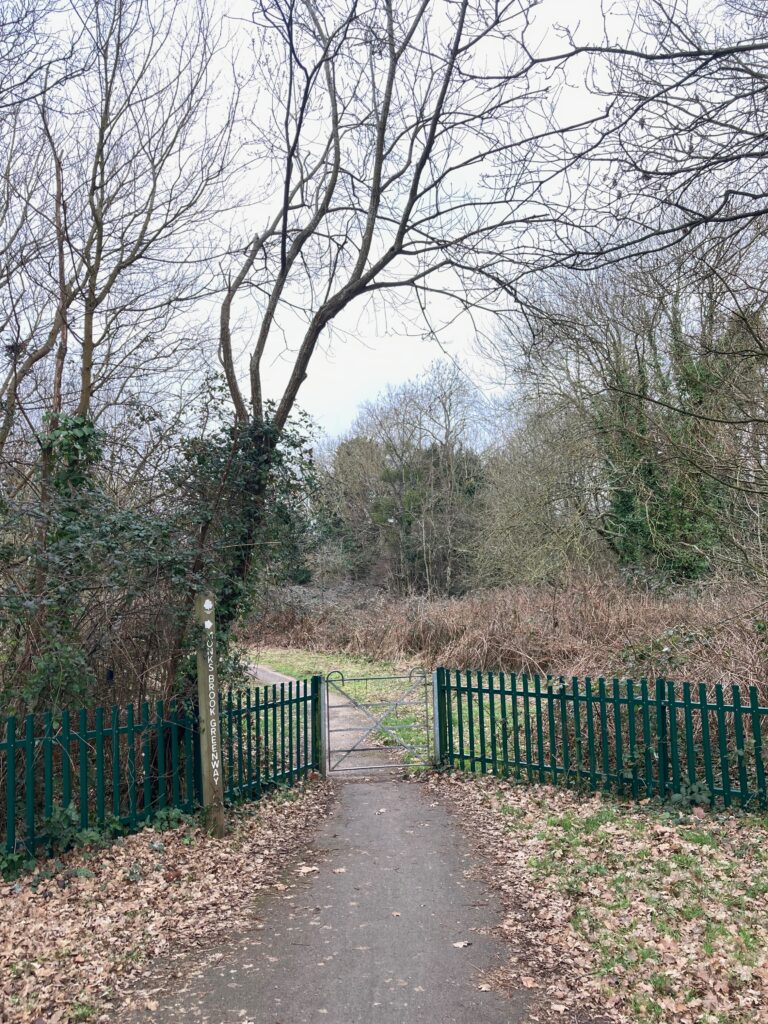
Tempted as I was to walk along Wessex Lane towards Swaythling railway station and have another look at the monument to the war horses and remount depot, I left this for another walk. Instead, I took the trail through Monks Brook Greenway because I was curious to see if they had replaced the blue bridge. This had the advantage of keeping me away from the road a little longer, too.
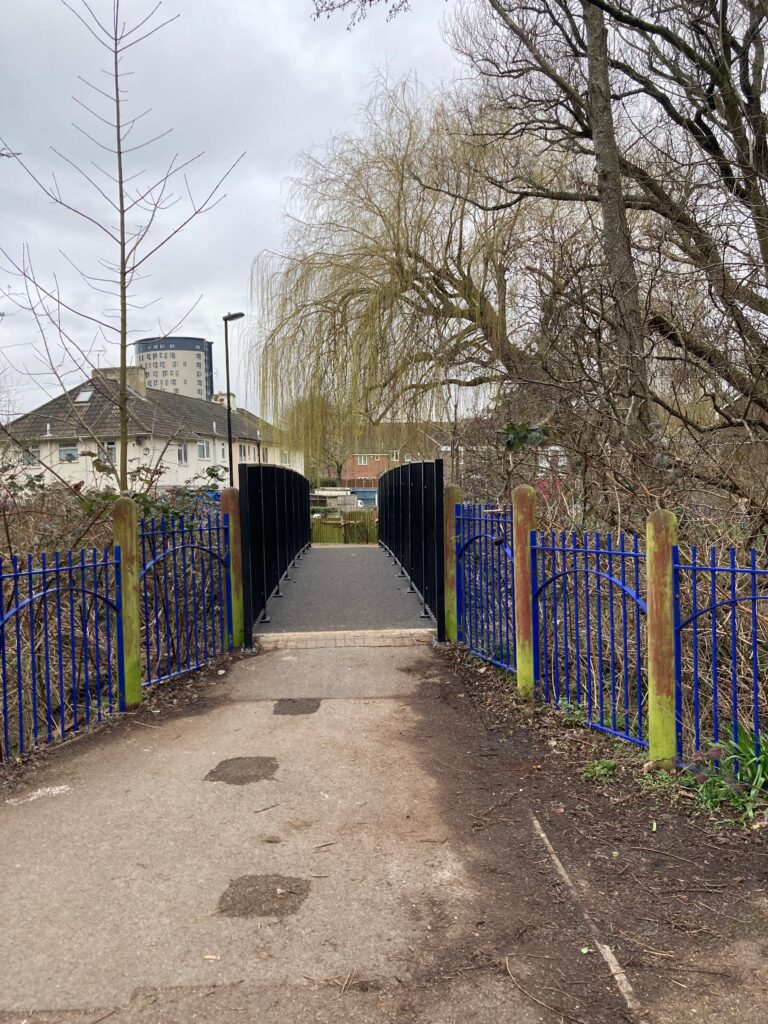
It turned out that the new blue bridge had been installed. Sadly, it is not nearly as pretty as the old wooden bridge, but it looks quite sturdy, and hopefully, it will last a long time. What a shame the powers that be didn’t think to paint it blue, though.

On the last section of the Monks Brook trail, I stumbled upon a whole colony of turkey tail fungi on some fallen trees beside the brook. As usual, I took far too many photographs, but the variety in colour makes these stripy, frilly fungi some of my favourite fungal finds.
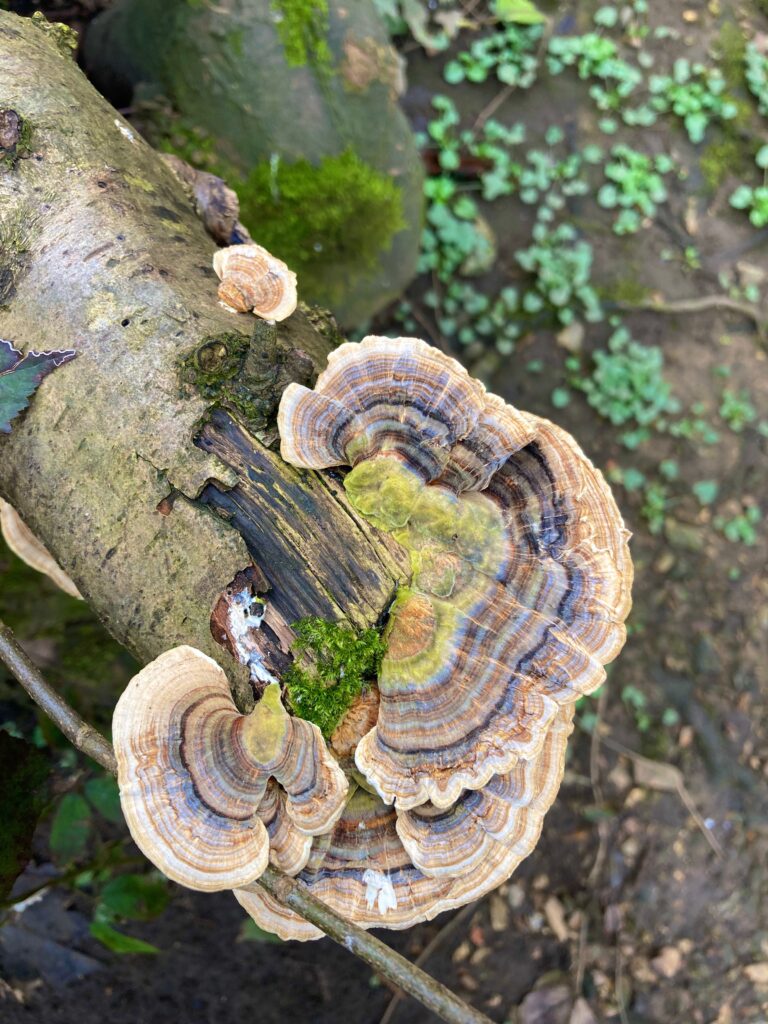
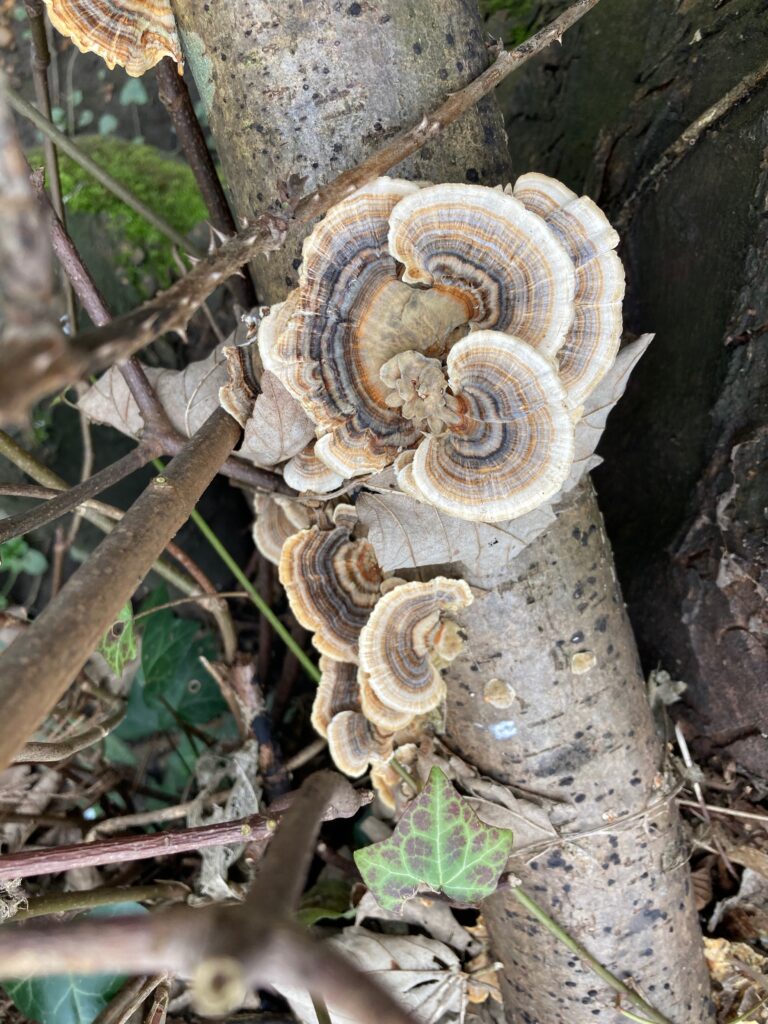

I finally left Monks Brook behind when I crossed the green bridge and headed towards the churchyard. Before turning my back on the brook, I stopped to photograph the catkins hanging over the fence. It’s looking like spring is really getting underway, and I love all the bright colours appearing after the dull greys and browns of winter.


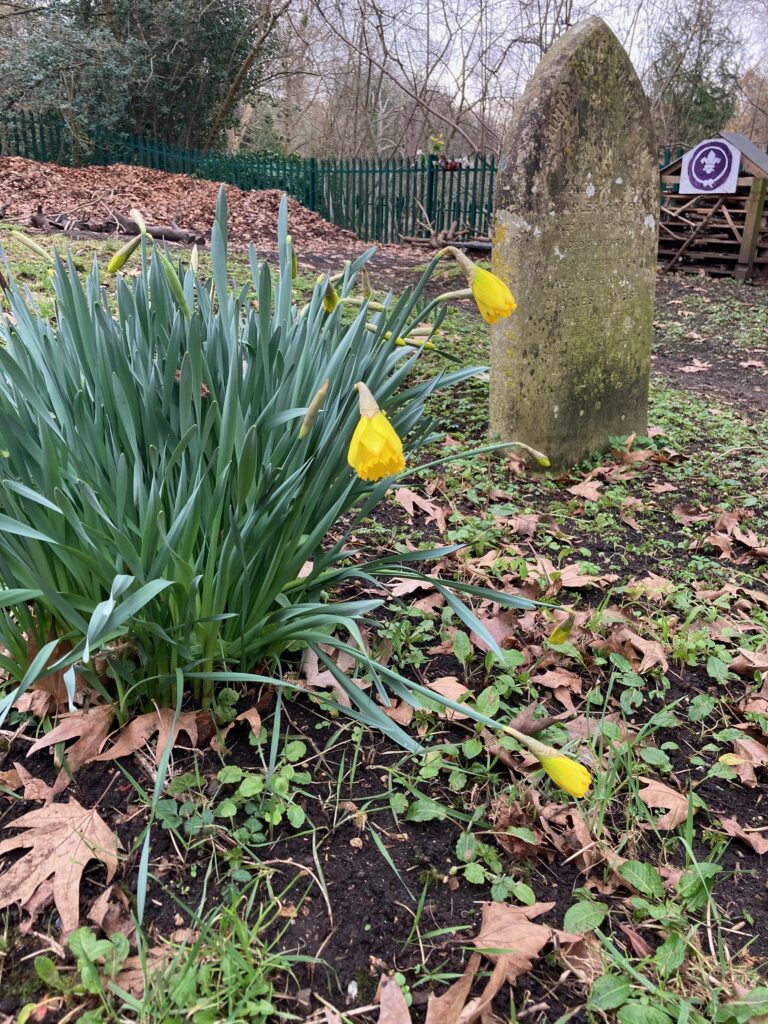
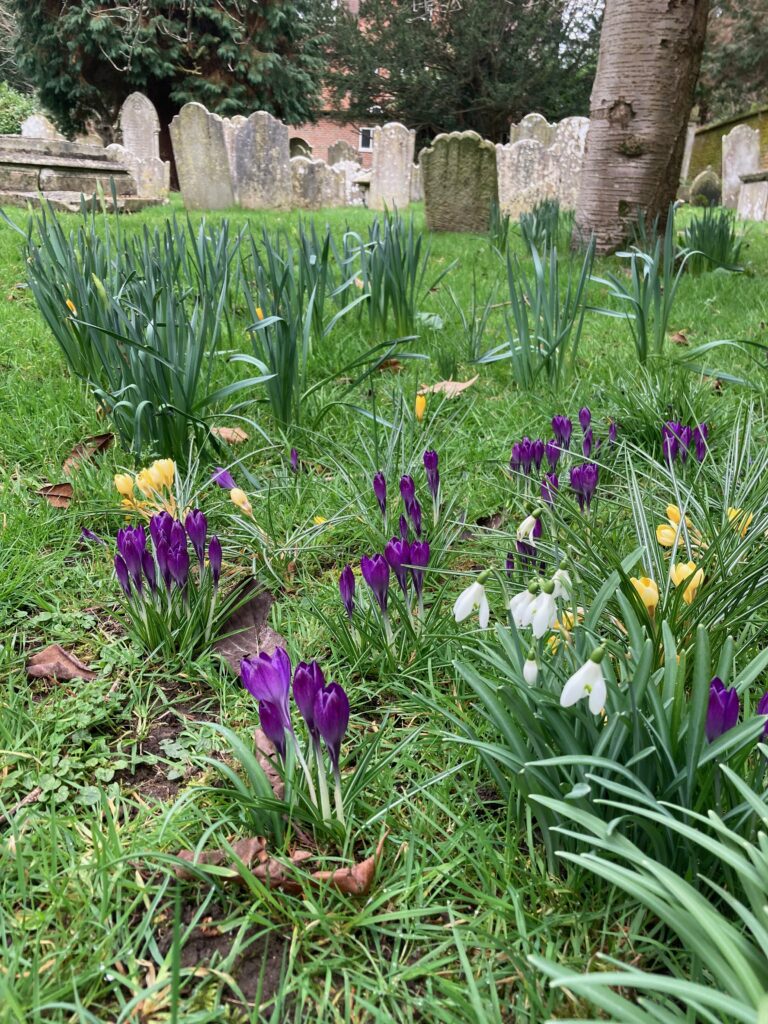
There were signs of spring in the churchyard, too. Clumps of daffodils are opening, and a host of colourful crocuses and snowdrops brighten the areas between the graves. The sky above me may have been grey as I walked the last couple of miles home, but the colours of spring filled my head and kept me smiling the whole way there. Never mind counting time in ‘hours, not minutes,’ these days I’m counting time in seasons, and spring really is my favourite.

If you like what I write, and you’re interested in my novels are available now on Amazon in paperback, on Kindle and via Kindle Unlimited. Check out my Amazon page here and my Goodreads page here. If you would like to help me keep writing, you can now buy me a virtual coffee by clicking on the little orange coffee cup at the bottom right.
A super walk with lots of interest. I do like Swaythling Arch and the splendid bridges too. Despite my fungi phobia (yes, really) the turkey tail is very attractively patterned.
Some of the fungi I find are truly beautiful.