
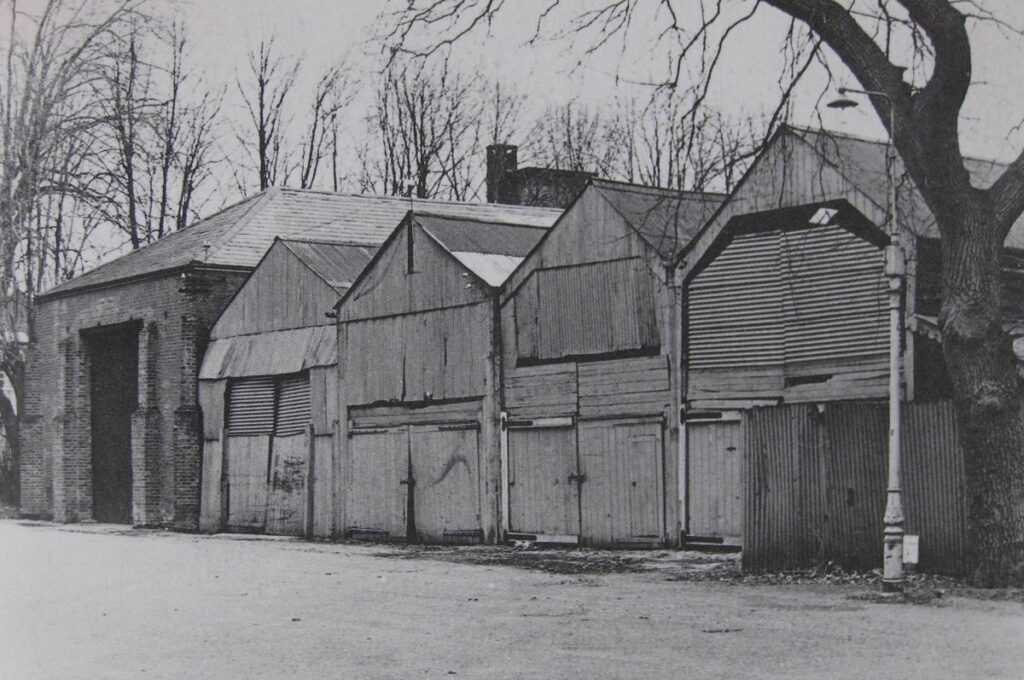
Once upon a time, Southampton had an extensive tram network. Every time I go to the supermarket for my big shop, I’m reminded of it as I go up the stairs from the car park, thanks to a large mural on the wall. The supermarket in question was once the old bus and tram depot. When I was writing Luck of the Draw, I fell down a huge research rabbit hole centred around the trams and the tram depot. The story centred on a tram driver and his conductor friend, the former inspired by my husband’s grandfather Walter Dowling, who was a real-life Southampton tram driver. The history of Southampton trams didn’t really make it into the book, so I’ll share my discoveries with you here instead.

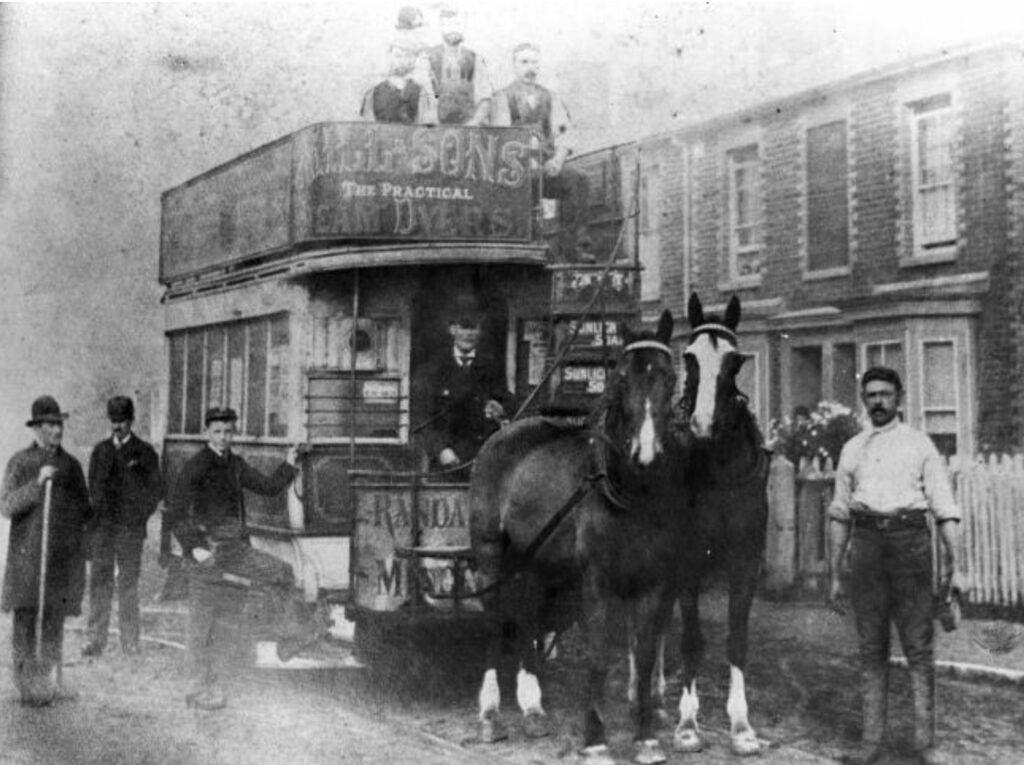
Despite some initial opposition from local traders, the first Southampton tram ran on Saturday, 3 May, 1879. There were two routes. One started from the newly built tram depot in Portswood, went along Lodge Road, through the Stag Gates, and through the Bargate to the Floating Bridge via Oxford Street. The other started on Shirley High Street from a depot in Carlisle Road, travelled to Commercial Road and joined the other route at Prospect Place, near the present day cenotaph. At first, they used horse-drawn vehicles built by Starbuck of Birkenhead.
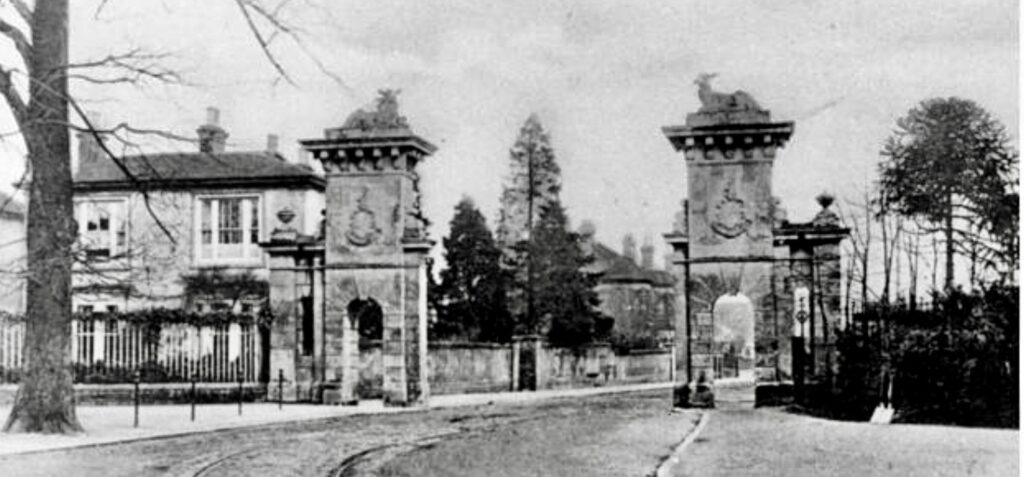

The traders’ objections proved unfounded. The new trams were a hit, so they added a branch line between Stag Gates and the Cowherds pub. More routes were suggested, but the Southampton Tramways Company wasn’t keen to invest more money because the terms of the 1870 Tramways Act allowed Southampton Corporation to buy the lease after 21 years.

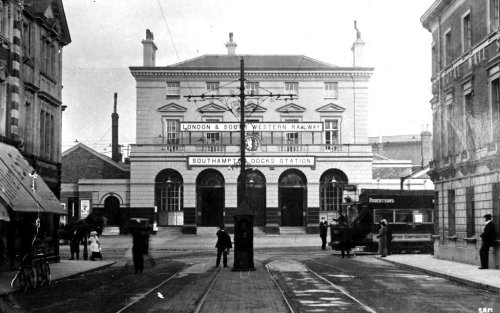
They were right not to waste their money. In June 1898, the Corporation bought the lease for £51,000 and immediately made plans to electrify the network. It was a costly process. New vehicles had to be purchased, and all the tram lines needed to be replaced with heavier rails to cope with them. The Corporation had also acquired the local power company, and they installed the underground cables and overhead lines. All this work took time, but the first section of the new electrified route opened on 22 January 1900. It ran from Shirley to the Terminus Station on Terminus Terrace. A second route soon followed, running from Portswood via Stag Gates, and joining the Shirley route at the Commercial Road Junction.


The Corporation purchased the first electric tramcars from G F Mines & Co of Birkenhead. They arrived by rail in pieces, and engineers in the Portswood and Shirley depots assembled them. Later cars came from Hurst Nelson & Co of Motherwell, but these were poorly designed and soon needed repairs. Luckily, by the time they did, the engineers at Portswood were able to rebuild them.

The Great War brought the rapid growth of the newly electrified Southampton Corporation Tramways network to a sudden halt. Many of the tram workers saw Kitchener’s posters and joined up. Women had to be drafted in as conductors and even drivers. At the same time, the tramway saw a massive increase in passengers thanks to war industries and troop movements through the port. A shortage of materials halted the work of rebuilding the flawed Hurst Nelson cars.

The Corporation bought some second-hand trams to help fill the gap left by the disintegrating Hurst Nelson cars. These weren’t put into service until August 1918 and could only run on limited routes. Southampton had a unique problem that called for an innovative solution. Most tram routes in the town went through the Bargate Arch. The Corporation wanted to move towards closed-top trams for the comfort of passengers, but standard closed-top trams didn’t fit through the medieval arch. After the war, they modified some second-hand trams to run through the Bargate, and James Dobson designed a new type of car with an open top and an enclosed lower saloon and platform. Dobson’s trams fit through the arch but didn’t satisfy passengers’ wishes to stay dry on wet Southampton days.

In 1923, Percy Baker became Tramway Manager. He looked at the Dobson design and came up with an innovative dome-shaped cover and a lower truck with smaller wheels to overcome the Bargate problem. The prototype car, number 12, was a huge success, and soon the engineering works had built or modified 50 more cars. The distinctive Southampton tram had arrived.

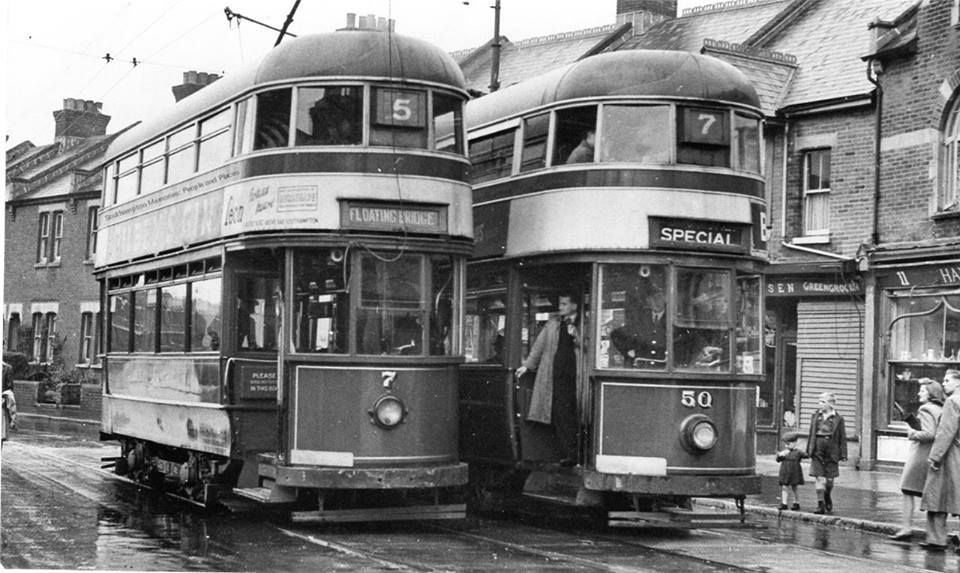
The 1930s saw the final extension of the tram routes from the Avenue, along Burgess Road, to join the line at Swaythling. The Corporation planned further extentions, but they didn’t happen. Just one route crossed the River Itchen over Cobden Bridge, terminating at the end of Bullar Road. Like the Bargate, the river was an obstacle. Northam Bridge was a toll bridge, and the crossing to Woolston was via the Floating Bridge. Trams could use neither.
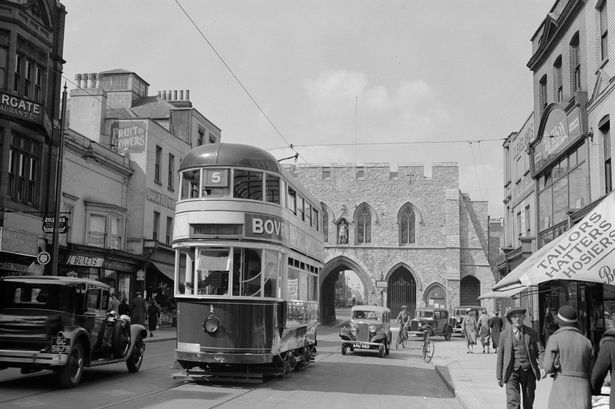


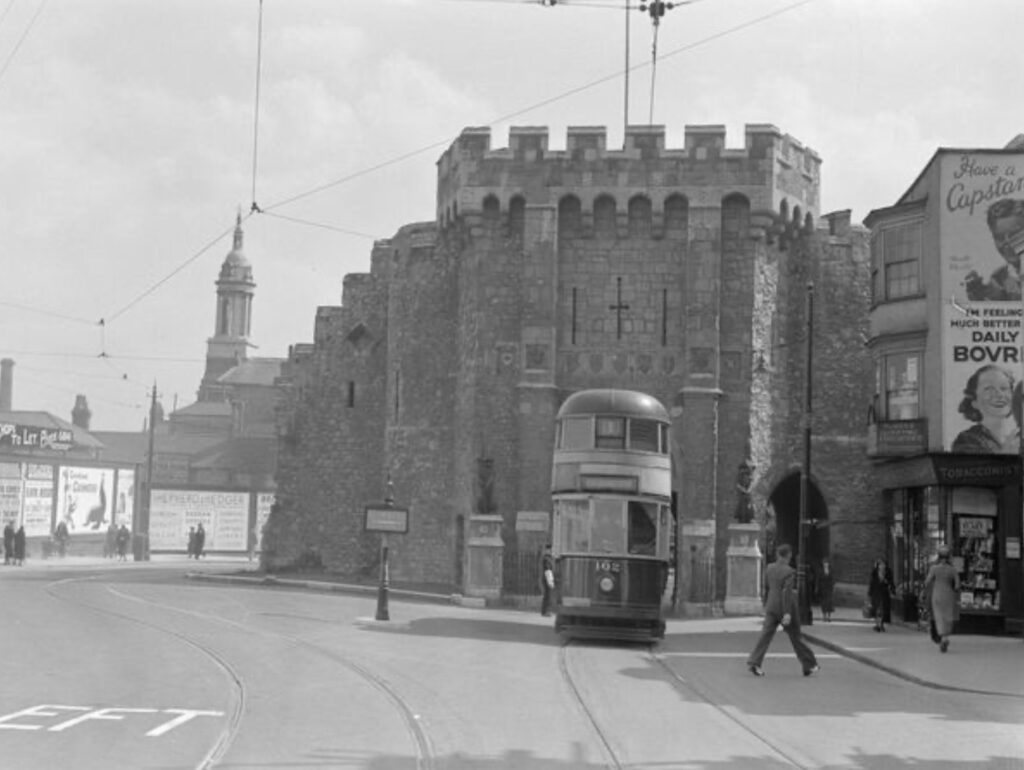
The new style of trams may have solved the Bargate issue, but ever-increasing motor traffic passing through the narrow opening still caused bottlenecks. In the 1930s, the Corporation bought the buildings on either side of the archway. In 1932, they demolished the first of them and created the eastern Bargate bypass. By 1938, new roads and tramlines ran on either side of the Bargate, and on 4 June, car number 8 was the last to pass through the medieval gate.


By the mid-1930s, the tram tracks needed renewal, and the council was reluctant to spend the money. They preferred the idea of trolleybuses like the ones used in Brighton, Bournemouth, and Portsmouth and made plans to phase out the trams by 1940. Of course, Hitler had other ideas. With war came fuel rationing and a drastic decrease in bus services. The trams had to cope with increasing passenger numbers, along with the biltz. The risk of a bombing raid destroying the Portswood or Shirley depots was very real. On the evening of 1 March 1941, German bombs dropped on Portswood. Some hit the bus station next door to the tram station. Falling debris trapped a Hants and Dorset worker while he was filling a petrol tank. Herbert Atkins, a Hants and Dorset fitter, rescued the seriously injured man and was awarded the BEM for his bravery. The blast smashed the windows on most of the buses, but the next morning they carried on, regardless. The tramways department, afraid their fleet could be wiped out, set up two temporary sidings on the Avenue below Burgess Road and parked older cars in them overnight.
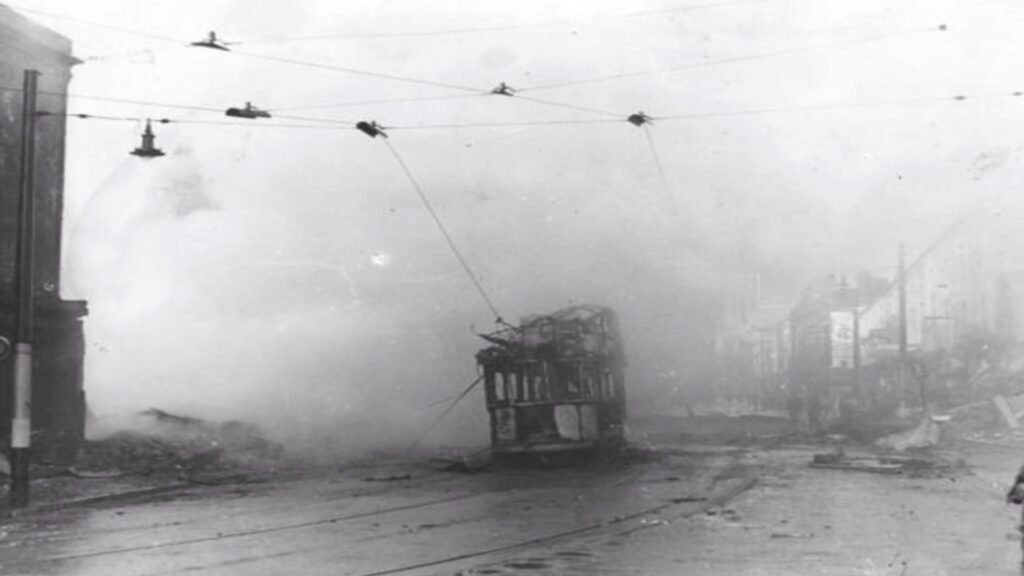
Worried that the red and cream trams would be visible to enemy planes, they painted the cream sections dark grey to help disguise them from the air. Thankfully, despite many tramlines being hit by bombs, including the one on St Mary’s Road that ended up outside my father-in-law’s front door on Northam Street, only one car was completely destroyed. On 15 September 1940, the Luftwaffe dropped bombs on Below Bar. Two members of the Home Guard were on duty outside a Post Office when a bomb exploded in the centre of the road. Both died, and another Home Guard was badly injured. In the same raid, a tram was hit on Bernard Street, then called Bridge Street. Another lost its roof on Shirley Road in a separate incident.
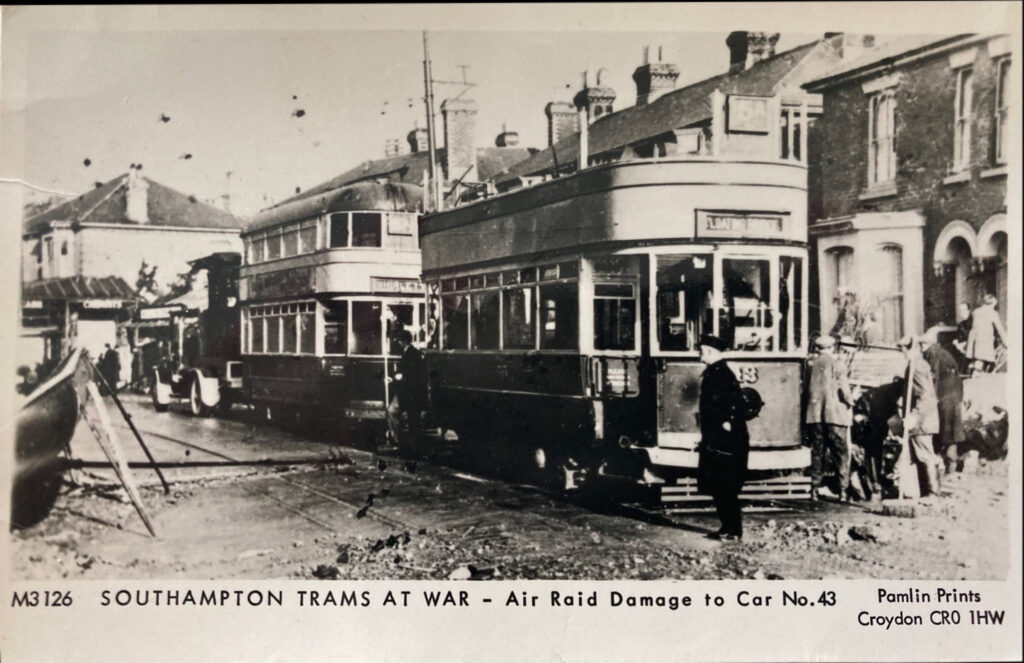
By the end of the war, the poor, battered old trams that had given such sterling service were in a sorry state. Southampton Corporation abandoned their pre-war ideas of an electric trolleybuses system. The nationalisation of the electricity-generating industry had put an end to cheap local power. Now, they saw motor buses as the way forward, but the waiting time for new vehicles was long. The trams limped on for a few more years.
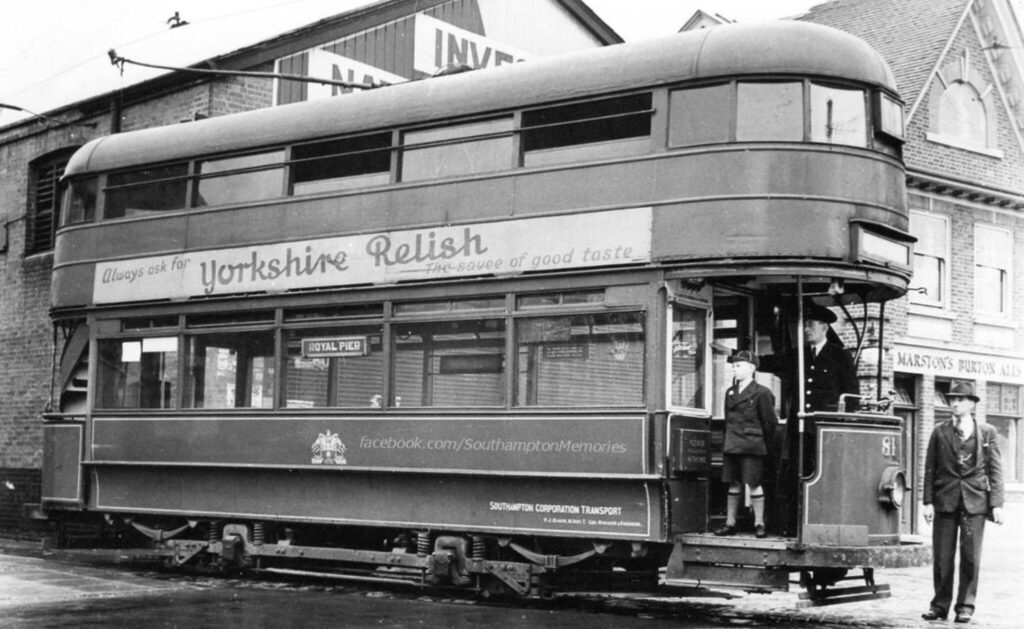
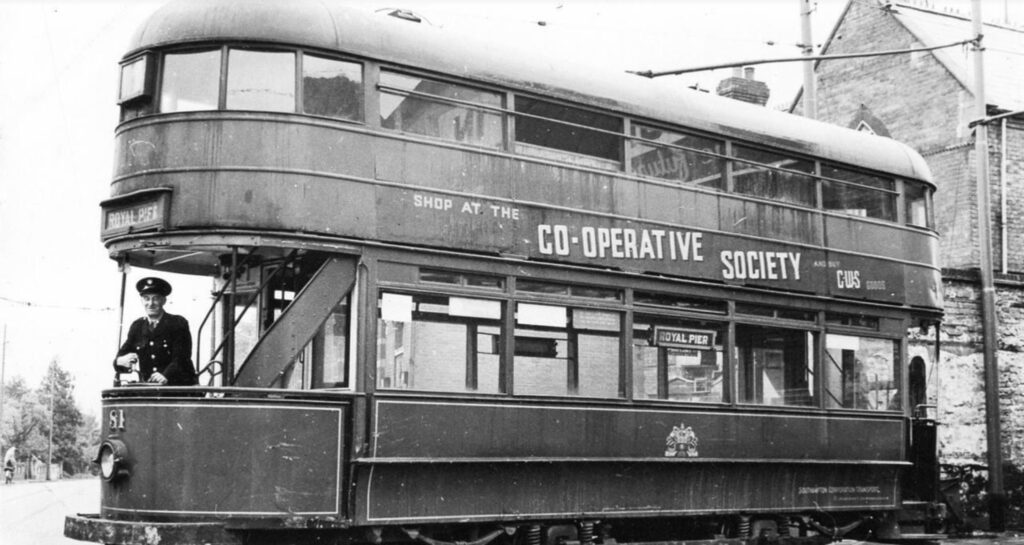

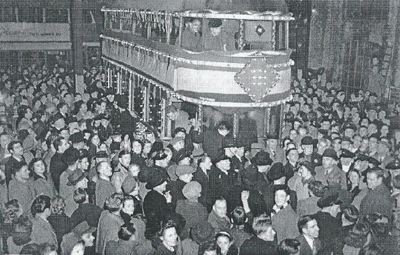
The Corporation ordered a fleet of Guy Arab buses, and by 1948, the first were running on Southampton roads. Little by little, the tram routes disappeared. The last to go was the Shirley to Floating Bridge tram. The final Southampton tram, car number 9, passed through the town on 31 December 1949, decorated with flags and lights and surrounded by crowds. Apart from a break when he joined the RAF for the duration of hostilities, Walter Dowling had been driving trams since he left the army and married Violet in 1932. With no more trams to drive, he became a bus driver, a job he continued to do until he retired.
The last two trams, numbers 21 and 101, ran through Southampton streets on 4 February 1950. Both were empty when they took them from the Shirley depot to the depot in Portswood. Some dome-topped trams were sold to Leeds, but most ended up at A F Harris scrapyard in Bevois Valley or found new uses as sheds and summer houses. Some have since been rescued and restored. If you’d like to learn more about them, you can see my post about the Southampton Tram Project here.
If you like what I write, and you’re interested in my novels are available now on Amazon in paperback, on Kindle and via Kindle Unlimited. Check out my Amazon page here and my Goodreads page here. If you would like to help me keep writing, you can now buy me a virtual coffee by clicking on the little orange coffee cup at the bottom right.
Very interesting. I was born in 1945 and just about remember the last of the trams, from the town to Swaythling. I was a very small boy then and my memory might be playing tricks on me! Sadly my father, who was in the police during the war, and my mother, an ARP warden died without me asking about their early days in Southampton. I do so wish that I had done so as they both would have had interesting memories to share. My father had a brother who died in 1917 and is commemorated in Tyne Cot Cemetery and on Southampton Cenotaph. I didn’t know that Dad had a brother until after he’d died. I can’t help wondering why Dad kept this a secret!
I’m glad you enjoyed reading. I e found out so many things I never knew about my family from researching on ancestry. Many family members were never mentioned, perhaps because the memories were too painful?
Thanks for this tremendous research, Marie. I never knew the trams, but I do remember the Guy Arabs!
Where I live now (Launceston in Tasmania) had trams about the same time. Although now long gone, there are still some signs around town they still existed. For example, some roads still have concrete strips down the middle which once held the tram rails. Funnily enough when I lived there in the sixties I never remember any signs that trams ever ran in Southampton, even though I was at that age where boys used to find anything to do with transport fascinating. They must have done a very good job when they went over to buses, or perhaps I was too young to recognise the signs!
I grew up in the 60s too, and never saw the trams running, but my mother talked about them and my husband’s grandfather drove them. It’s been an interesting subject to research.
I was born in Southampton in 1943 and have vague memories of the Southampton trams. My grandfather on my father’s side and one of my mum’s younger brothers both worked as drivers on the trams and at the same time. Unfortunately I don’t have any old photos to share with you but the article brought back fond memories.
Thank you. I’m glad to have brought back some memories. I don’t remember the trams but I wish I’d seen them.
I don’t have any personal memories of trams but for some reason I have a fondness for them. I really enjoyed reading this post and thank you so much for your research and for sharing the vintage postcards, they are very special.
My pleasure
Until I read the little book on these trams found in Bitterne library recently I was convinced I had seen as a child the trams at Stag Gates! Impossible as you write; I was born in 1952. I think it must have been an “implantation” from my mother telling us about them as we used the number 47 bus going through Stag Gates. I often reflect as I use the bus from town through Shirley in the traffic I may as well be on a tram as it’s following the same original route, going no faster, stopping and startt at every stop …….
I’d loved to have seen the trams, but, like you, I was born too late.
Hi Marie, such lovely photos of the trams. I was born in Hedge End in the early 60s so missed the tram era. As a child, I was convinced that Watts Park was named after me 🙂
I missed the tram era too. It feels like we made a mistake getting rid of them. I’ve seen how well they work in other countries. Imagine having a park named after you