
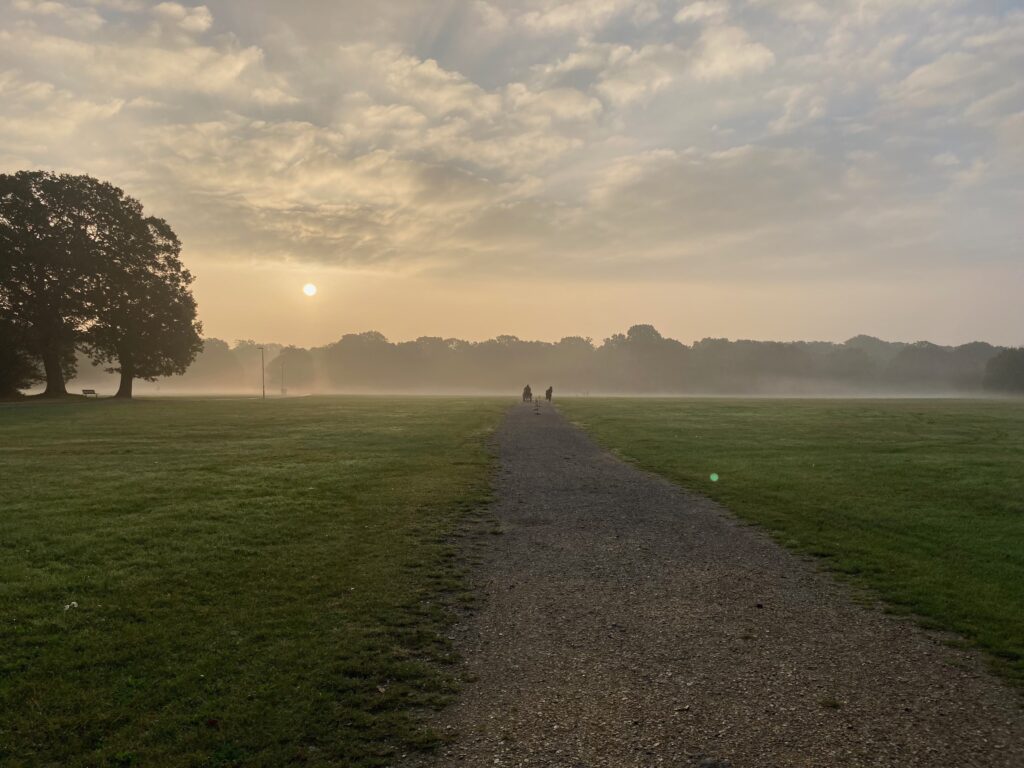
When we strolled across an eerily beautiful and somewhat misty Common in early October 2021, I had no idea that Commando had another bit of time travel up his sleeve to surprise me. As far as I was concerned, it was just another ordinary Saturday morning watching parkrun and having a wander in the Old Cemetery. My head, as usual, was full of the book I was plotting, listening to the voices of my characters clamouring for attention. The fifth book in the series revolved around a tram driver and his conductor friend. The first draft was written, but despite extensive research about Southampton trams, I’d never actually been on one. The last Southampton tram ran on 31 December 1949, more than ten years before I was born.
Everything seemed perfectly normal, right up to the moment when we finished our lunch and Commando said he thought we might go for a little drive. There was a glint in his eyes that told me he was up to something, but I had no idea what. It wasn’t until he parked up at Cross House and we began to walk towards Albert Road that I worked out where he was taking me. Some time before, I’d read something about the Solent Sky Museum having an open day to show off some trams they’d acquired and were restoring. I’d thought it might be interesting to visit, especially as Commando’s grandfather, Walter Dowling, was a tram driver. With all the excitement of our visit to Witney, I’d forgotten all about it, but Commando had remembered.

As we approached the museum a small model tram came whirring past us. That was when I realised this was going to be an interesting experience. The Solent Sky Museum was originally all about aviation. We’d been to see the planes before but the trams were a new addition, brought to the museum in August 2020 to be restored by the enthusiasts of the Southampton Tram Project. Originally the three trams, two from Southampton and one from Lisbon, had been stored in Southampton Docks, but the space was needed and Solent Sky Museum offered them a new home. Trams were not the only non aviation exhibits either. Outside we got our first glimpse of the old floating lighthouse, Calshot Spit, another project undertaken by the wonderful volunteer restorers.

We’d last seen Calshot Spit in Ocean Village, where she was beached for many years. She was moved to her present position in December 2019 on self propelling rollers. The plan is to restore her and use her as part of a museum cafe. Built in 1914 by J Thorneycroft for Trinity House, she was originally a lightship, stationed at Calshot Spit to guide flying boats to their terminals and warn ships of sandbanks. Six crew lived on her, keeping the light and the foghorn working, but in the mid 1960’s she was replaced by a buoy. It’s good to see her being looked after and I look forward to visiting her again when she’s fully restored.
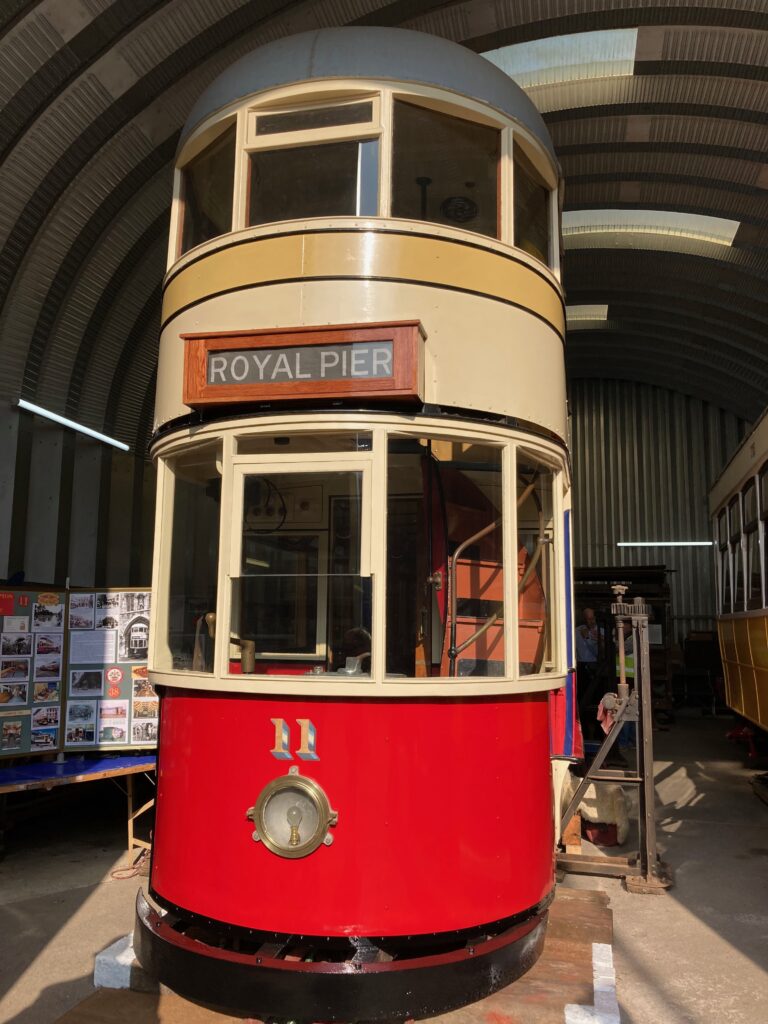
We paid our entrance fee and entered the museum. It was tough to walk past all the planes, but we’d seen them before. Today, the focus of our visit was trams. We found them in a shed at the very back of the museum. The first tram we saw was number 11, resplendent in red and cream with a sign telling us she was going to the Royal Pier. She didn’t always look quite so loved and cared for though. When I was researching Southampton trams to write book five, I’d stumbled upon the Southampton and District Heritage Trust website, so I knew a little of her story. She was discovered, in a very sorry state, on a private estate near Alresford in 1977. In 1979 she was moved to a British Gas site at Millbrook and the long, slow process to restore her was begun.
Part of the reason I’d been so keen to see the trams in real life was to add authenticity to my book. Number 11 gave me ample opportunity to explore and to ensure that the things I’d written actually made sense and would have been possible in real life. One of the problems with writing historic fiction is not always knowing exactly how things were back then. The first thing that surprised me was just how cramped the drivers of those old trams must have been. Drivers had no seat. They had to stand at the controls, right next to the spiral stairs leading to the top floor. As trams couldn’t turn around on the tracks, there were stairs and controls at both ends, and the driver would work at whichever end was the front on any particular journey. Obviously, the passengers must have used the stairs at whichever end was the back during their journey.

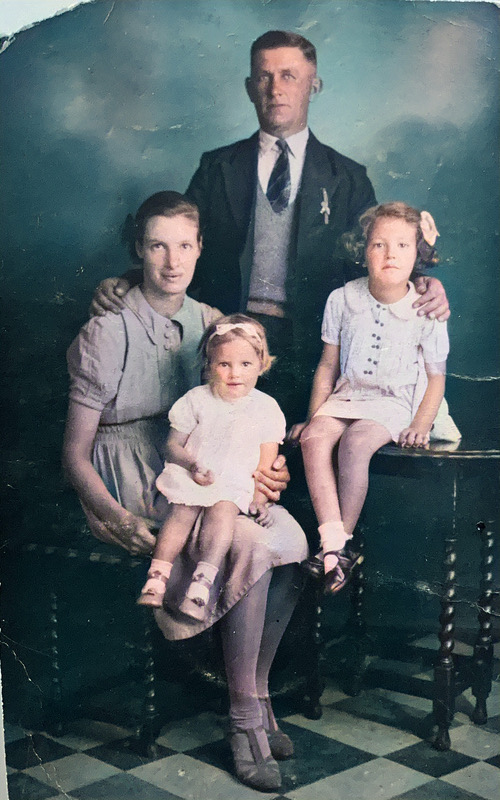
For Commando, this museum visit was a little more personal. His Granddad, Walter Dowling, had been a tram driver. He may well have stood at the controls of this very tram. I can only imagine what was going through Commando’s mind as he stood in his grandfather’s footsteps, but it felt like a little piece of history was being recreated.

Walter lived in Lobelia Road with his wife Violet and their three children, Beryl, April and Michael. April, the second born, was Commando’s mum. Before he took up tram driving, Walter was a soldier in the Royal Hampshire regiment in India. When World War Two broke out, he enlisted in the Royal Air Force Voluntary Reserve and became a cook, just like my own father did. Perhaps their paths even crossed. After the war, Walter went back to tram driving and then on to bus driving.
While Commando remembered his granddad, I was busy looking at things that played a part in my story. Luckily, one of the volunteers, a very kind gentleman called William White, was more than happy to explain things to me and share his expertise. When I asked about the way the driver changed ends of the tram at the end of a run to make his return journey, he explained how the driver or the conductor of the tram would have to reverse the direction of the trolley pole (the cylindrical pole used to transfer electricity from the overhead wire) by swinging it through 180 degrees to avoid the tram being ‘dewired.’
One of the things I was especially interested in was the bell. I’d been thinking of the tram bells as something like the bells I remembered on the old buses, a cord near the roof of the bus that the conductor would pull to let the driver know it was safe to pull away. It turned out that the bells on the trams were altogether different. They were actually on the floor, near the door and were operated by the conductor’s foot.

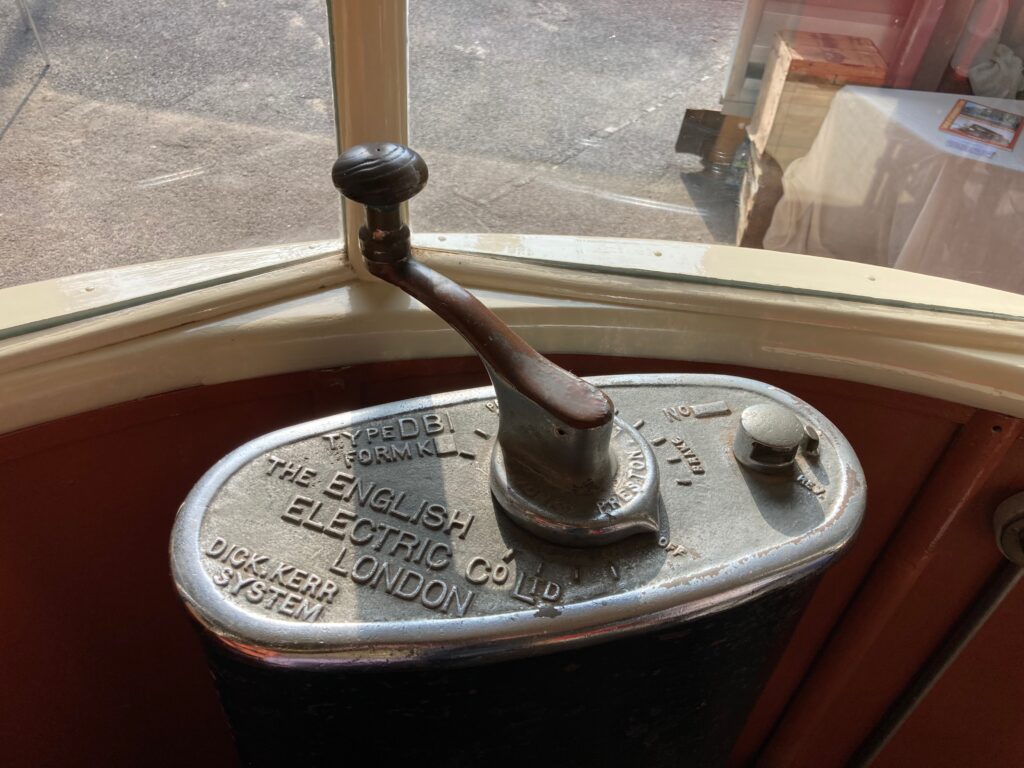
Then there were the tram controls. I knew from all my reading that the driver had a spanner like key he’d insert to make the tram go, but seeing the controls in real life made it easier to understand. Of course, the exact workings of the tram weren’t integral to my story, but knowing them did help to understand what it must have been like to drive a tram and to get into the mind of my character.

Another surprise were the seats. I’d imagined them being like the ones on the old buses. In actual fact the downstairs seats were wooden benches, running along the length of the tram. Part of my story involved the day Oswald Mosley was chased off Southampton Common and made his escape from the angry crowd on a tram. One of the accounts I’d read of this episode mentioned the seat cushions being piled up against the windows to stop missiles entering the tram. William assured me that the trams back in the 1930’s didn’t have cushions as far as he remembered, so this was one piece of information I could put down to being a myth.

Another thing I wanted to know for sure, was exactly how much the driver would have been able to see of what was going on inside the tram. This really did play an important part in my story. Being on a real tram I could see how the internal doors worked and what visibility would have been like. It was clear that the driver would have been able to turn his head and see along the length of the tram, although reflections in the glass door might have limited visibility somewhat. There were some parts of my story that would need some rethinking and some rewriting, but this was the whole point of seeing the trams with my own eyes.


The stairs of the tram were far narrower and steeper than I’d imagined, far more so than the stairs on the old buses. The seats upstairs were very different to the ones downstairs. They were more like the old buses I remembered, although they had no cushions and couldn’t have been particularly comfortable. William showed me how the passengers could move the seat backs backwards and forwards to sit facing either direction. It seemed a clever idea and something I’d not known about before.


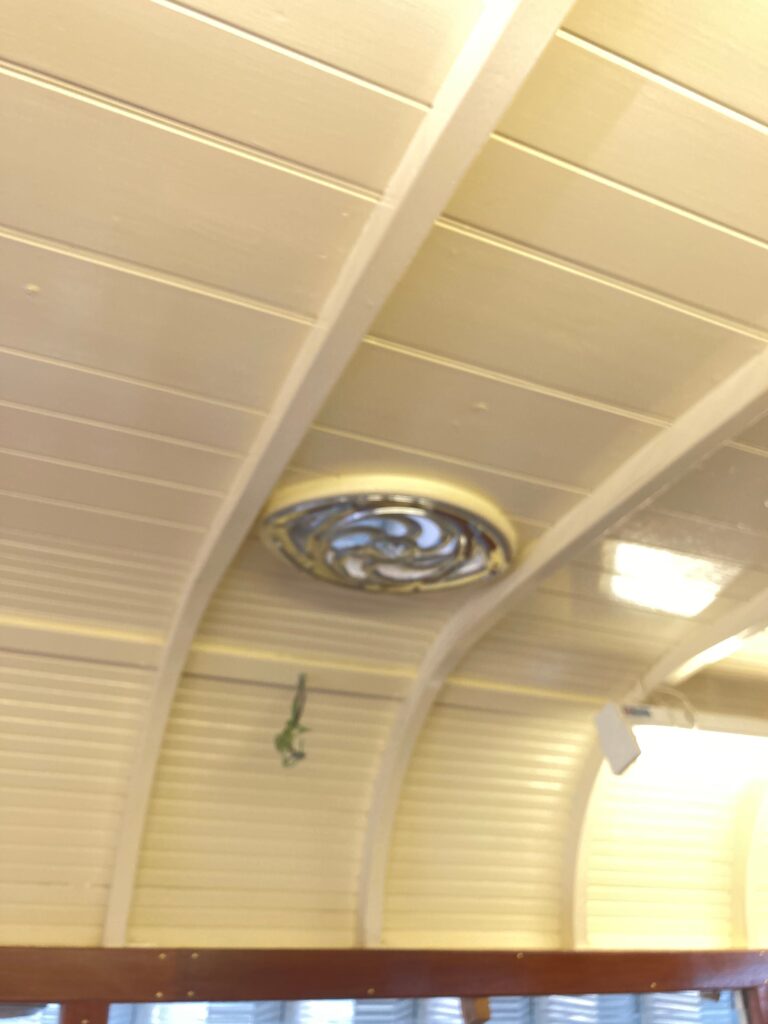
Then there was the curved roof of the trams. This was a special innovation in Southampton to allow the trams to pass under the Bargate arch. William explained how difficult it had been for the restorers to recreate. Commando, who knows far more about making things out of metal from his days building both ships and aircraft, agreed that this would be a time consuming and labour intensive task for anyone who built these special Southampton trams.
The other tram in the shed was Lisbon 715. For obvious reasons, this single-decker tram was not quite as interesting to me, but we did go to have a look at it. The Lisbon tram divers had a much easier time of it. They even had a seat. The passengers, too, look to have had a much more comfortable journey on padded seats.


In the end, it was tram 11 that captured our hearts and helped me with my story. Museums like Solent Sky really do help to bring history to life, and for writers like me, this is invaluable. The wonderful volunteers who dedicate their time to restoring these old vehicles have my utmost admiration.


I’d like to give a very special thank to William White, whose knowledge and good humour made our visit all the more special. He really is a wonderful gentleman. I’m sure this won’t be our last visit to the trams and I’m very glad that they are being preserved for future generations to see.


There was a lot more to see at the Solent Sky museum than trams, but Commando bumped into one of his old workmates who was visiting with his dad. This turned out to be a very interesting meeting, as his dad’s of a certain age and had been brought up in Northam. He remembered a lot of the things I’d heard about when I was researching Plagued and Land Fit For Heroes, like the flooding that happened so often along the shore and the children playing on the logs seasoning in the river. Books six and seven are about the dark days of the early 1940’s. I’d heard plenty of tales from my mother, who was a young woman during the blitz, but the the chance to speak to someone who’d lived through those times was far too good to miss.

We also stopped to look at a new exhibition being put together, covering this very period. Sadly, it wasn’t complete so we could only get glimpses but it certainly fired my imagination. There was an Anderson shelter, filled with the kind of things people really would have taken to the shelter with them. The baby’s gas mask looked rather horrific and I was quite pleased not to have any memories of being put into such a contraption, although my sister, who was born in 1943, may well have. I also recognised the old ceramic hot water bottle as something I’d seen as a child. Thankfully, our own air raid shelter had long gone by the time I was born, although I do remember peering into the one in our next door neighbour’s back garden. The thought of having to sit in a such a cold, damp and unwelcoming place for hours on end was hard to contemplate, but the alternative was even harder. The mock up of a bombed out house was certainly food for thought, although from the photographs I’ve seen during my research, I think the real thing would have been far more horrific.

There were lots of intriguing rooms I’d have liked a closer look at. I’m not sure what all of them represented but some seem to be mock ups of typical houses and businesses of the time. For a writer of historic fiction such things are extremely useful, although much of my childhood was spent surrounded by things that dated from the 1940’s, so much of it seems familiar. Hopefully, I will get the chance to go back at some point to see the finished exhibition.


Something else that caught my eye before we left was a marvellous model of Southampton High Street, complete with trams and cars. This really did look like a labour of love and the detail was outstanding. I could have spent hours staring at it. Instead, I took several photographs, none of which really do it justice. It really does have to be seen to be appreciated.


If you’d like to see the trams for yourself, a visit to the Solent Sky Museum is well worth the admittance cost and you can also browse all the amazing aeroplanes and other exhibits that they have on show. If you’d like to support the work of the Southampton Tram Project, or to find out more about what they do, they can be found on Facebook.
If you like what I write and would like to help me keep doing it, you can now buy me a virtual coffee by clicking on the little orange coffee cup at the bottom right. If you’re interested in my historic novels, Plagued is available now on Amazon.
What an interesting visit to see the trams, they have been beautifully restored. It must have been extremely uncomfortable to stand up while driving one! I love the model of Southampton High Street too. The Solent Sky Museum is another place to go on my ‘to vist’ list.
It really is worth a visit. The trams were fabulous. I really will have to go back to see the blitz exhibition finished.
Wow! Marie this article inspired me in my own memoir stories. I have always told one story with my Mum and me getting on a bus circa 1943 (i was a baby!), but reading the fascinating website of the Southampton Tram Project (spurred by your article) I found that buses probably were not in use then! So I contacted the Society and had a lovely reply from David Hutchings who confirmed that the buses were not running until 1949 in the docks area, so it would have been a tram we used. Saved from a faux pas. David sid that mine was the first enquiry they had had from Australia, which surprised me a little. It may not be the last! Thanks for your fascinating (to someone born and bred in Southampton especially!) stories.
I’m glad my writing has inspired you to look into your own story. In writing my books I have probably spent more time researching than actually writing, because I know how jarring it is to read a piece of historic fiction and find a piece of information that is anachronous. I’m lucky to still live in Southampton so have access to a lot of archives that might not be available to others, but museums like Solent Sky have been a great resource. Keep writing. Our stories are important.