
The Millers Pond episode proved to be a turning point, of sorts, for plotting my next book. The Botany Bay, Sholing characters wouldn’t talk to me because the plot didn’t work, no matter how much I tried to make it. As soon as I stopped listening for their voices, I heard the other characters clamouring to have their say. They weren’t in Sholing at all. They were in Eastleigh. On Valentine’s Day, Commando dropped me off outside a foggy Eastleigh Railway Station on his way to work. I hoped walking the five miles home would prove inspiring.

Anyone who’s followed me for any length of time may recall my epic walks to Winchester and back, training for various walking marathons. Eastleigh was always the first stop, and coffee was always the order of the day. This misty Valentine’s morning proved no exception. While I drank my coffee, I did some research on my phone. Apparently, the Carriage Works at Eastleigh were involved in secret work building boats, landing craft, parts for Horsa gliders and other military equipment to prepare for D-Day. They employed women to replace the men who’d gone to fight. Almost ninety thousand women worked on the railways during the Second World War. They became ticket collectors, guards, porters, track maintenance, wheel tappers, fog signallers, shunters and, most importantly, they worked in the carriage works. Suddenly, instead of going around in pointless circles, my plot began moving forward in my mind.

Eastleigh was once a small village called East Leah — leah being a Saxon word for a clearing in a forest. In 1838, the London and Southwestern Railway Company laid a line from Southampton to Winchester and built a station in the village. They called it Bishopstoke Junction after a larger village nearby. Within a year, they’d extended the line to London. In 1891, when the LSWR needed to expand their carriage works in Nine Elms, London, they built a new works at Eastleigh. The greenfield site gave them more room for expansion, so when the LSWR became the Southern Railway in 1923, Eastleigh became the main carriage works. Of course, all this brought jobs to Eastleigh, and the railway company built cottages near the station for their employees. By 1881, Eastleigh’s population had grown from a couple of hundred to over a thousand. There were three streets of terraced railway cottages — High Street, Market Street, and Southampton Road. My walk took me along High Street, where little had changed in the last hundred and forty years apart from the cars parked on the street.

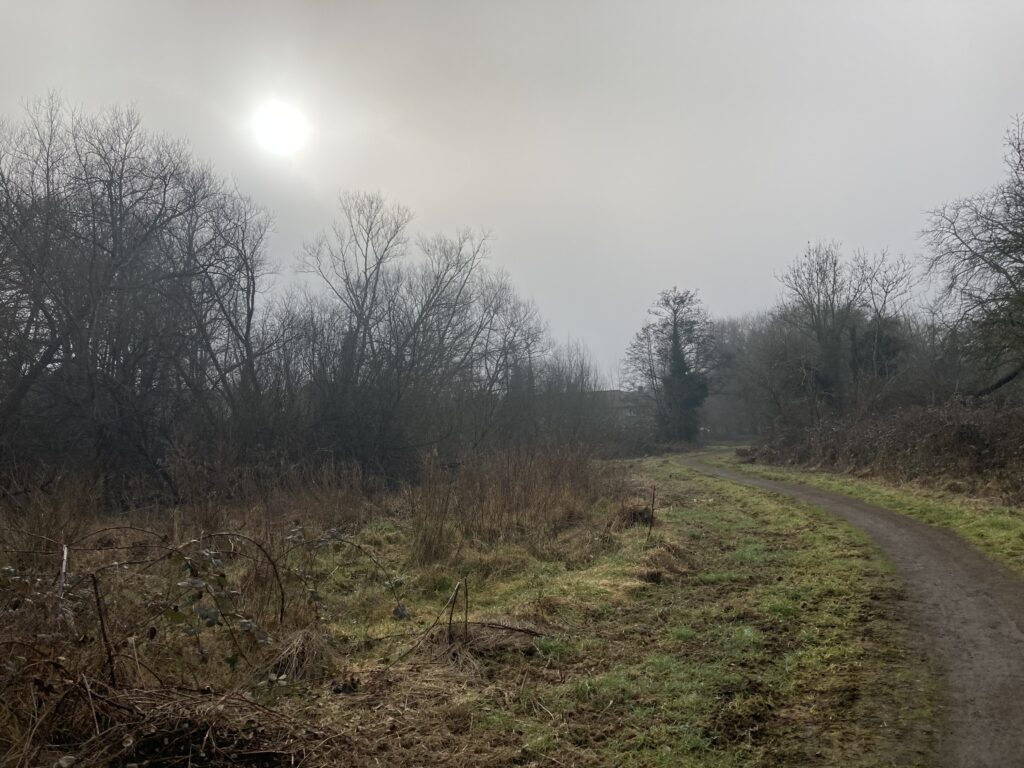
By the time I’d passed the railway cottages, the characters who’d been silent for so long were chattering away in my ear. Rather than stick to Southampton Road, I took a detour through Lakeside Country Park. I knew I’d find a seat there to sit and jot down a few of the ideas swirling around in my head. The morning mist still clung to everything, and through it, the sun looked more like the moon.


On a clear day, there’s plenty to see at Lakeside — lakes built on old gravel pits, a miniature steam railway and lots of wildlife. The morning was anything but clear, though, so a detour around the lakes would have been pointless. Skirting the edge of the park, I stumbled upon a rotten log covered in orange peel fungus, and I found the bench. There wasn’t much of a view, but I wrote a few notes before continuing on my way. The story taking shape in my mind was set at the end of the Second World War. Back then, Lakeside was nothing but fields and a few allotments. The real action centred around the railway and the airfield.


The morning mist hid the airport, too, but I stopped briefly to photograph the Spitfire on the roundabout at the top of Wide Lane. There is a certain irony that taking a picture of the Spitfire is almost impossible without also including the Mercedes Benz sign on the nearby car sales lot.

At the bottom of Wide Lane, I crossed the road and headed for Monks Brook Greenway. When I spotted a sign tied to the kissing gate, I worried that I might have to rethink my route. It turned out to be about bridge repairs, but which bridge wasn’t clear. Even so, it looked as if I’d be able to get through, so I carried on.

By this time, the sun was slowly winning its battle with the mist, and I was trying to decide whether to turn left towards Mansbridge or right towards Woodmill. It would depend on which bridge was being repaired and whether I could get past. I didn’t have long to wait to find out.
Between Wide Lane and Mansbridge, two bridges cross Monks Brook. One is blue, and the other is green. The blue bridge has always been my favourite, mainly because it’s arched and wooden, and the railings on either side are painted a lovely shade of cobalt blue. When I turned the corner, workmen were dismantling it. Disappointing as this was, one look at the wood they’d removed showed they had little choice in the matter, and a chat with the workmen told me they were putting in a new bridge. Whether it would be as pretty as the original remained to be seen.


On I walked, still undecided about which way to turn at the end of the trail. I’d hoped there’d be a few spring flowers poking through the soil here and there, or some interesting fungi, but all I saw was the tree stump mushroom and a lot of strappy leaves that might be daffodils, bluebells or snowdrops.

When I reached the green bridge, I made a snap decision and turned right. The green bridge is nowhere near as pretty as the blue bridge, but it does lead to St Mary’s Churchyard, and there I found the spring flowers I’d hoped to see along the river.


This route took me past South Stoneham House, on the corner of Wessex Lane and Woodmill Lane. Thomas Dummer of London built this large manor house in 1705, and Capability Brown designed the gardens. In 1740, William Sloane purchased it. His brother, Irish Physician, Naturalist and collector Sir Hans Sloane, bequeathed his collection to the British people and provided the foundation of the British Museum, The British Library and the Natural History Museum. By 1819 the Fleming family owned the house, and in 1888, they sold it to Sir Samuel Montague, who later became Lord Swaythling. In 1921, it was sold to the University College. They built a rather ugly tower block right next to it in the 1960s, spoiling the look of the place completely. Since I last walked this way, the tower block has been demolished, so despite the mist still tenaciously clinging, I stopped and took a few photos. It will be interesting to see what happens next.

By the time I reached Woodmill, there was a definite hint of blue in the sky, but the playing fields were still shrouded in mist. This gave everything a soft, ethereal glow that was almost dreamlike. Most of the miles were behind me now, so I strolled through the park, taking photographs, enjoying the bare branches of the trees silhouetted against the brightening sky.


There was one more surprise in store for me before I reached home. The jetty where we sometimes stop to feed the swans was cordoned off. A sign said repair work was being organised, but I couldn’t see what there was to repair. It all looked pretty much as it always does. The poor swans and gulls are still huddled around it. They must be missing being fed.


I was pleased to see the row of trees they’ve planted at the edge of the path looking healthy. When they grow, I’m hoping they provide a little shelter from the cold wind that whistles across the park on mornings like this one.

Cobden Bridge was directly ahead of me now, and my walk was almost over. I’d set out hoping for inspiration, and now I had a plot slowly forming in my head. All I had to do was remember it long enough to get it down on paper.


If you like what I write, and you’re interested in my novels are available now on Amazon in paperback, on Kindle and via Kindle Unlimited. Check out my Amazon page here and my Goodreads page here. If you would like to help me keep writing, you can now buy me a virtual coffee by clicking on the little orange coffee cup at the bottom right.
Wonderful writing and photos – I haven’t walked this route for decades but will try on my next visit ‘back home’ Fond memories of the long gone Junction Hotel which was demolished to make way for the Eastleigh Railway Station car park. I sang with local pop groups from 64-72 and 1965 saw my ‘Unforgiven’ group as the resident entertainment at this well known pub. Very lively, full of ‘characters’ with a few punch-ups along the way! Many walkers now start the Itchen River walk from Eastleigh up to Winchester if lucky enough to have the stamina. Chris Packham boosted this on a recent TV programme. My own website has a wealth of local info on the Hampshire 60s music scene, linked to my own books that highlight our heritage and history.
Thank you. I have walked the Itchen Navigation many times, but I’m slowly getting back into longer walks after covid.
Hi Marie,
Nice to hear news of my old stomping grounds once more! Eastleigh was a common destination for young lads in the sixties as the steam locomotive shed was there and could be relatively easily accessed. Towards the end of steam on the Southern in 1967, the place was rundown and filthy but still a magnet. Saturday afternoons saw plenty of action. Eastleigh railway station served a very good bread pudding, too. 6d would fill you up till tea time!
I was interested to hear that South Stoneham tower has finally been demolished. I remember it being built in 1962. Last I heard, the University was between a rock and a hard place, the tower being too dangerous to leave standing and too full of asbestos to be easily (and cheaply) demolished. Sounds like it’s finally gone.
You had an interesting pictureof a wooden bridge across Monks Brook. I think that must have gone in when they tore down “The Grange”, as I don’t recall it. From the angle of your picture, it looks as if it may have replaced the cast concrete one that I used to cross on my daily walk from our shop to Mansbridge school. The green bridge I knew well, it was there when I moved to Swaything in 62. I do hope they do something interesting with South Stoneham House. In my time everything on the otherside of Wessex Lane was playing fields. And now the landmark towerblock has gone. The times, they are a-changing indeed.
Eastleigh will feature in one of my novels, so I will pay regular visits while I’m writing it. The year in question is 1943/44. Your memories of sneaking into the steam loco sheds and the bread pudding made me smile. I can imagine it so vividly. I’m not sure how they got around the asbestos problem when demolishing the tower, but I’m glad to see it gone. It really was an eyesore and I’m sure they’d never allow something so out of place to be built today. I’ll be watching what happens next with interest. I think you must be right about the blue bridge. It’s definitely on land that was once part of the Grange and there is no concrete bridge, only the blue and green bridges and the road bridge. The times they certainly are, a changing.
I’m glad it was the tower block that was demolished and not the old manor house – I do hope it is a listed building! I love that view of Cobden Bridge, very atmospheric.
Me too. I’m not sure if it’s listed or not but I’d love the chance to see the gardens.