Lately, I’ve been posting about 2021, the lockdown, and life slowly getting back to normality. All the while, life in the here and now has been moving on. The threat of COVID may have been downgraded, but the spectre of war has taken its place in the daily news. If researching and writing about the first half of the twentieth century has taught me anything, it’s that the newspapers and the media are not to be trusted. They may be great for propaganda, but they’re not so good for solid facts. Even so, the invasion of Ukraine can hardly be ignored. The parallels between these days and the dark days of the late 1930’s are clear for all to see and my heart breaks for the ordinary citizens of Ukraine.
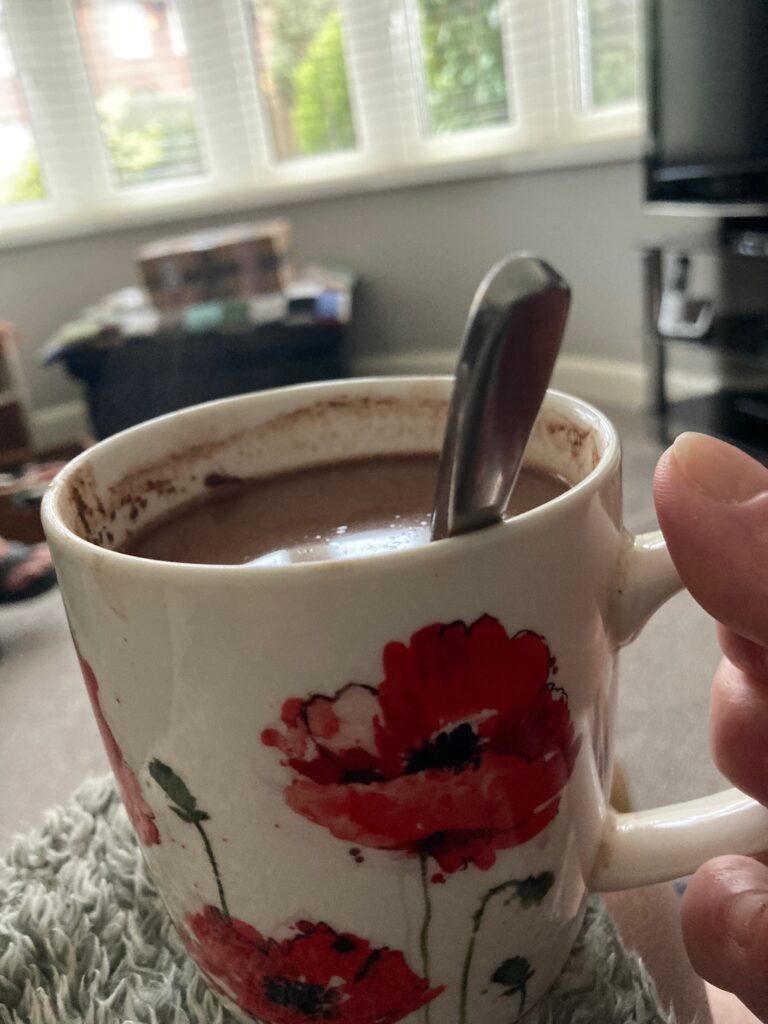
Of course, there is nothing I can do about any of it, except check everything thoroughly before I believe it and try to avoid all the budding William Joyces, popping out of the woodwork. If history really is repeating itself, I hope the conclusion will follow suit and the fate of the new Lord Haw Haws and the war criminals will be the same as it was in 1945. Rather than the news reports and propaganda, I prefer to look to the human side of things. I follow a handful of ordinary Ukrainian women on social media. Their stories are not political, they’re about the every day things. The long queues to get into empty shops. No coffee beans to make coffee. Joy at finding bottled water for sale, because the water main has been bombed and nothing comes out of the taps any more. Packing a tiny suitcase to flee Kyiv, not knowing if you will ever see the things you’ve left behind again. Sending messages to friends and family each day, just to check they are still alive after a night of sitting in a shelter listening to bombs falling. There is guilt too, because I cannot help, and because it feels voyeuristic somehow. It seems wrong that their misery, and the danger they’re in, should help me understand the reality of war in a way no other research has. Yet, every morning, I sit with my mug of cocoa and check on them, worried each day that one of them will have disappeared and I will never know how, or why.

This Saturday, after my normal cocoa and granola, it was off to parkrun as normal. My Ukrainian friends had all survived the night but they were on my mind. There was melancholy in the air. Perhaps it was from the dark clouds hanging over the Common threatening rain. Then again, it could have been the dark thoughts swirling around in my head. My youth was spent living under the shadow of the mushroom cloud and it felt as if it was slowly rolling back across the sky. How could humans be so stupid as to wage a war no one could ever win? Had mankind learned nothing?

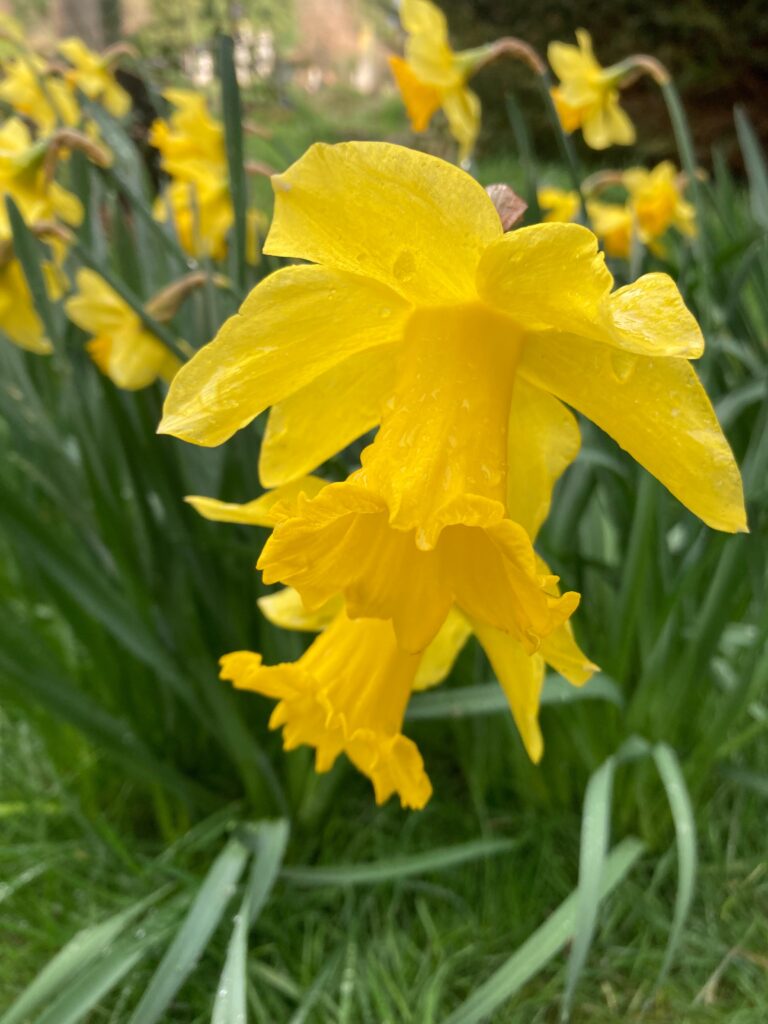
The melancholy lifted a little when I saw daffodils between the graves. Whatever the future might hold, I had to live in the here and now. Just like Ira, Yaroslava, Lily, Nastya and Anna, we all need to cherish every moment, because none of us is guaranteed a tomorrow. The ground was too muddy to risk the circular path I usually walk, so I stuck to the paved route. The cloud had broken to reveal a few patches of blue sky, and the sun made a brief appearance. Some of the trees were in blossom, a reminder that spring is almost upon us. I risked the mud to get a closer look.
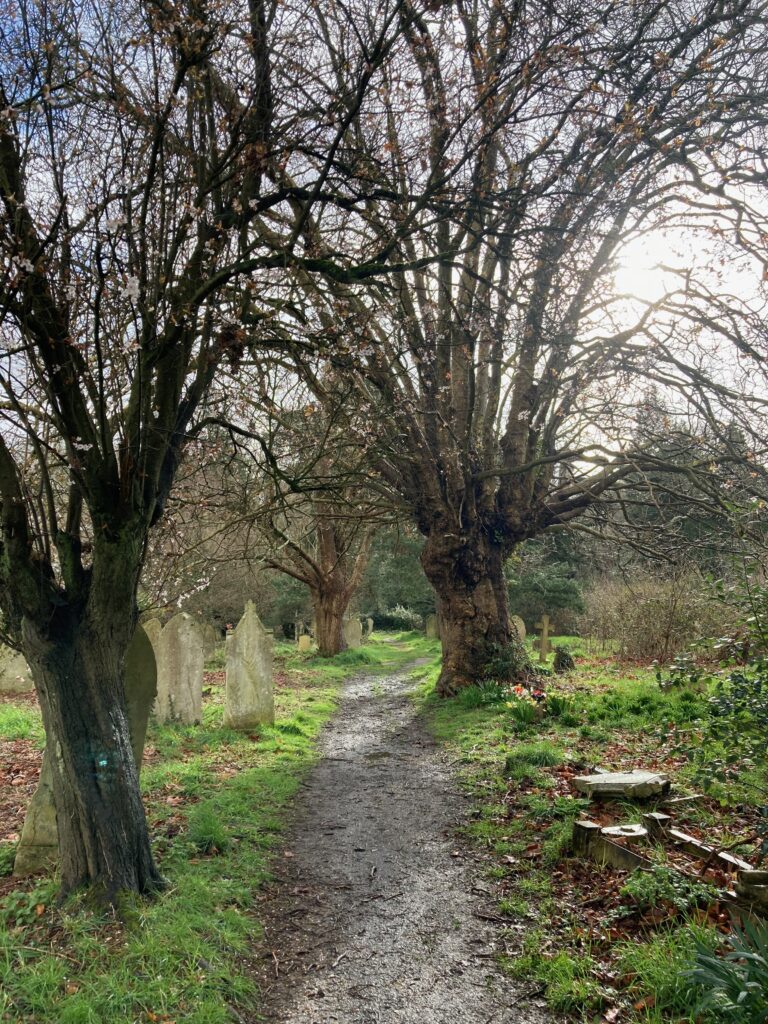

There is something about the first blossom of the year that makes my heart sing and something poignant about seeing it amongst the graves. It was almost a metaphor for my morning mood. As I walked further, I saw that the whole cemetery was bursting into life. Several other trees were blooming and the daffodils were poking their heads up everywhere. In the midst of all the death, life goes on.



The names on many of the graves here are familiar to me. Some of them feel like old friends. Every so often, as I pass through the cemetery, a new grave catches my eye and I add it to my mental list of the names I know. This morning, the grave that captured my attention belonged to George Buckle and his wife Elizabeth. A closer look showed two more names, John George and Winifred Buckle. The dates suggested the men might be father and son and I resolved to see if I could find out more about their stories later.

Back, at home, I did a little research on these two ordinary men. George was born on 23 March 1863, at 6 Landsdown Place, Southampton. He lived at various places throughout his life, Church Road, Hound, and in Southampton at Fives Court, French Street, Church Lane, near St Michaels Church and finally St Michaels Square. He worked as a salesman, a carman and a fruit and potato merchant. It struck me that the son, John George, must have stood at this graveside mourning his father in 1913, not knowing that he would be buried there in five short years.
John George Buckle was born in 1890 and worked in his father’s business. He married Winifred in 1915, at around the same time as he enlisted as a private in the 2nd Hampshire Regiment and went off to war. His regiment fought in Gallipoli and France, they fought in the Battles of the Somme, at Arras and in Flanders. At some point, John must have been wounded and transferred to the Labour Corps, because he was no longer fit for active service. He became a Lance Corporal in the 680th Agricultural company. How and where he died is a mystery, but the date, 25 October 1918, is so close to the end of the Great War, it is heartbreaking to think he came through so much, but didn’t live to see the armistice. These stories are one of the things I come to the cemetery to find and this one was certainly food for thought.

Of course, I didn’t know the story of the Buckles when I left the cemetery. What I did know, was that the rain that had been threatening had finally started. I pulled up the hood of my coat and scurried down Cemetery Road, hoping it would only be a shower. The rain kept falling though. When I turned to go through the new Common gates, I spotted a rhododendron in bloom. Despite the rain I stopped to snap a photo or two.

Further on, near the Hawthorns Cafe, the blackthorn was a mass of white flowers and the rain had stopped. It was time to hurry back to parkrun and find Commando, then traipse across the Common to the Bellemoor for a coffee and a chat. The thought of that coffee took my mind back to Yaroslava. Every morning she makes herself a cup of ‘war coffee’ and sits to let the world know that she has survived another night. She writes little messages about ‘that life’ and ‘this life’ and how different the two are. She hopes to make a book from her war diaries one day. I hope she does because I’d love to read it.

If you like what I write, and you’re interested in my novels are available now on Amazon in paperback, on Kindle and via Kindle Unlimited. Check out my Amazon page here and my Goodreads page here. If you would like to help me keep writing, you can now buy me a virtual coffee by clicking on the little orange coffee cup at the bottom right.
Your comments about Ukraine reflect what many of us feel now, enraged, concerned, helpless & thoroughly pissed off at the inanity & insanity of leaders who want so much but deliver so little, especially Putin. Things are also, but not so horrendously, bad for many Russians. I have a remote Russian contact who, in a copied email to our mutual contact over two years ago, stated “Sanctions have made things very bad here”. Think how it is now for the average Russian absent the financial access their so called ‘elites’ have! Far worse for sure.The hell with Putin’s war!
I despair when I see all the parallels between now and the time I’m researching for my current book. When my Ukranian friends post photographs and stories of air raids, it is so like the stories and pictures from my research it breaks my heart. I hope history will not repeat itself but I worry it will.
one of the best written essays i have ever read