
For my birthday this year, Commando decided to take me on a mini break to London, and I came up with a list of interesting, non-touristy things to see. To avoid the rush hour traffic, he thought it would be a good idea to catch the train from our local station. They only run once an hour, but it gave us time to have a coffee in the local coffee emporium near Southampton Central Station before our London train arrived. We strolled down the road to the station with our overnight bags over our shoulders, feeling as if we were on an adventure. There was a train on the platform, so we hastily bought our tickets from the automatic ticket machine and ran across the bridge. It looked as if we’d timed it perfectly.
Once upon a time, I caught the train at this station every morning. My first full-time job was in a data input centre, typing timesheet and railway timetable information onto paper tape for British Rail. There were perks to the job — free rail travel and lessons in touch typing. The former was useful while it lasted, and the latter has stood me in good stead throughout my life. Other than that, the job was boring and monotonous, and I soon moved on to the much more interesting job of data transmissions manager, sending the said paper tape to various other data centres via a modem the size of a giant American fridge. The major hazard of this job was paper cuts. Often the paper tape was spattered with my blood. We sat on the train, and I reminisced about the chubby and cheerful station manager who used to say good morning and good evening and warn us of any delays. It was an ironic subject, as it turned out.
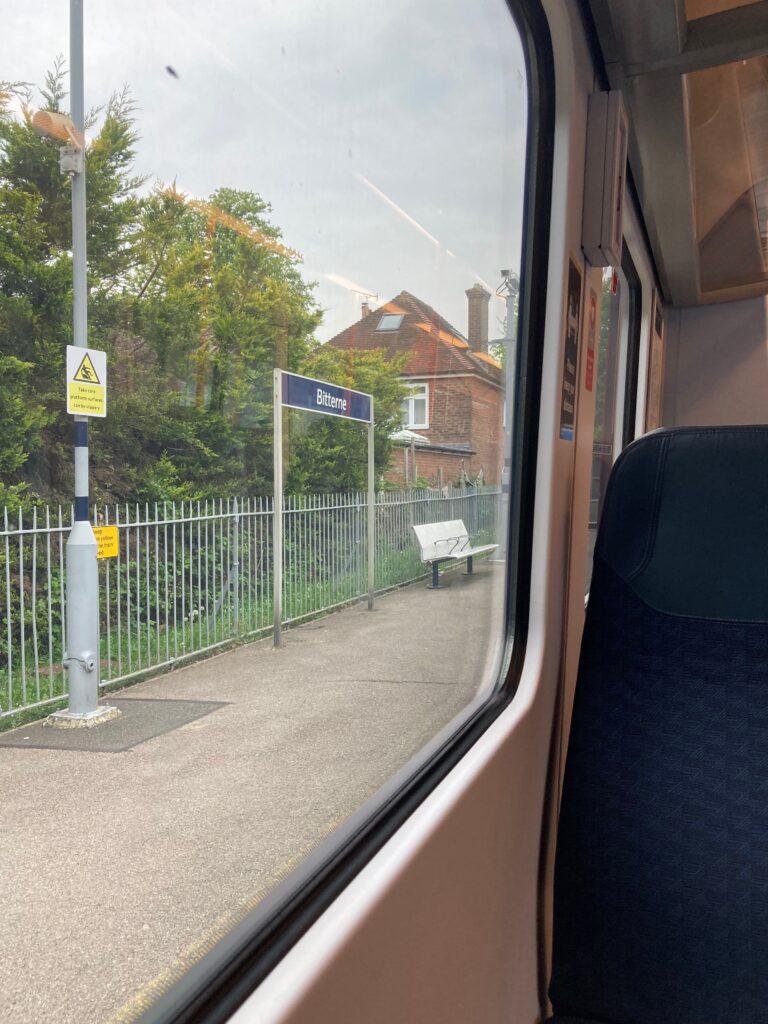
We’d been sitting for some time waiting for the train to move when we noticed a few people getting off. This was a worry, not least because our coffee drinking time was being eaten into. A quick look at the train app showed a delay, but not the cause or the length. We wondered whether it would be better to get off the train and catch a bus after all. When I saw the guard walking along the platform, I asked him if he knew what was going on.
‘Signal failure ahead somewhere,’ he said. ‘No idea how long it will be before it’s fixed. If you’ve got a connection to catch, you’d be better off making alternative arrangements.’
So, feeling a little miffed that no one had told us before, and that we’d spent money on tickets, we crossed the road and caught the next bus into town. Hopefully, the signal failure wasn’t beyond St Denys station and wouldn’t affect our journey to London.
Thankfully, the signal failure turned out to be an issue at the Adelaide Road railway crossing. This is before the St Denys junction, so it only affected the Portsmouth trains. We had time for a very quick coffee, and then we hopped onto the Waterloo train and settled down. It was an uneventful journey. At Waterloo, we transferred to the underground. It took two trains to get to Putney Bridge, where we were staying, The Jubilee Line to Westminster, and then the District line to Putney Bridge. Convenient as it is, I’m not a great fan of the underground. I don’t like being under ground and enclosed. The Jubilee line, being the deepest at 105 feet below sea level, is my least favourite. Luckily, we only had to travel one stop. The District line is a sub-surface line, meaning the majority is hardly underground at all. I survived the journey without losing my marbles.

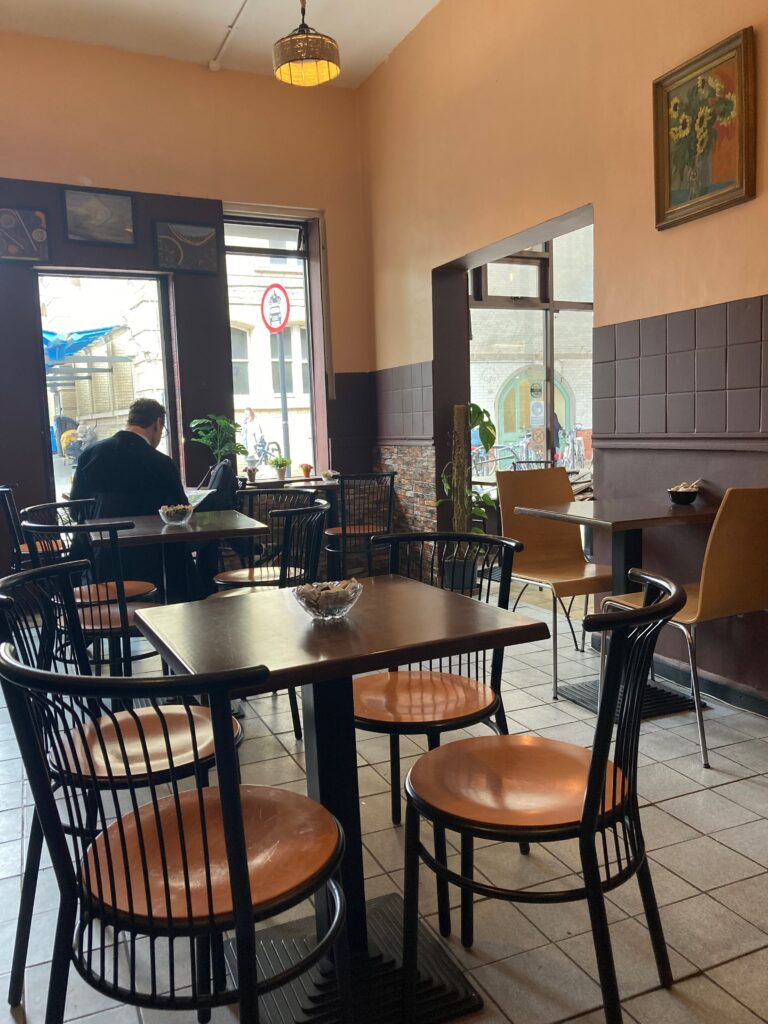
By the time we’d checked into our hotel and freshened up, we were hungry. We’d passed a couple of likely-looking eating venues when we got off the tube, so we went into one of them. We’d picked it at random, mainly because we liked the name, Cafe Smiley. It turned out to be very accurate. The man in charge was smiley and very friendly. The food was cheap, by London standards, and tasty. Admittedly, it was only filled baguettes, but they hit the spot.

So, fresh, fed and raring to go, we headed back to the underground station. At this point, you may be wondering why, in the whole of London, we had chosen Putney as our base. While we wait for our train to arrive, I will explain. Back in 2011, I walked my first London Moonwalk. Hotels in London are expensive, and with the congestion charge on top, things add up. Commando did the research and found a Premier Inn close to a suitable underground station and outside the congestion charge area. When I did my second Moonwalk in 2013, we stayed there again. It had proved to be the perfect base for a short London break. Admittedly, I hadn’t actually slept there either time, but still, you get the picture.

As we only had the afternoon left to us and the weather was fairly suspect, we’d decided to make our first objective the Imperial War Museum. The reasons for wanting to visit are probably obvious given my recent writing projects. It was also one of the few London museums I’ve never visited. The journey involved changing from the District Line to the Bakerloo Line at Embankment. Thankfully, none of the journey was deep underground. The train was packed with school children on an outing of some kind. It was noisy, but this was a distraction from my claustrophobia. We got off at Lambeth North.

The magnificent spire of a church across the road from the station distracted me for a moment. As I stopped to take a photograph, a member of the station staff asked, ‘Are you looking for the Imperial War Museum?’ He then proceeded to give us detailed directions and ended by saying, ‘If I had a pound for every time I tell someone how to get there . . .’ We were glad of his advice, but it did distract me from looking more closely at the church. This is a shame because it has an interesting history. Christ Church, Lambeth, was founded in 1876 as part of a complex of new mission buildings in the city. Sadly, the victorian chapel was destroyed during the London blitz, and only the tower remains today. Had I looked a little closer, I might have seen the original foundation stone, salvaged after the war and placed at the foot of the tower.

The walk to the Imperial War Museum was short and uneventful, apart from passing William Bligh’s house. We would never have known about the famous resident, if not for the blue plaque between the two downstairs windows. For anyone who can’t place the name, Bligh was a controversial figure. An officer of the Royal Navy, he is probably best remembered for being cast adrift from HMS Bounty by mutineers in 1789. After a journey of over three and a half thousand miles in a small launch Bligh and the men loyal to him reached Timor. Not all the men survived. Three were so weakened from the journey they died of sickness in Batavia while awaiting transport home, two others died on the way to England. Seventeen years later, Bligh was made Governor of New South Wales, Australia. His actions in trying to clean up the corrupt rum trade resulted in the Rum Rebellion. Bligh was arrested by the New South Wales Corps in 1808 and his command removed. He died in December 1817, in London.

Although the house looks fairly unassuming from the outside, it has some interesting nautical features inside and in the garden. As it is a private dwelling, there was no chance to see them. The only curiosity I could see was a sculpture of a fox peering down from the roof. So far, I haven’t been able to find out what this represented, so if anyone knows, I’d love to hear about it.

The Imperial War Museum was easy to spot. The giant naval guns gave the game away. Before we went inside, we stopped to have a closer look at them and discovered birds of some kind had built a nest in a small crevice. We could hear the cheeps of the chicks, but we didn’t want to disturb them, so didn’t get too close. Instead, Commando took a photograph of me standing beside one of the enormous shells. The thought of having something like that fired at me was horrifying.
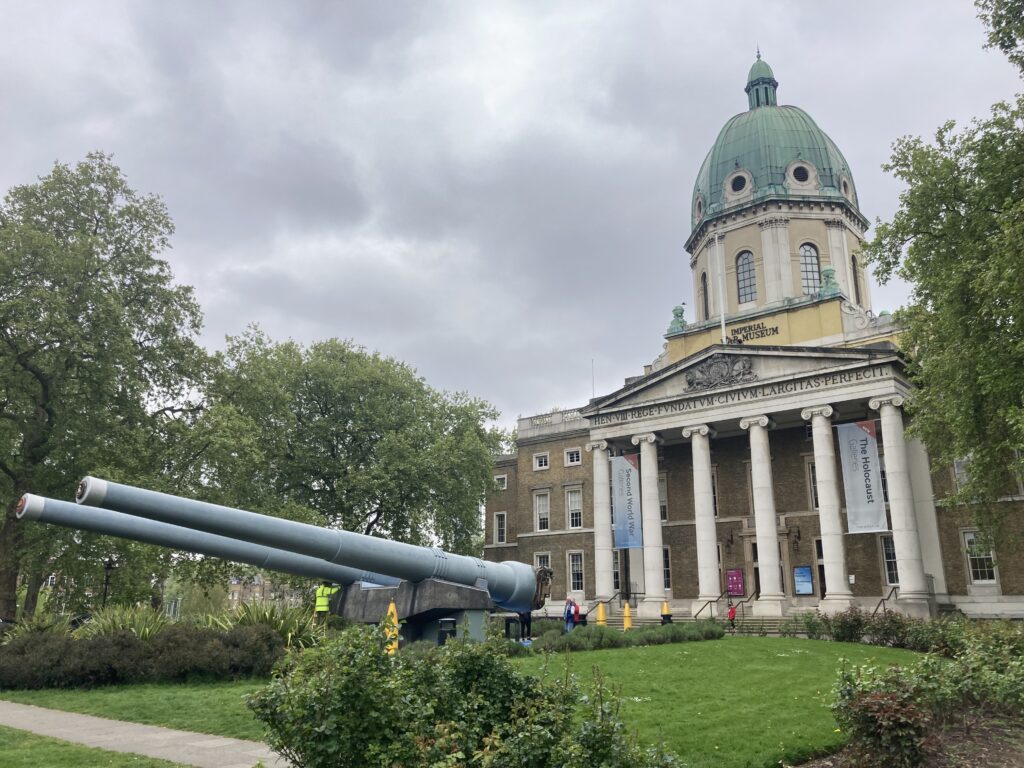
For anyone wondering, the guns came from WW1 warships, HMS Ramillies and HMS Resolution and were installed in 1968. The gun from Ramillies was first used in 1920 during the Greco-Turkish war. It was last used against Italian warships in late 1940. The gun from Resolution also saw action during the Greco-Turkish war. It was later remounted on HMS Roberts and used during the invasion of Normandy in 1944.

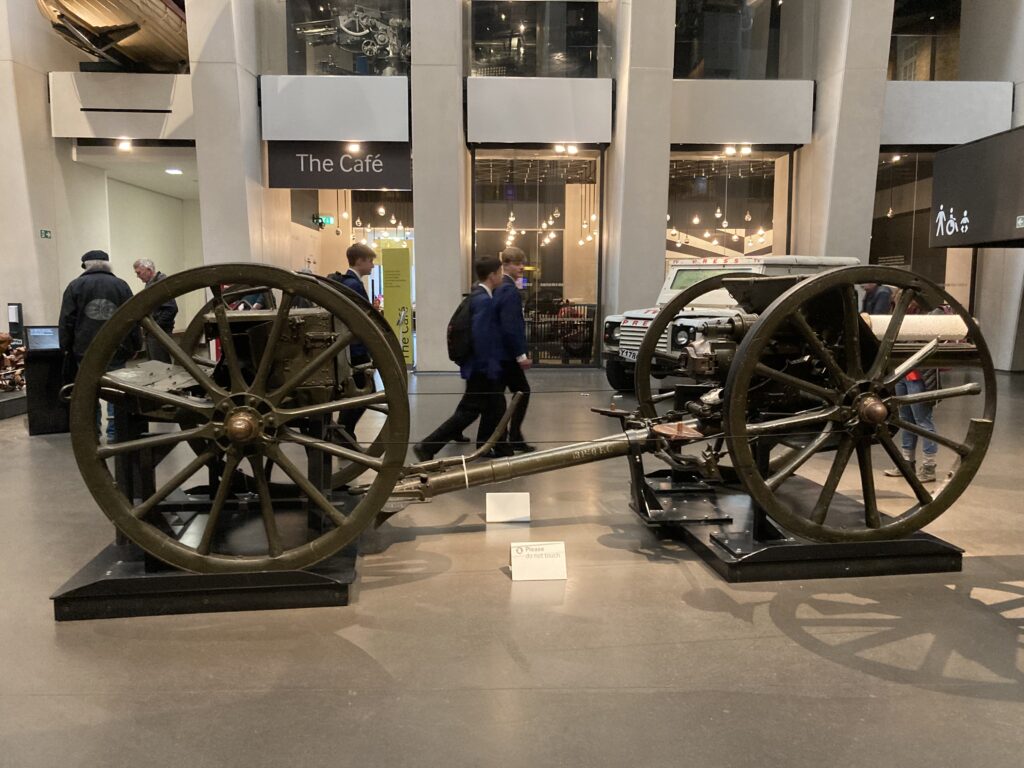
Our afternoon in the museum was interesting and, at times, emotional. Photographs are, quite rightly, not allowed, with the exception of the foyer. It is not an experience that could ever be captured on film, and stopping to snap pictures would have detracted from our enjoyment. The highlights are too many to mention, although seeing one of the tins Princess Mary gave to all the troops for Christmas 1914 brought a lump to my throat, as did the exhibition about Japanese prisoners of war.


The hours sped past, and by the time we looked at the big guns again, we were both tired, hungry and looking forward to getting back to Putney and finding somewhere to eat. Unfortunately, our return journey on the underground was not as straightforward as it might have been. We were on the District Line, counting down the stops to Putney Bridge when an announcement was made. Due to signalling failure, the train would be going no further. It must have been the day for it. So, two weary and rather hot travellers had to get off the train and find our way back on foot. Thank heavens for Google Maps, or we might still be wandering around London now.

If you like what I write, and you’re interested in my novels are available now on Amazon in paperback, on Kindle and via Kindle Unlimited. Check out my Amazon page here and my Goodreads page here. If you would like to help me keep writing, you can now buy me a virtual coffee by clicking on the little orange coffee cup at the bottom right.