
We left The Angel Inn refreshed and eager to see as much of Witney as we could in the short time we had. We’d seen the houses of Corn Street where Alice was born and we’d seen the church where several of my ancestors were baptised, married and buried, even if we hadn’t found any graves. I knew that my great great grandfather, Thomas Haley junior had moved from Corn Street to Woodgreen by 1861, but the only address on the census was Private House. Ten years on, he’d moved to West End but there was no address I could trace. By 1881 though, he was living on Narrow Hill and, due to a stroke of luck, I knew exactly which house he’d lived in. After a quick stop to take a closer look at the Town Hall, we set off to find it.

Witney is such a pretty place I could easily have spent the whole day taking photographs of all the buildings. With more time, I probably would have. As it was I was on a mission and I had to limit myself. Even so, there were a few places I couldn’t resist snapping. The Corn Exchange was one. It was built in 1863 by the Corn Exchange Company (who numbered blanket maker Edward Early amongst its directors) to replace the sixteenth century Corn returns office. It was also seen as a replacement for the town Hall, which had by then seen better days. The beautiful Italianate stone building, designed by J Collier of Putney, was well worth a photograph. Today it’s used as an arts and music centre.

Across the road a pub called The Company of Weavers made me smile. Weaving is a theme running through this town, and well it should. Witney was built on wool and weaving after all. Another wool themed place that caught my eye was the Woolgate. This name conjured up the medieval walls of my own town, Southampton, and I imagined carts loaded with wool being brought through the arch in medieval times. It all looked a bit too modern for that kind of thing though. Later I discovered that this was actually a shopping centre, built in 1987, so it’s probably just as well I didn’t stop to explore further.


The settlement of Wyttannige, as it was then called, began in Saxon times as a meeting place for the king’s council but it was soon transferred into the hands of the Bishops of Winchester, who seem to have owned just about everything at one time or another. Witney did make its name from wool, although not from moving fleeces up and down the river and trading them as Southampton did. By the seventeenth century there was a thriving wool trade here making all kinds of high quality woollen goods, the most famous of which were blankets.

Blankets were not the only famous product of Witney however. Along with gloves, like the ones Alice made, the town was also famous for mops. Apparently, at one time every single ship in the British Navy used Witney mops for swabbing the decks. The blanket weaving began as a cottage industry, with weavers like my Great, Great, Great etc grandfathers setting up looms in their little cotswold stone cottages. Of course it was only a matter of time before mechanisation came along and the work and the weavers were transferred to factories.

As we walked along the High Street I couldn’t help wondering if any of the little cottages we passed had once been weaver’s houses. Amid all the butter coloured stone I was intrigued by one three story property built of red bricks. There were some wonderful ghost signs on the walls that told me this was once a hotel, and a store selling bedding and carpets amongst other things. The name Glosten House* was intriguing, but I haven’t been able to find out what it means.

A little further on we spotted a shop selling Witney blankets. Sadly, it was shut or I might have been tempted to buy one, although I have an idea they are expensive these days. Then we caught our first sight of the River Windrush. Rumour has it that this river was the secret to the high quality of the Witney blankets. Apparently the water used to produce them was drawn from the river and its magical properties transferred to the blankets somehow. Then again, it could all have been clever marketing.
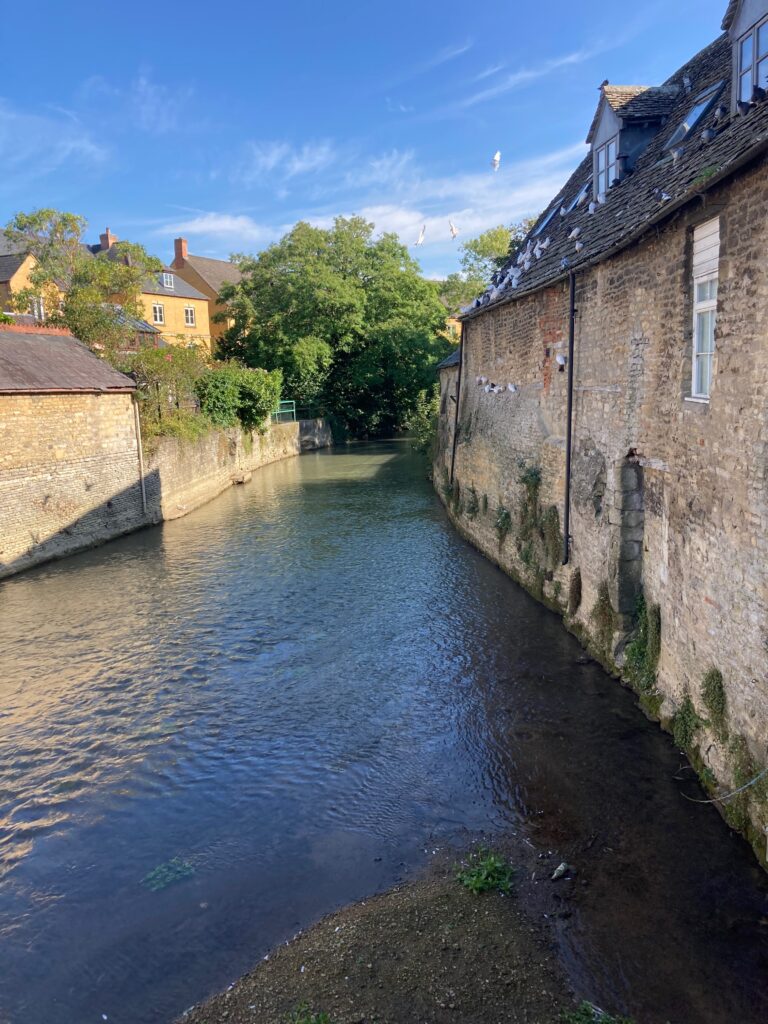
We stood for a little while watching the river flow beneath us and marvelling at the huge number of pigeons gathered on the roof and wall of the house beside it. The river and Google Maps told me we weren’t too far from the place we needed to turn to find the house where Thomas Haley once lived. Before we got much further, we came to the most wonderfully dilapidated house with what must once have been an impressive doorway. The paint might be peeling on the double doors and the glass might be broken but the ornate window above told me this was once the house of an important man. A blue plaque supplied the rest of the information. The house had once belonged to William Smith, a blanket manufacturer and the founder of the Bridge Street steam powered mill which had stood next to the house between 1850 and 1875.
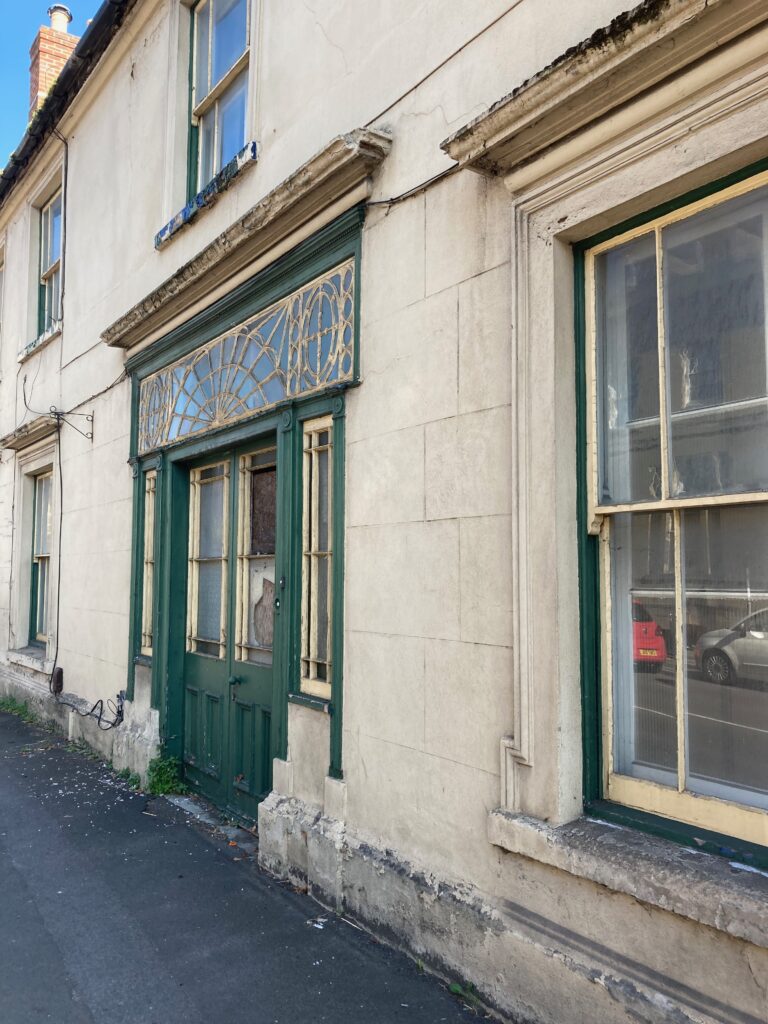
Later I looked William Smith up on an marvellous website called The Witney Blanket Story. He led an interesting life and his steam engine was the first ever used for blanket making in Witney. His company did very well and he diversified into making mops, for which he secured some large government contracts and earned the name ‘The Great Mop Maker of Bridge Street.’ Much as I like a dilapidated building, it seems a shame that his house is so run down now.

Shortly after this we reached the roundabout where we had to turn left onto West End where my great great grandfather Thomas Haley once lived. There was a quick stop to take a photograph of the first sign I’d seen saying Hailey. As this was the village where my great grandfather Elijah Haley was born and is very likely the origin of my family name, it seemed too good an opportunity to miss.

It was a very short walk from the roundabout to the bottom of the road that used to be called Narrow Hill. Today it is called Woodgreen, but one look at it and it’s quite clear how it got its original name. At some time after the 1871 census my great great grandfather Thomas Haley moved his family from West End. The census didn’t give a house number but a stroke of good fortune told me exactly what house it had been. When I was looking at Google Maps trying to work out which house it was based on the number of houses from the corner of West End, I spotted a blue plaque celebrating James Allen Shuffrey an artist. On the census he was listed as living next door to Thomas Haley and his family.

James Allen Shuffrey was born into a family of Woodgreen blanket weavers in 1859, just three years before my great grandfather Elijah. The Shuffrey family were of Huguenot origin and had lived in Narrow Hill since the early eighteenth century. James went to school at the Corn Exchange in Witney and was inspired to paint by a painter, Miss Cropper, who came to the school from Oxford once a week. These were the only painting lessons he ever had. He was one of the first members of the British Watercolour Society and became a member of the Oxford Art Society. Without him, I would not have been able to know with any certainty which house Thomas and his family lived in.

So, thanks to this stroke of good fortune, I was able to find the house where Thomas Haley lived with his family. It was a larger house than I’d expected with an opening that looked like a garage or may have once led to a workshop of some kind. Whether this was an original feature or something more modern I couldn’t tell. Back in the 1880’s though, Thomas Haley was living there and working as a blanket weaver. With him lived his wife, Mary, a blanket picker, his son Joseph, a fellmonger (which is a dealer in skins, particularly sheepskins), my great grandfather Elijah and his younger sister Mary. In 1881, Elijah was 19 and was also a blanket weaver.


We’d found the house we were looking for, now it was time to go to the top of the hill because there was a church there that might just have some Haley graves in the churchyard.
* Thanks to Steve Harris on the Witney Memories Facebook page, I now know the sign said Gloster House. Apparently, to the left of the building is Gloucester Place/Cape Terrace and the building has been a hardware store with a small holding behind, a jewellers and is currently a funeral directors. I knew someone clever would know. Thank you Steve.
If you like what I write and would like to help me keep doing it, you can now buy me a virtual coffee by clicking on the little orange coffee cup at the bottom right. If you’re interested in my historic novels, Plagued is available now on Amazon.
I lived in Witney from 1991 to 1999, only a short time, but i very quickly settled in and made it my home. I worked at the (now demolished), Crawford Collets on Tower Hill, which had a lot of history itself, and employing many local people for many years.
A great piece. Witney has such a wonand rich history. Reading it took me right back. Great photos too.
I’m so glad you enjoyed reading. this was my first visit to Witney but my grandfather, who played a huge part in my upbringing, was born there so it was a poignant visit.
Hi Marie – I am really enjoying reading your work – particularly as I grew up in Witney, only leaving in 2016 apart from occasional periods working abroad. I love its rich history too and following on your journey to uncover your ancestor’s past is magical! I feel as if I am walking with you – with the added bonus that I know all these places well and some hold great memories.
Just one note on the ‘garage’ opening – this would originally have been a ‘tewry’ – passageways that allowed access for the horses and usually leading to stables at the back. These can still be seen all over Witney. Some of these houses are beautiful inside with unexpected grounds beyond – maybe next time you will get a chance to go inside your great, great grandfather’s home. As you can see, I am far from home now so this has made discovering your writing even more poignant! Thank you
I’m so glad you enjoyed walking with me. I did later work out what the ‘garage opening’ was, although I didn’t;t know it was called a twery. I really would love to see inside the house, but I fear it will be a long time before I get the chance to go back. It really was a magical day.
Let me know if you are back in summer at all as Im home all summer and happy to show you around other areas if you wish
I may take you up on that if I get the chance to go back.
What a special day you had in Witney. Fabulous photos.
It was an emotional day for me. I felt as if my grandfather was walking with me.
Hi Marie,
I don’t know if you got to look at the town’s war memorial? There are no ‘Haley’s on there. But I wondered if you knew that the only woman on the memorial (and the most recently added) Lucy Harris, was indeed a Haley?
Her family lived in Newland and she’s buried in Cogged Churchyard.
Hi, I did see the war memorial in the market square but didn’t know what about Lucy Harris. I will have to look into it further. Thank you.
Marie, a superb documentation of a brief but meaningful visit. Thank you very much. I must get my camera out too.
Just for the interest of you and your viewers the Witney Blanket Hall at 100 High Street is open Wednesdays to Saturdays. The store does sell lovely Witney Blankets and general wooden goods but additionally has an excellent free to all blanket museum in the upper story . This tells the story of Witney Blankets through time. It will also help you learn amongst other things the role of teasels, the origin of the term “tenterhooks” and what “point” blankets were and who bought them! Advanced students can look for “Wool” graves locally! There is a cafe at the back of the shop which opens up to a outdoor space with seating on the Windrush (rare in Witney). Strongly recommended visit. I have absolutely no commercial interest or contact with this store.
PS The blankets were so popular with a relative in Chicago that we had to give another for her partner to maintain domestic harmony!
Thank you for that. Hopefully,I will get back one day.