
26 April 2015
Once I’d left Cutty Sark and crossed Deptford Creek, it was a relief to be away from the crowds and walking along the empty embankment. The creek, I found out later, was the site of the Battle of Deptford Bridge, the last battle of the Cornish Rebellion, on 17 June 1497. Created as a Royal Dockyard by Henry VIII, in the sixteenth century, Deptford Dockyard gave employment to many shipbuilders until its closure three hundred years later. In fact, in 1580, Queen Elizabeth I knighted Francis Drake there on board the Golden Hind. The ship remained moored in the creek until it broke up. It seems it a pity it couldn’t have been saved and restored because I would like to have seen it.
One ship that was saved and restored was HMS Belfast. She looked much larger close up. Now a museum ship belonging to the Imperial War Museum, HMS Belfast was launched in 1938 and was part of the British naval blockade against Germany in World War II. She had an illustrious career including escorting Arctic convoys during 1943, a starring role in the Battle of North Cape and the Normandy Landings in 1944. In 1963 the HMS Belfast Trust was formed to save her. Today she attracts over a quarter of a million visitors a year. Sadly, due to lack of time, I was not one of them.
So busy was I admiring the ship, I almost missed an rather interesting statue right behind me. It was a curious looking thing but a little later Googling explained. Russian Tsar, Peter the Great studied shipbuilding at Deptford for three months in 1698. Along with several fellow Russians he stayed at the Deptford Manaor house, Sayes Court, as a guest of diarist John Evelyn. He and his companions got drunk and caused a great deal of damage to the house, much to Evelyn’s annoyance. The house was demolished in 1728, hopefully not as a result of Peter’s antics.


The statue, by Mikhail Shemyakin, could hardly be called a thing of beauty. Erected in 2001, to commemorate the Tsar’s infamous visit, it portrays an impossibly tall Peter with a tiny head standing between a peculiar dwarf holding navigational instruments in his hands and a throne like chair. Apparently Peter was almost seven foot tall but I somehow doubt his head was as out of proportion as the statue suggests. The dwarf is probably a reference to his obsession with genetic curiosities. There are also small cannon at either end of the ensemble but I’m not even going to begin to think about what they might signify. The most beautiful, if bizarre, part of the whole thing were the two gargoyle like end pieces. For a moment or two I considered sitting on the throne but it was soaking wet so I gave it a miss.

A diversion away from the river around the derelict site of Convoys Wharf took me to a tiny gem of a Park. Later I discovered this, along with the site I’d skirted round, was part of the original Sayes Court on the western edge of what was once Evelyn’s estate. Sadly, the remains of the estate did not survive the Second World War. The remaining two acres of garden were redesigned by the council in 1951 and included a playground, paddling pool and toilets.

Sadly, much of the former glory is gone now. The toilets would have come in handy but, if they were there, I couldn’t find them and resorted to the time honoured tradition of hiding behind a tree. Neglected they may have been but there was beauty there with wisteria, choisya and lilac all in bloom and dusted with rain drops just as I like them. The Convoys Wharf site has been derelict for fourteen years but Boris Johnson, the Mayor of London, has approved plans for three thousand five hundred new homes. I hope this also includes a park.


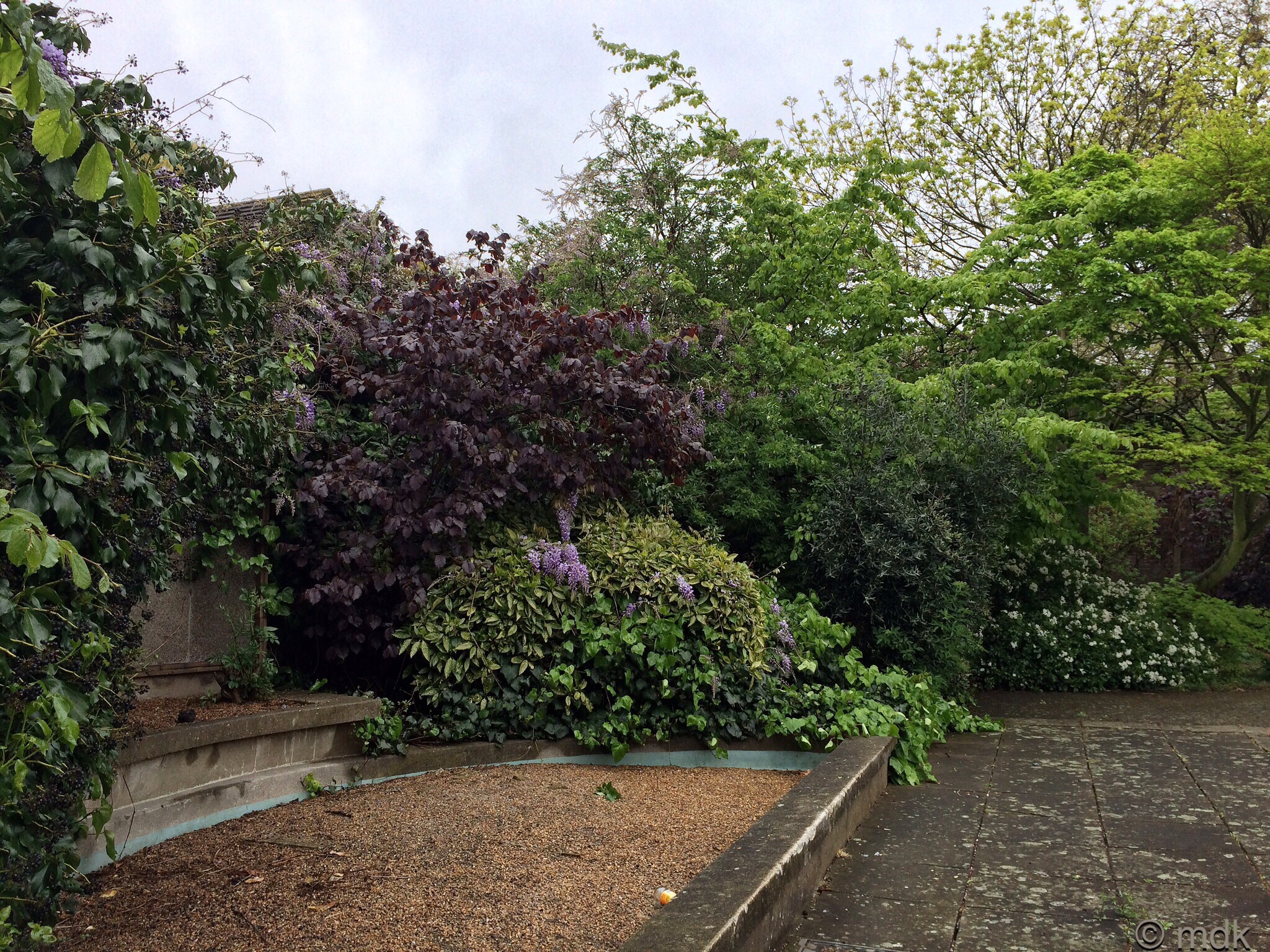

Since I left Cutty Sark I’d been following signs for the Thames Trail, much as I did when I walked from Dorny Lake to Windsor a few weeks ago. Of course this was not a rural towpath it was a city walk along a London embankment but the trail was still worth following. Now it led me from one little park to another, this time Pepys Park, built over the site of a Victualling Yard for the Royal Navy in 1742. Originally opened as a playing field in the 1950’s and called Royal Victoria Yard, in 1968 it was renamed Pepys Park, after Smauel Pepys, secretary to the Admiralty during the reign of Charles II. This is the borough’s only riverside park and has a nature trail area that I’d have liked to explore further.

Back on the embankment again I looked out over the skyscrapers on the east bank of the river and admired the cannons lined up along the water’s edge. There were old barges moored on the river and I smiled when I stumbled across a boundary stone. It seemed an irony that I’d hunted so hard for the stones in my own city and this one had just appeared in front of me without me even looking. It was, the plaque told me, the boundary stone for St Paul’s Parish, Deptford and St Mary’s Parish, Rotherhithe and would also have been the boundary between Kent and Surrey until 1899. Until 1988 it stood on a bridge over nearby Earl Creek but was relocated. If it hadn’t been I’d probably never have seen it.


With boundary stones and barges on my mind I found myself at a dead end and had to turn inland. Pretty soon I had to cross a rather complicated lock. This, I found out later, was part of the Grand Surrey Canal, constructed during the ninteenth century to transport cargo to the Surrey Commercial Docks. As with so many canals this one is no more. All that remains is a small area called Greenland Dock and the South Dock Marina the mouth of which I crossed via the lock.
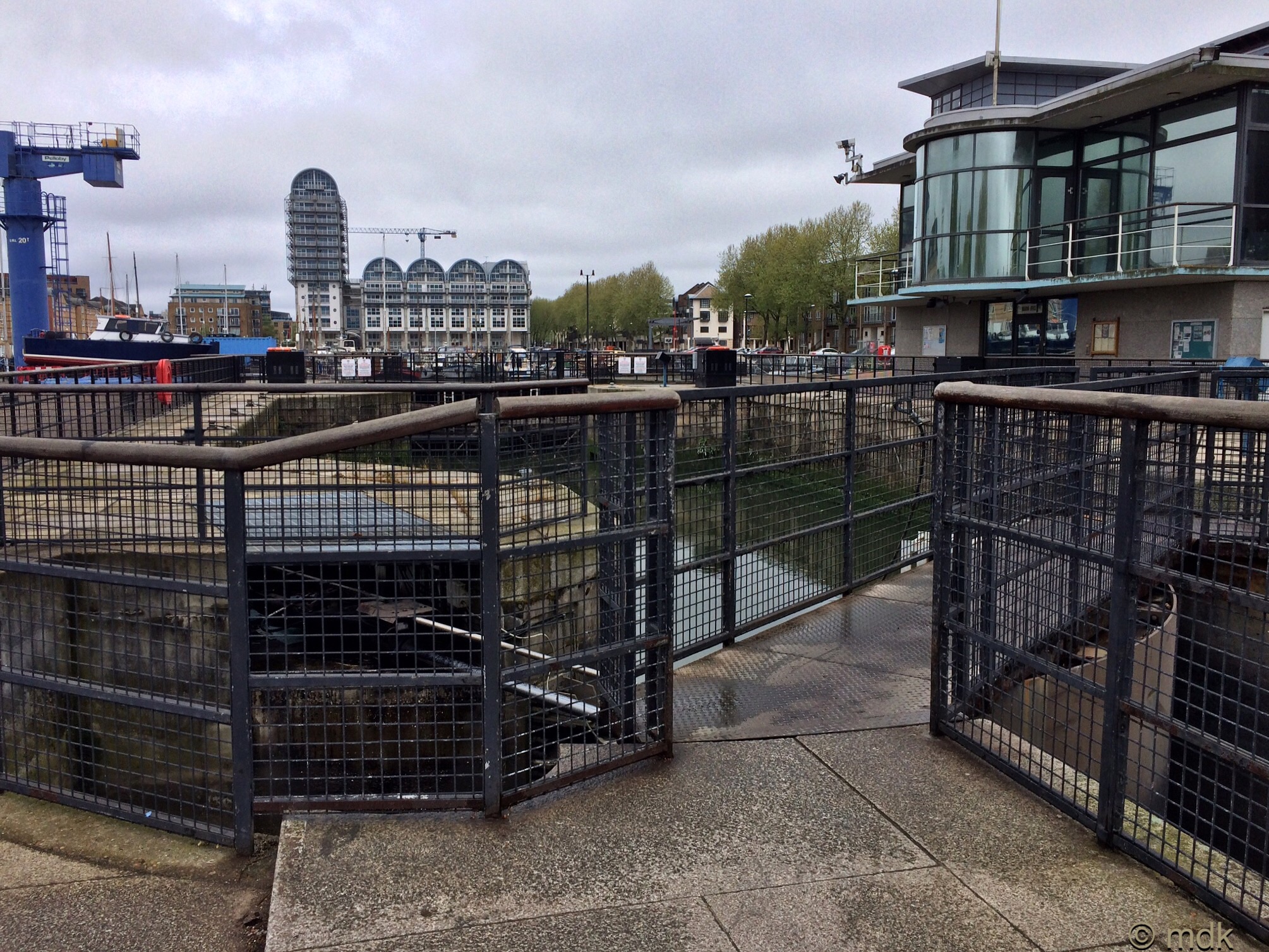


Had I been able to check my map I’d have realised I could carry on straight ahead. As it was I made my way back to the embankment. This turned out to be a happy accident as, when I came to the next dead end, I found a wonderful little building. This was the Tide Gauge House, used by the lock keepers to gauge the level of the tide on the Thames. Of course I then had to turn back inland. Apparently, the canal was used by the coal barges of the South Metropolitan Gas Company to supply the gas works on the Old Kent Road. Maybe the barges I saw on the river were some of those? Much like the Itchen Navigation, the canal was never particularly profitable and was closed progressively between the 1940’s and the 1970’s. It was, however, the first to have canal police called Bank Rangers, who were the forerunners of modern day British Transport Police.

Crossing what had once been the mouth of Greenland Dock I stopped to look at a beautiful lattice bridge. Manufactured in 1904 from bolted cast iron by Armstrong, Whitworth and Co. the two parts could be swung to each side by hydraulic pumps to allow tall ships to pass. Unfortunately it is no longer in use.

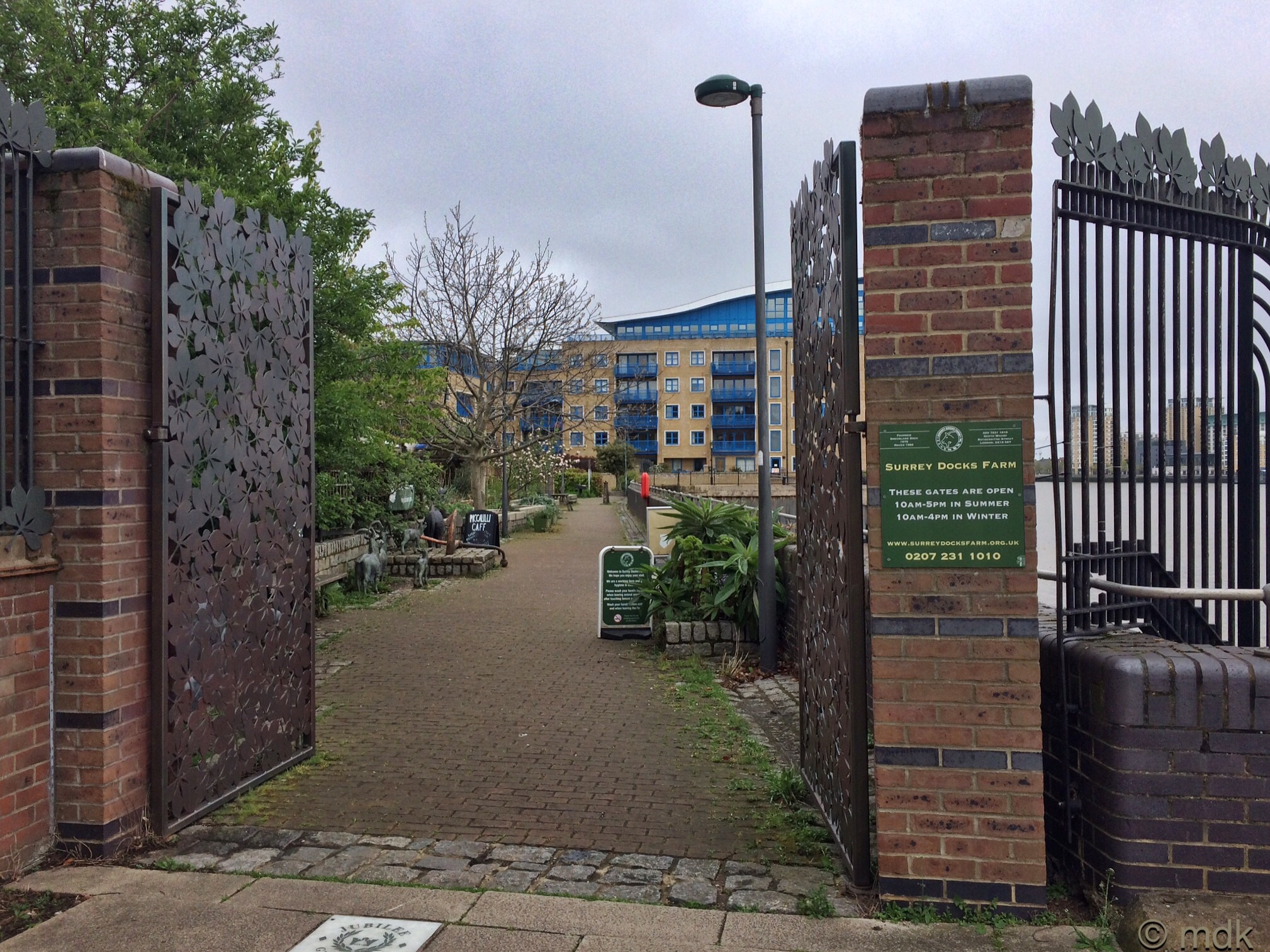
After a short detour through warehouses and modern housing developments the Thames Trail signs took me past another interesting place I’d have liked to explore further. Beautiful leafy wrought iron gates opened onto a small passageway with a sign telling me this was Surrey Docks Farm. Inside the gates were quirky sculptures of farm animals, pigs, goats and a shaggy looking donkey. There were vegetable gardens and, behind hedges, intriguing looking paths. This is a working city farm established in 1975 on a derelict area of dockland once part of the largest shipyard on the Rotherhithe peninsula. It is certainly worth a visit.


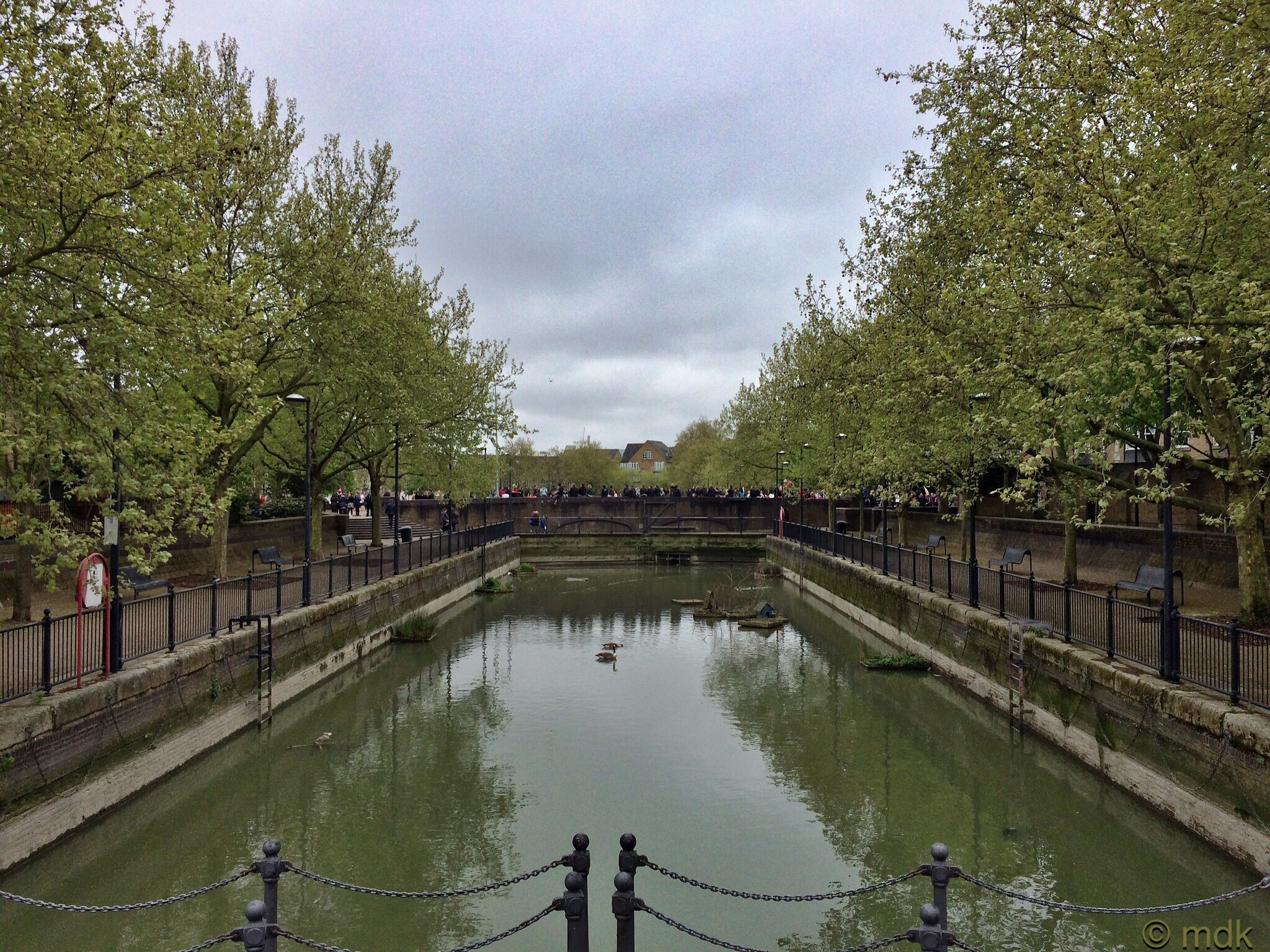
By this time I’d been walking for almost two hours. The Thames Trail now ran behind modern apartment blocks with many signs pointing me back to the embankment only to lead me back the the road again moments later. It felt as if I was walking a crenalated path and I was becoming a little disenchanted with snatched views across the river that only served to show me how little progress I was making. For a while I stuck to the street winding around the tip of the Rotherhithe peninsula until I came to another lock. This was, apparently, the first lock entrance to the Grand Surrey Canal and now seems to be a small but pretty pond with an odd model house and, when I was there, a couple of ducks.
Behind this was Surrey Water but, as I could hear and see the marathon, crossing the road behind it, I made a hasty retreat. Yes it would have been nice to spot Commando running but, let’s face it, a pig flying past was more likely. Shortly after this I missed my golden opportunity to get to the other side of the river. I knew the Rotherhithe Tunnel was there somewhere and, if I missed it, I’d have to cross the river at Tower Bridge with the marathon right beside me.
With no working map I was stuck so I stopped a passing dog walker and asked him where the entrance was.
“Where is your car?” he asked, giving me a rather odd look.
“I don’t have one, I’m walking,” I admitted, feeling as if I’d just owned up to being a complete weirdo who probably didn’t own anything more complicated than a few stone tools and some flint for making fire.
“It’s for cars only,” he explained, “and you’ve already gone past it.”
Feeling bitterly disappointed I thanked him and carried on towards Tower Bridge, which, from my next view from the riverbank, seemed to be about twenty miles away and moving further by the minute. If only the phone network hadn’t been down I’d have been able to Google it and find out you can walk through the tunnel, although no one does because it’s pretty polluted when it’s full of cars. Given the extra miles I had to walk and the fact there was unlikely to be much traffic on a Sunday morning when the marathon was on, it would have been worth turning back for.

Mind you, if I had crossed via the tunnel I’d have missed the most wonderful sculptures a little further on. For a while I’d been walking feeling a little cross about the bridge situation when I came to a small park called King’s Stairs Gardens and there it was, a little bronze group by the river wall at Bermondsey. It put me in mind of Alice in Wonderland and was called, so the plaque told me, Dr Salter’s Dream. Dr Salter was a local philanthropist and social reformer and he sits on a granite bench near his wife Ada and daughter Joyce while, on the wall, a wonderful cat looks ready to pounce. The bridge in the background didn’t look any nearer though.


It was around then I began to get a little panicked about the time. Nothing had gone right so far and I’d been walking for two and a half hours without a stop. Tower Bridge was still some way off and, even when I’d crossed I had a lot further to go to reach the Mall, if I could find it without a map. Time was running out, or so it felt. It was time to put my head down and march for all I was worth.
Wow! Such wonderful sculptures abound in your world!! Love this and can’t wait for the next!!
There were certainly more than I expected.
Hi Marie, wonderful post. I walked that stretch of the Thames Path earlier this year. Funny how we see different things, I missed or can’t remember Peter the Great, but I do remember – and loved – Dr Salters Dream. Just in case you need it the future – Surrey Docks Farm has a free toilet 😉
I almost missed Peter the Great myself, too busy looking at the river. Wish I’d known about the loo though.
I used to walk to the Albert Dock through a pedestrian tunnel.
I did hear about that after the event.
Well, just think of all the calories you burned. You could have celebrated with cake and ice cream after all that and still been on the plus side.
That peter the great statue is really bizarre.
There was a little cake later I have to confess, but only a little. The Peter the Great statue really is odd isn’t it?
Your photos always amaze me – thank you, Marie!
It was an interesting walk, even if it wasn’t one I meant to take.
Nice to see all the spring flowers out!
It certainly is
I agree, that statue of Peter is most peculiar! The pig family though is so cute! What a walk, and I love the way you tell the history behind everywhere you went, even the park and Boris Johnson’s plans for the area. Your flower photos as always are exquisite.
The whol walk would have been easier if I could have accessed my maps but the marathon meant the mobile networks were down most of the day.