23 February 2016
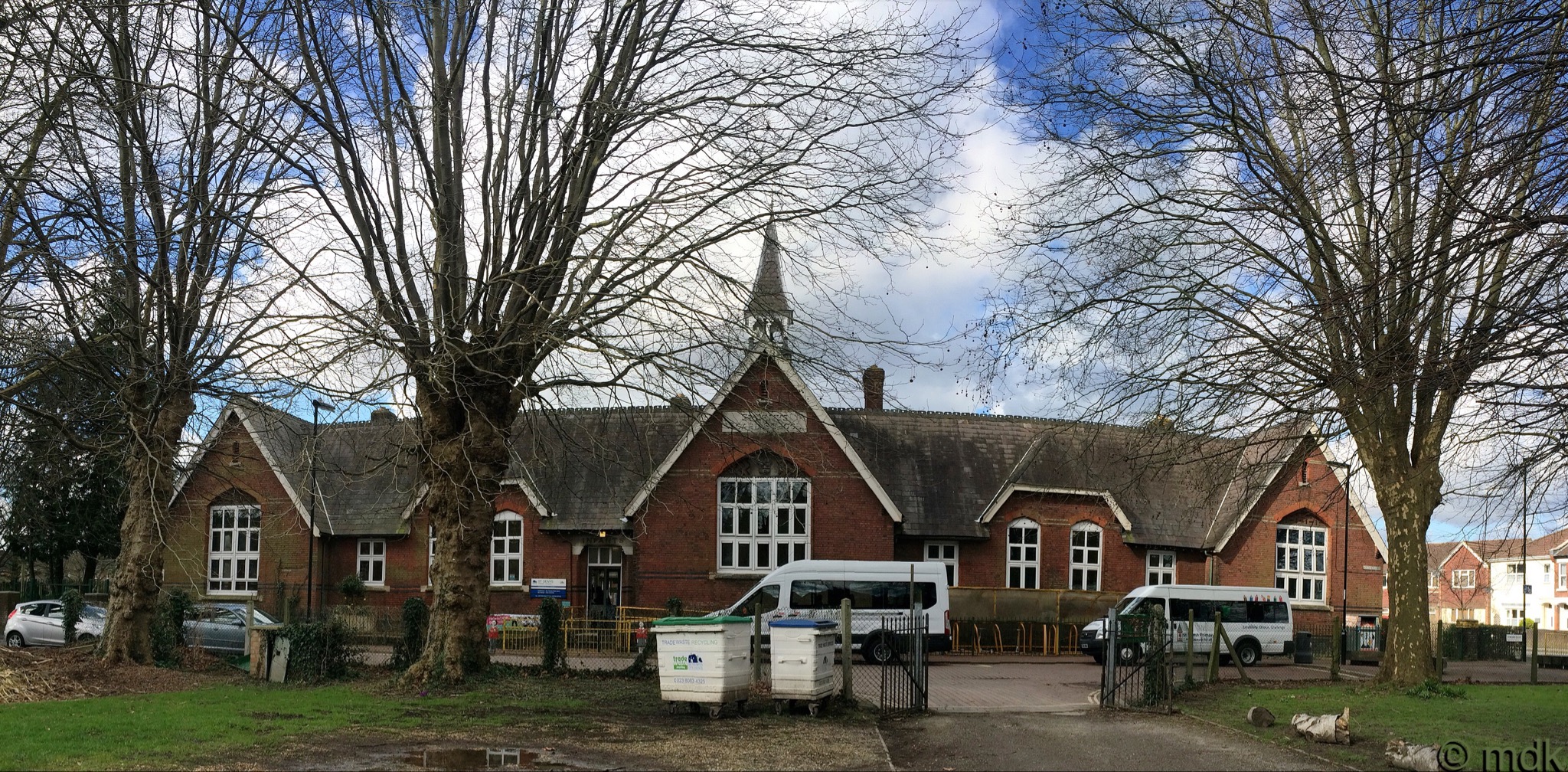
Feeling pretty pleased with myself for discovering far more of the old priory than I’d expected I left St Denys Church and was immediately face to face with the next interesting building. These days most school buildings are modern boxes of steel and glass. A few old style red brick school buildings remain and St Denys has one of them.
In 1870 William Forster’s Education Act saw the beginning of locally elected School Boards and the first Board Schools began to spring up all over the country. The school in St Denys was one of these, built in 1881 of red brick in a style that would become a familiar sight all over the city. Most have since been replaced with modern buildings, which may well have better facilities but lack the charm of these old Victorian schools. Commando spent his formative years in such a school in Woolston.


As it was mid morning on a school day I quickly snapped a few pictures and was on my way. It would have been nice to have a look around inside but, short of posing as a parent with a prospective pupil,mthat isn’t going to happen. Before too long I was crossing the railway bridge and standing on tiptoe to peer over the parapet towards the station.

At this point there was a quick detour to Portswood to buy supplies from the giant Sainsburys. There are a lot of interesting buildings nearby and I was tempted to have a closer look. There were still things to see in St Denys though so Portswood would have to wait for another day.
Walking back along Osbourne Road I was in very familiar territory. My first flat was nearby in Belmont Road and every morning I dashed down the cutway beside it to St Denys Station to get the train to work. Since then Thomas Lewis Way has been built, changing the face of the area considerably, but the cutway is still there bringing back memories of those early morning and late evening walks.


Surprisingly, the Dolphin Pub has survived too. It was built in 1907 and, from the evenings I spent there, I remember it as being a traditional spit and sawdust type pub. These days I believe it has live music and a beer garden which might explain why it’s still around. With a bag of shopping and other things to see there was no time for more than a passing glance before I headed along the new bridge towards the station, although I did get a good view down into the beer garden.


Back in the days of rushing catch my train to work the cutway continued on the opposite side of Osbourne Road and passed behind the pub to the front of St Denys Station. Standing on the bridge looking down over the new road I tried to remember how it had been before but it was impossible. Surely there was another road here and houses but the name of it escaped me and, as with Bitterne and the bypass, it felt as if someone had moved everything around while I wasn’t looking.
These days the front of the station building looks a little forlorn with the new road so close and cars whizzing past at fifty miles an hour. There is no more walking through the station door, flashing a ticket at the station master and saying good morning. The only access now is over the new footbridge.

The first railway station was built in 1861 after local residents complained how far they had to walk to catch trains. Until then the nearest stations would have been in the centre of Southampton. Originally it was called Portswood Station and was north of the St Denys Road bridge but, when the Netley branch line opened in 1866, a new station was built. This is the station I looked down at from the bridge. In was renamed St Denys in 1876 to avoid confusion with Portsmouth.
Much like St Denys itself, the station is a place people pass through or change trains at more than they stop, being at the junction between the London Waterloo mainline and the West Coast Line to Portsmouth. For this reason it’s larger and busier than you’d expect this small village to warrant with four platforms and tracks. Much like Woolston Station, St Denys Station is lucky to have survived. On 14 August 1940 a bomb fell on the line just ahead of a train. The train couldn’t stop in time and was derailed.

From the bridge I could see Horseshoe Bridge along the tracks. This was where I was heading. First, there were a couple more things to see. The bridge comes out on Adelaide Road right next to the South Western Arms, another pub. Obviously, with so many passengers waiting for connections, a pub on either side of the tracks would have been a welcome sight and, like the Dolphin, this was opened in 1907 and is still open. It’s an unremarkable building and not one I’ve ever visited but it’s probably very welcome to weary travelers.


More interesting is the Junction Inn at the junction of Adelaide Road and Priory Road, close to the foot of Horseshoe Bridge. The building dates from the 1860’s and features on the ninteenth century drinking map of Southampton. This document in the Southampton City Library archive might make interesting reading. When I worked at the Bus Mines I passed it most days but I’ve never been inside although I’ve admired the lovely green painted arches of the ‘eyelid’ windows and the balcony with its stone columns. Apparently, it has an interesting period fireplace so maybe I should put it on my list of places to visit. The football stadium is just a fifteen minute walk away so the pub is popular with football supporters along with sailors and fishermen using the slipway in Priory Road.


Horseshoe Bridge was ahead of me and, with it, my tour of St Denys had come to an end. Of course, this was just a snapshot of the place and I’m sure there were things I’d missed but it was time to head home with my shopping. The river was a pleasing mix of blue and green as I looked across at the path by the Millennium Flats.

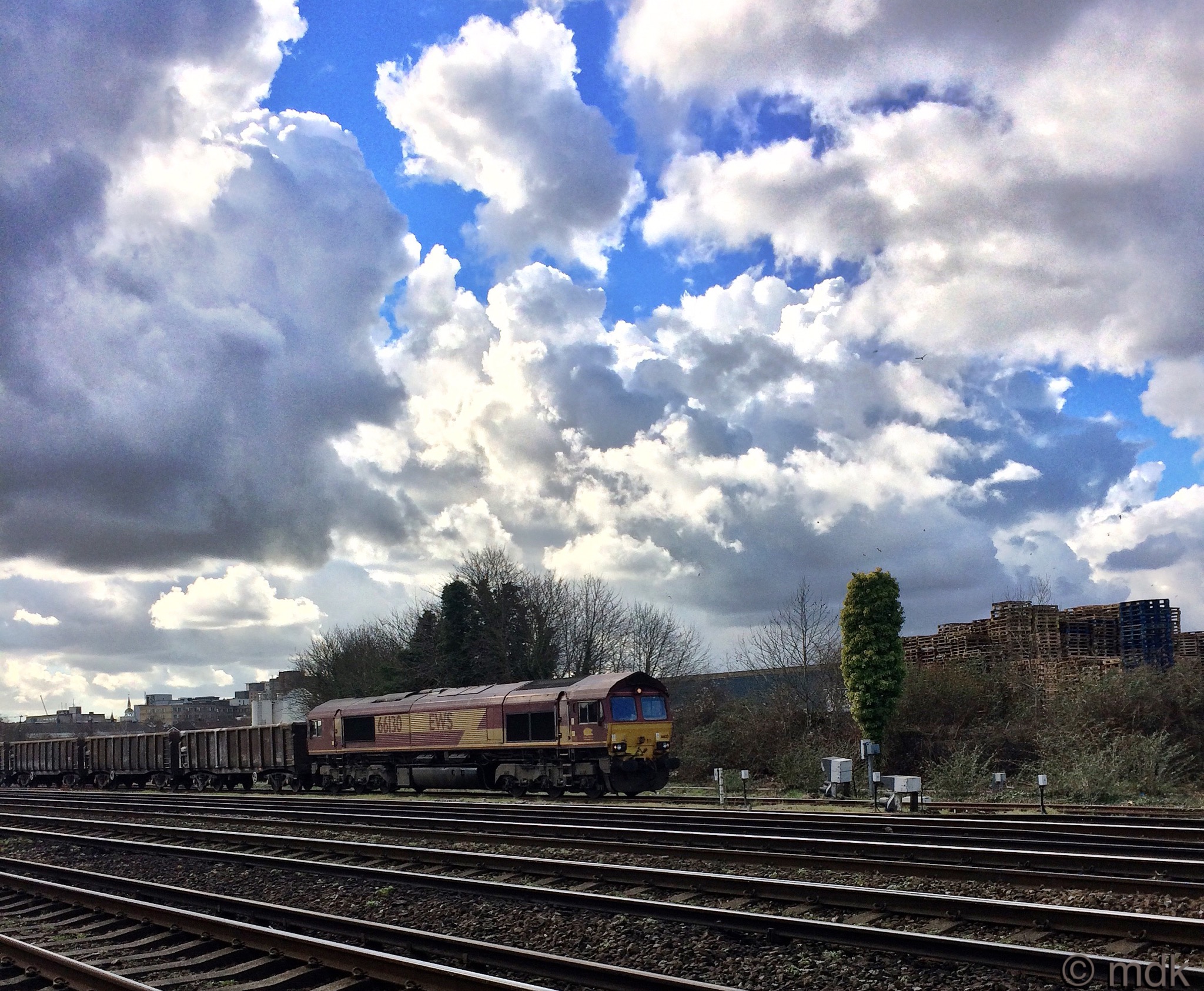
The sun seemed to put a spotlight on the arch of Horseshoe Bridge as I walked down the slope. Oddly, the Boardwalk was completely bereft of any spring flowers. About half way across I stopped to look back. There across water reflecting sky and clouds was the blue line of the railway bridge and the tangle of boats I looked down upon so often from Cobden Bridge. Behind me, through the railings, a goods train sat waiting for a passenger train to pass. The rails sang to tell me it was on its way.


The tide was high and, when I got to the corner, the hippie ship was almost overwhelmed. A mother and child were feeding the swans so gulls flew all around me, some coming close enough to make me duck. At the big stones I stopped for one last look back towards St Denys. Swans, gulls and this year’s cygnets bobbed on the water, the red hull of Dutch Courage gleamed in the sun like a beacon and a cloud of black smoke drifted over Bitterne Park. Someone had a bonfire by the look of it. St Denys is a small place, often overlooked, but after my morning walk I felt I knew it a little better and had uncovered a few of its secrets.

Please see my copyright information before you copy or use any of the above words or pictures.
I loved the water and sky in your final photographs, so artistic.
Thank you. It’s hard to take a bad photo of the river.
Fabulous post! So many reminders of my first 12 years.
Glad to bring back good memories Mike.
Your pictures and text are always so wonderful. Every time I visit here I think you must find a wider audience. The London Chamber of Commerce, tourist guide books. Thanks for turning your lens toward the past and present in your lovely isle.
You never know Marian. Someone might want to employ me one of these days 🙂 it’s a pleasure wandering around finding things out.
Great tour again lovely photos and thanks again for booklet on your pappy and my mum x
Thanks Kathleen. I’m glad you liked the booklet.
That school building reminds me of the one I started school in. My father went to school in a one room schoolhouse, which is still standing. You don’t see many of those anymore.
Sometimes I’m more amazed by what I didn’t see than what I did. It’s always surprising to see what we’ve missed, even though we’ve walked by it again and again.
My first two schools were modern buildings but my last was based on a Victorian school with new bits added. One classroom was actually a Nissen Hut. It was freezing in winter. I think the familiar places often hold the biggest surprises. Perhaps it’s because we walk through so often we don’t really pay attention.
Plenty of good railway pictures here. Excellent.
I had a feeling you would like them 🙂