
A while ago, I began to tell you about our trip to London in May. Recent events meant I never finished the story, so I suppose it’s time to get back to it. When I left you, it was 4 May. The day before, we’d had a few issues with trains and visited the Imperial War Museum. This was our only full day in London, and I had a long list of things to see and do, most of which I knew we wouldn’t have time for. So far, we’d seen the monument to the Great Fire of London, stopped at Pudding Lane, and walked up a steep hill to look at a church that wasn’t there. After a bit of backtracking, and some grumbling from Commando, we finally found the church down a narrow alleyway I really should have spotted at the start. The alleyway was called St Dunstan’s Lane, and the church was St Dunstan in the East.

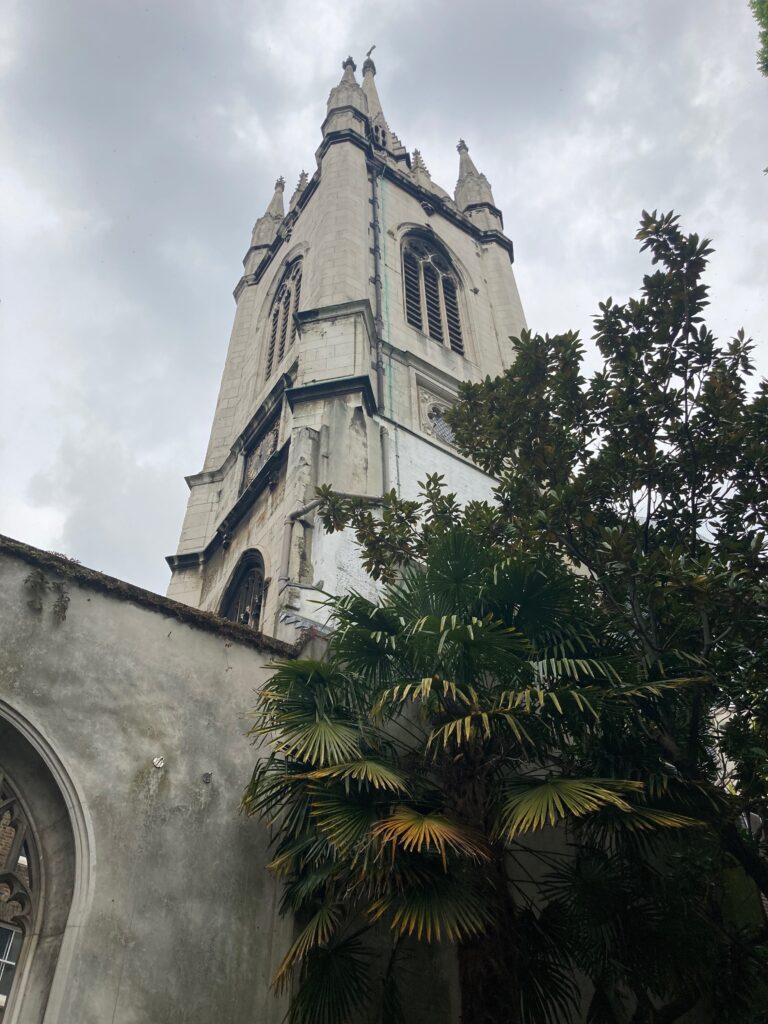
St Dunstan’s is an ancient church, built in around 1100, but added to in the late 1300s and repaired in 1631 and 1818. Being so close to Pudding Lane, it’s hardly surprising that the Great Fire damaged it badly. Unlike many of the surrounding wooden buildings, the stone church wasn’t completely destroyed, and over the next five years, it was patched up. The gothic steeple with four flying buttresses, designed by Sir Christopher Wren, was added in the late 1600s.

Interesting as this was, it was not my main reason for wanting to visit the church. My most recent WIPs are set in the early 1940s and the Southampton Blitz has been a big feature of my research. Southampton was a Luftwaffe target because of the docks, the Supermarine factories and Vosper Thorneycroft’s shipyards, and it was one of the most badly bombed towns in the country. Of course, London bore the brunt of Hitler’s rage. Between 7 September 1940 and 11 May 1941, it suffered the worst blitz in the country. For fifty-seven consecutive nights, it was bombed. Londoners slept in the underground to avoid the bombs and incendiaries, but 43,000 civilians were still killed and countless others made homeless. In 1941, the church that had risen from the ashes of the Great Fire suffered a direct hit. Only the north and south walls and Wren’s steeple survived.

There would be no rebuilding or repairs this time. With so much of London destroyed, the post-war rebuilding was a long slow process, and St Dunstan’s was left in ruins. The ruins were designated a Grade I listed building, and in 1967, the City of London Corporation came up with the idea of turning the bombed-out shell into a public garden. It was to be a memorial to those who lost everything and a testament to the resilience of Londoners to survive against the odds. The gardens were opened in 1971.
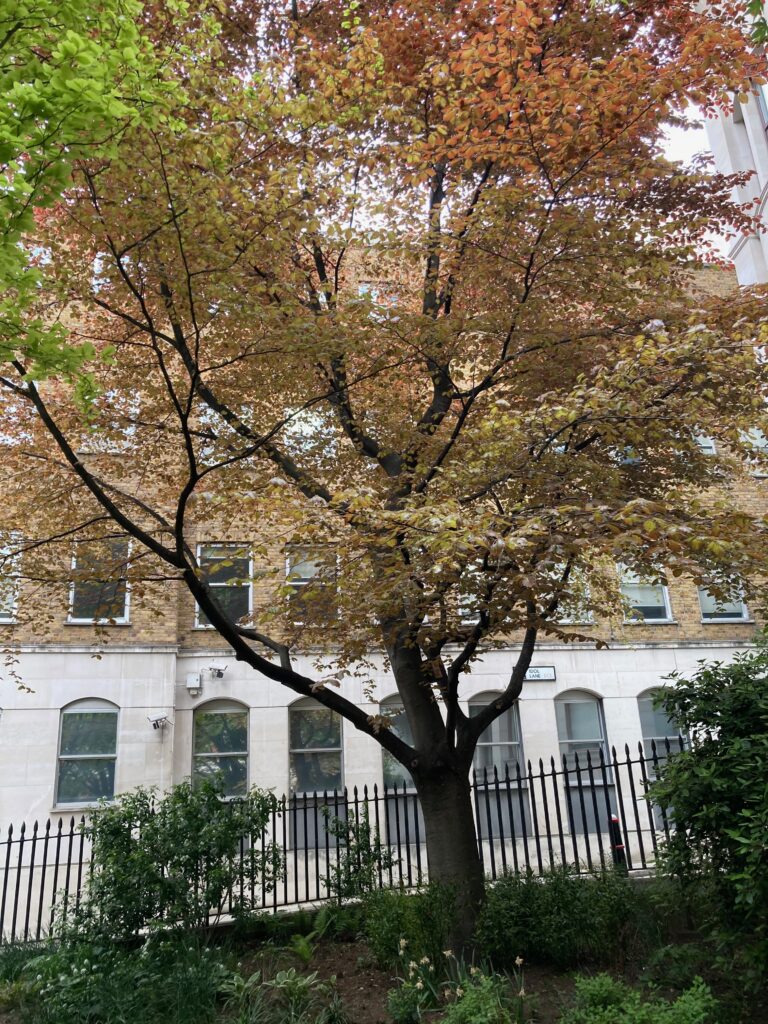
I read about the church when I was looking for unusual things to see on our London trip. It reminded me of Southampton’s Holyrood Church. The church, built in 1320 on Southampton High Street, was destroyed in November 1940, during one of the worst raids the town experienced. The Luftwaffe dropped eight hundred high explosive and nine thousand incendiary bombs that night. Most of Southampton town centre, the docks and seven churches were damaged or destroyed. Holyrood was left in ruins, much like St Dunstan’s. In 1957, the Holyrood ruins were dedicated as a memorial garden to the memory of merchant sailors who once worshipped there.
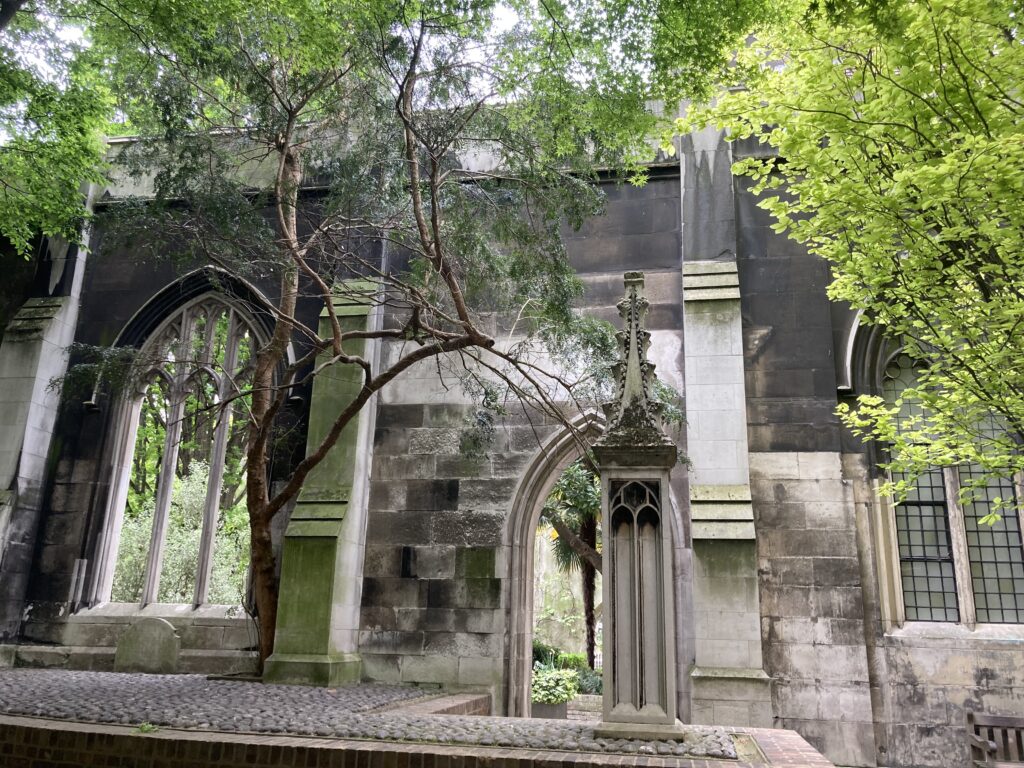
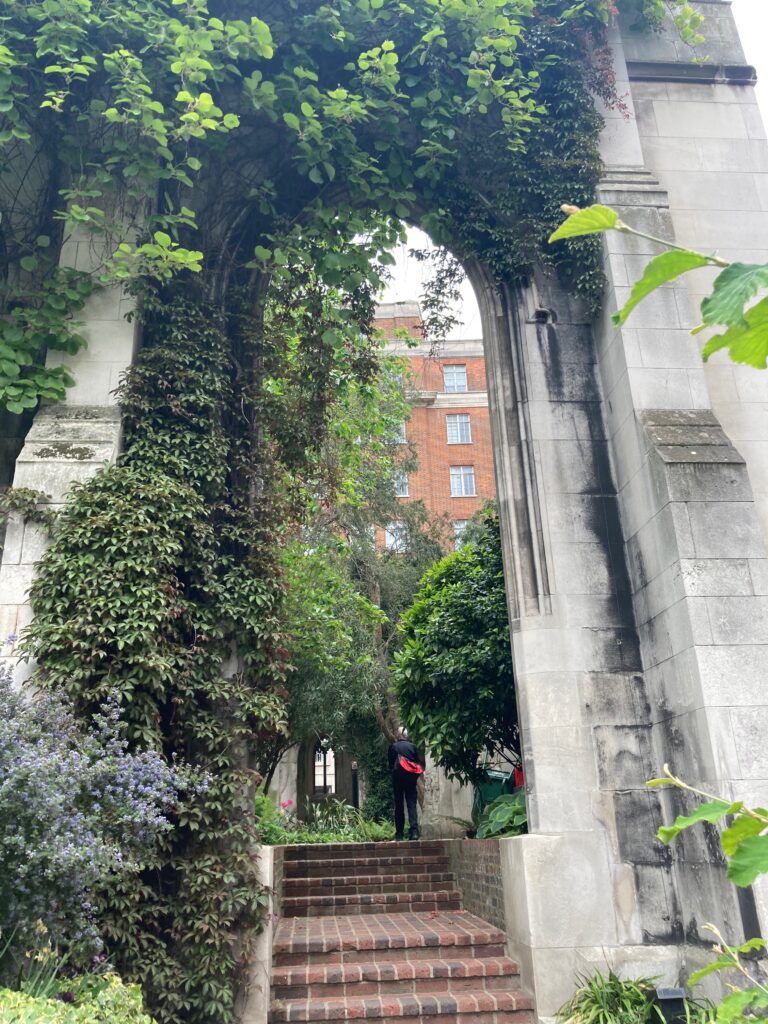
St Dunstan’s is far greener than Holyrood. The London Architects and Parks Department designed and planted the St Dunstan’s garden. They used creepers to clamber over the ruined stonework, exotic plants and trees to form an oasis of green, and seating to give people the chance to sit and reflect. Unlike Holyrood, which stands amid the hustle and bustle of Southampton High Street, St Dunstan’s is tucked away between the modern high-rise buildings that replaced the other bombed London landmarks. Within the church walls, it’s hard to believe you are in the middle of London.

St Dunstan, the church’s namesake, had a history of survival against the odds, too. He was born near Glastonbury in around 909 and studied under the Irish monks who occupied the ruins of Glastonbury Abbey. As a child, a fatal illness struck him. It isn’t clear what the illness was, but he made a miraculous recovery against all odds. By all accounts, he was a precocious child, devoted to learning, and an accomplished and artistic craftsman. His parents sent him to the ancient church of St Mary, where his skills and devotion saw him appointed to the court of King Athelstan.

He soon became a favourite of the king. Favouritism breeds jealousy, and his rivals hatched a plot to disgrace poor Dunstan. They accused him of witchcraft and black magic and the king banished him from the court. Not content with this, his enemies waylaid him as he left. They beat him, bound him, and threw him into a cesspool. Somehow, he crawled out, freed himself, and went to Winchester, where he served the Bishop. The bishop tried to persuade him to become a monk, but Dunstan declined. Shortly after his arrival in Winchester, his body erupted in a plague of boils so bad they thought he had leprosy. In was probably a reaction to being thrown into the cesspool, but it changed Duncan’s mind and he took holy orders in 943.

He then returned to Glastonbury, where he built a small cell, five feet by two and a half feet, against the old church of St Mary. He lived there as a hermit and continued to study, play the harp, and work as a silversmith and in the scriptorium. Legend has it that the devil temped him, but, as the folk rhyme goes,
St Dunstan, as the story goes,
Once pull’d the devil by the nose
With red-hot tongs, which made him roar,
That he was heard three miles or more.
Dunstan became famous as a musician, illuminator and metalworker. When King Athelstan died in 940, the new king, Edmund, made him a minister of his court in Cheddar. Once again, jealousy reared its ugly head, and Dunstan’s enemies persuaded the king to send Dunstan away. Before he could, The King went on a stag hunt in the Mendip Forest. During the hunt, the king chased a stag towards the Cheddar cliffs. The stag and hounds ran over the cliffs and it seemed as if the king and his horse would follow. At the last moment, the king promised God he’d make amends to Dunstan if his life was spared. The horse immediately stopped at the cliff edge and King Edmund was true to his word. He made Dunstan the Abbot of Glastonbury and promised to help him restore Divine Worship.

As Abbot, Dunstan began to recreate monastic life, rebuild the abbey, and establish a Benedictine monasticism in Glastonbury. Within two years, King Edmund was assassinated. His successor, Eadred, also favoured the spread of Catholicism and moral reform. For nine years, Dunstan refused to leave the new king’s side, despite being offered the office of bishop at Winchester and Crediton.

Things took another bad turn for Dunstan in 955, when Eadred died. His son Eadwig was headstrong and wild. On the day of his coronation, Dunstan found him cavorting with a noblewoman and her mother when he should have been at a meeting of the nobles. When Dunstan confronted him, it ended badly. Dunstan was once again out of favour. The king plundered Dunstan’s monastery, and he was in fear of his life.

Dunstan fled to Flanders, where Count Arnulf I welcomed him and sent him to the Benedictine Abbey of Mont Blandin, near Ghent. Meanwhile, in England, things were not going well for Eadwig. The Mercians and Northumbrians revolted, drove him out, and installed his brother Edgar on the throne. Edgar became king of the country north of the Thames, while those to the south of the river remained faithful to Eadwig. Edgar recalled Dunstan and made him Bishop of Worcester in 957. The following year, he was also made Bishop of London. In October 959, Eadwig died, Edgar was accepted as King of Wessex and Dunstan became archbishop.

These were troubled times for the kings of England. In 978, King Edward was assassinated at Corfe Castle, and Æthelred the Unready became king. It was Dunstan’s last state event. When the new king took his oath, Dunstan criticised the violent act that had made him king and prophesied that misfortunes would befall him. His influence ended, and he retired to Canterbury. During his retirement, Dunstan worked hard to build and restore churches and schools. He defended widows and orphans, promoted peace and enforced respect for purity. He also practiced his crafts, making bells and organs, correcting books in the cathedral library, as well as teaching in the cathedral school.
On the vigil of Ascension Day 988, a vision of angels warned that Dunstan would die in three days. On the feast day, Dunstan said mass and preached three times. At the last address, he told the congregation he was about to die and wished them well. That afternoon he chose a spot for his tomb, then went to bed. On 19 May, he assembled the clergy. They celebrated Mass, and he died. His final words were, ‘He hath made a remembrance of his wonderful works, being a merciful and gracious Lord: He hath given food to them that fear Him.’ The English people accepted him as a saint shortly after his death and he was formally canonised in 1029. He is the patron saint of English goldsmiths, silversmiths, locksmiths, jewellers, and armourers.

I have to come clean and admit that I knew nothing about St Dunstan until I looked for different things to do in London and stumbled upon this beautiful ruined church. In fact, I thought he was the patron saint of blind servicemen. It seems I am not alone in this. The confusion comes from the fact that Blind Veterans UK used to be called St Dunstans. The charity was founded during the first world war to help blinded soldiers. In 1915, they opened a hostel for blind soldiers and sailors in London. When numbers grew, an American Business man, Otto Kahn, loaned his house in Regent’s park to be used to help the men learn to live with their disability. It became the headquarters of the charity. The house was called St Dunstan’s because the projecting clock of the church of St Dunstan’s in Fleet Street was relocated there when the church was demolished. The charity took on the name of St Dunstan, although it was changed to the present name in 2012. You can find more information about the charity here.


Despite the shaky start, and all the unnecessary hill climbing, the church was well worth a visit. It really is an oasis of tranquillity hidden away in the middle of London. The crumbling fire blackened walls and the glassless windows are a reminder of what London suffered, not only during the blitz, but during the fire in 1666. It is also a symbol of hope. Even in the worst of circumstances, peace and beauty can rise from the ashes of defeat and despair.


If you like what I write, and you’re interested in my novels are available now on Amazon in paperback, on Kindle and via Kindle Unlimited. Check out my Amazon page here and my Goodreads page here. If you would like to help me keep writing, you can now buy me a virtual coffee by clicking on the little orange coffee cup at the bottom right.
What a fascinating account of Dunstan’s life. I’d heard of him but only from the Glastonbury connection. The ruins are very beautiful and if I ever get another visit to London will be a must see on my list of things to do. Thanks for sharing your photos.
It was an interesting story and was partly why I wanted to see the church. The building itself was far better than I’d expected. I can highly recommend a visit.