
On Easter Sunday 2020, I decided to venture further afield. Since the end of March all my walks had been short, and, for the most part, not very sweet. This had little to do with Michael Gove’s suggestion to limit outdoor exercise to one hour per day, or even the busybodies who set themselves up as lockdown police and general finger pointers at anyone they felt wasn’t toeing the line. To be frank, the real reason longer walks felt out of the question was more about the shops, cafes and, more importantly, loos, being closed, not to mention the crowds in the parks and pretty places. If I was going to be stuck with walking the streets, I figured I might as well try to find some interesting ones.
My old ‘two bridges’ route seemed ideal and I set off feeling strangely optimistic. My good mood was bolstered when I came to the little railway bridge and saw spring flowers bursting from every crevice and bank. It felt like a timely reminder that Mother Nature will always find a way to overcome any obstacle. The virus and the restrictions wouldn’t last forever.

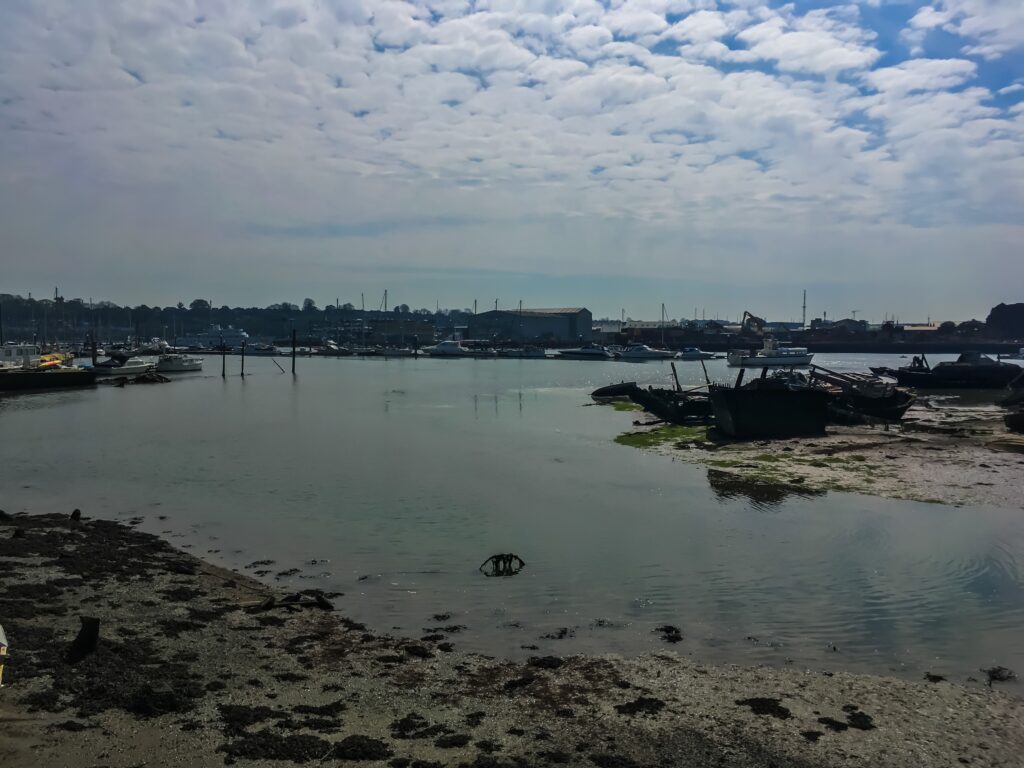
Then I reached the river. The tide was out and the old wrecks sat on islands of weedy mud in a blue green sea. The mackerel clouds revealed patches of blue and the sun sparkled on the rippled water. Apart from the squawking gulls and the lapping river there was no sound and I hadn’t seen a single soul so far. As I approached the road I saw it was completely empty of cars. This was more like it.


Much as I enjoyed the silence and solitude, it did seem a little eerie, especially the deserted road. Even the sky was quiet and empty of planes. It felt like an echo of another time, when flying was for birds and traffic meant the clip clop of hooves and the rumble of cart wheels. Back then, the bridge I was about to cross was a toll bridge, although of course, it wasn’t the same bridge at all back then. The first bridge, built in 1799, was made of wood, the second, built in 1889, was iron, the modern bridge is the third incarnation. The toll was finally lifted in 1929, but the majority of traffic was still horse powered and the airport was a grassy field with a handful of hangars.

On the far side of the bridge I turned left to follow the line of the river, although I could no longer see it. My mind turned to the lockdown restrictions. There was less than a week left before they were due to be reviewed but rising numbers were being hospitalised with the virus. It didn’t look as if they would be lifted. For the most part, people seemed to be complying, although I’d heard a few moans and complaints about civil liberties. In the circumstances the lockdown rules seemed quite reasonable to me. They were certainly far less restrictive than the rules in place during the pandemic in 1918. Of course, those rules were not about Spanish flu at all.
The Defense of the Realm Act, or DORA as it was known, was introduced on 8 August 1914, originally to help prevent invasion and keep morale high during the Great War. The act imposed censorship on journalism and the letters sent home from the front line, and gave the government the power to requisition any land it needed. The penalty for breaching the regulations could be severe. The first person to be arrested under the act was John Maclean, a Scottish Marxist and revolutionary who had ‘uttered statements deemed prejudicial for recruiting.’ He was imprisoned and lost his job as a teacher. Over a million arrests were made and eleven people were actually executed as spies under the terms of the act.
As the war progressed DORA was amended. Some of the things added seem reasonable, such as the ban on talking about naval or military matters in public places or spreading rumours about military matters. Others appear odd at first glance. For instance, it became illegal to buy binoculars, trespass on, or loiter near, railway lines, bridges, or tunnels, melt down gold or silver, light bonfires, set off fireworks, fly kites, ring church bells, feed bread to horses or chickens, use invisible ink, or whistle for a taxi. Weird as they may be, each of these rules had a purpose. The threat of spies was felt to be a real danger to the war effort, hence the ban on binoculars, invisible ink and loitering near possible targets for zeppelin raids. Bonfires, fireworks and kites could easily be signals to the enemy, and church bells and whistles could be mistaken for air raid, or invasion warnings.
Perhaps the most hated restrictions were those pertaining to food and drink. By the spring of 1915 pub opening hours had been restricted, people were banned from buying drinks for others and drinks were actually watered down. This was an attempt to increase productivity and reduce drunkenness. Ironically, at the same time, the men on the front line were being given a rum ration each morning and before they were sent into battle. U-boats were sinking ships, which meant supplies were short, particularly of grain to make bread. Flour was mixed with soya or potato flour to make War Bread, a dark coloured and rather unpleasant alternative to real bread. By 1917, rationing had been introduced.

As I walked past the deserted football stadium, I wondered what the people who grumble about civil liberties today would make of the old war time restrictions? There is no doubt that not being able to see friends and family, go to the pub, go on holiday, or gather for events is hard, and some businesses have suffered badly. However, looking back certainly puts these things into perspective. The homes we are stuck in have all manner of wonderful gadgets the people of the last pandemic could only have dreamed of. Back then there was no internet, no TV and most ordinary people didn’t even have a phone, or a radio to entertain them. The shops, when we have to venture into them, are well stocked for the most part. When they’re not, it’s because of panic buying rather than real shortages. The furlough scheme has saved many people from losing their jobs and helped some businesses to survive. No one is being forced to go to war. No one is sitting waiting for an official letter to say their loved one has been killed or wounded. No zeppelins are flying overhead dropping bombs and no U-boats are sinking ships. Maybe we should all count our blessings?
So far, this walk certainly felt like a blessing. Not a single person had passed me, not even a car. On the ground beside the stadium I spotted a slightly battered, Christmas bauble on the ground and smiled. One of the best things about walking is finding strange things in strange places and wondering how they got there. Not every question has an answer and that is part of the fun.

The weather was another bonus, April was turning out to be warm and sunny. In fact, by the time I reached the American Wharf, I was positively boiling. Thankfully, the river wasn’t too far away and I knew it would be cooler once I reached it. As I made my way to the steps of the bridge I spotted another of those little blessings I love to find on a walk. A pretty little plant, a geranium I think, had somehow made a home in one of the drainage holes at the base of the steps. Amid all the grey concrete it made a bright splash of colour.


The walk across the Itchen Bridge is a little under half a mile, not counting the steps on either side. At its highest point it is ninety two feet above the water. On a wet windy day it’s a blustery and unpleasant walk, but on a hot day it feels heavenly. The wind cooled me and blew my hair around my face. One of the other problems of lockdown was a slightly overgrown, shaggy look as my last haircut appointment had been due just as restrictions started. Irritating as it was, a bit of extra hair was hardly a disaster.

When I reached the far side I climbed the steps down from the bridge glad of the shade of the overhanging trees. In fact I loitered there for a while, enjoying the coolness. What a good job DORA is not still in force, or I might have found myself in trouble. Then I walked through the long round tunnel back to the road, wondering if the light at the end might be an omen, or just a metaphor.


The final blessing on this walk was a garden full of pansies and daffodils. It might not have been the prettiest of walks. There were no trails, no woodland, just roads, pavements and a couple of bridges. It was the best lockdown walk so far though and a lesson in making the best of things because you can’t always get what you want.

I think I had hatched my 10k plan by Easter. Before lockdown I’d been increasing my long run with the aim of getting to a half marathon. I was two weeks away from it in the middle of March, but there was no chance that I could run ten miles plus in less than an hour. I switched all my runs to 10k so that I’d have a good base from which to get to a half marathon when things eased a bit. I was trying to enjoy people’s front gardens, which mostly worked and continues to work.
gardens kept me sane. I missed the woods and trails so much though. I still do because I haven’t really ventured back to a lot of my favourite walks yet.
Blessings counted……….continually, rain or shine.
I always try. I don’t always succeed.
What an enjoyable walk and very interesting information about DORA. I can understand all the restrictions imposed too – and yes, I think we should all have been counting our blessings as opposed to moaning about everything, though it was certainly worse for some folk than others. I can’t imagime what it would have been like in a high rise flat in the centre of a city with children to try and educate / keep amused.
I think your little plant is Herb Robert which is indeed a variety of geranium (geranium robertianum). It has many common names incluidng ‘Stinking Robert’, ‘Pink Pinafores’, Bachelors Buttons, Granny-thread-the-needle and Death Come Quickly”. There is a wealth of folklore about it too and it also comes in a white variety.
I agree, lockdown must certainly have been harder for some than others, but, even so, previous generations had a lot more to worry about. I think you’re right about Herb Robert. The older I get the more plant names escape me.
Lovely to be reading your blog again, I pounded the pavements even more than usual during lockdown amd often thought about things I’ve learned from reading these.
Thank you. It’s been a strange journey for sure. I’m glad some of my ramblings inspired you.
So enjoyable reading Marie. Very interesting about the 20thC pandemic and that the general public were not given much information.
I walked every day, sometimes alone or with a friend and found the quietness very eerie. The bird song was loud and clear with very little traffic noise. Thank you again for your blog.
I’m glad you enjoyed it. The lack of information in 1918 was mostly down to the war. The government were frightened the public would panic and the soldiers would too if they were worried about their families at home. The neutral Spanish were the only ones who reported about it in the news at first, hence the name Spanish flu. The British press either said nothing or played it down until things were so bad they couldn’t cover it up any more. The bird song when walking, even on the streets is something I remember and miss now the traffic is back. Imagine if there were no cars, how peaceful the would would be.