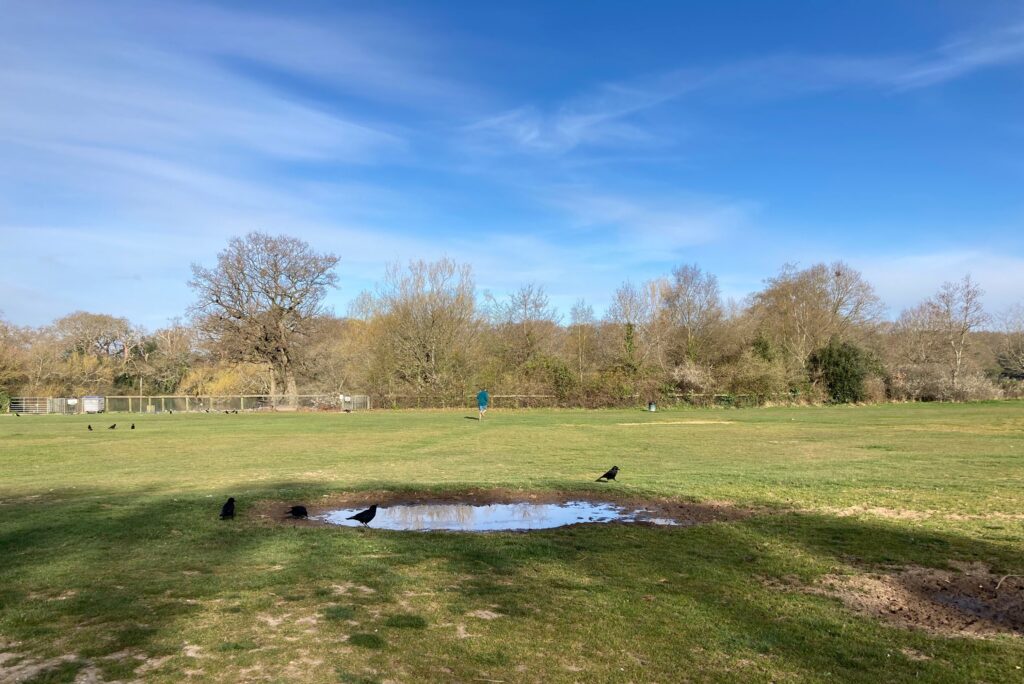
The first parkrun of April 2022 began with puddles, crows and a walk in the Old Cemetery. In a strange way, it felt like an echo of the December parkrun I told you about last time, except it was far warmer and the book hurtling towards publication was a different one. Land Fit For Heroes was with Hayley at Hangar47, just as Plagued had been in December. The only difference to my thoughts about the process was that it now felt as if I’d handed over my second born child. A walk in the cemetery in the early morning light was just the thing to take my mind off all the things that could go wrong. To be honest, I had no idea exactly what could go wrong, but that didn’t stop me worrying about it.
A wander in the cemetery is always a cure for my worries, especially on such a beautiful morning with sunlight slanting through the trees and little robins playing hide and seek with me. It’s a place filled with stories to spark the imagination and names from a bygone age. Some of the names and stories wander their way into my books in one form or another. Other graves I pass bear names that feel like old friends now. On this beautiful April morning, one in particular caught my eye.

The grave of Ethel and Hector Young is one I’ve mentioned before, but I’d stumbled upon them in my research since I last passed this way. I might have been worrying about Land Fit For Heroes, but I’d actually been working on a manuscript covering a different period in Southampton’s history. I’d been researching the Southampton blitz, and this was where I’d seen Ethel’s name. The inscription on the gravestone says that Ethel Young ‘fell asleep’ on 24 September 1940, but the actual story is far less peaceful. The date gives a clue why.

On 24 September 1940, there were two air raids on Southampton. The first lasted just forty-eight minutes, between 13:30 and 14:18, and was concentrated on Northam and Woolston. The targets were the gas works and Electricity power stations in Chapel and the Supermarine Works in Woolston. The bombs began to fall almost as soon as the sirens sounded, giving people very little chance to take shelter. The Supermarine workers dashed for the surface shelters on the edge of Peartree Common, but they didn’t find the safety they sought. The damage to the factory was minor, but a stick of bombs fell on the railway embankment and one shelter was hit. Many workers were buried alive and more than twenty died.

The second wave began at 16:25 and continued until 18:00. As far as I can tell, this was when poor Ethel died. Woolston and Northam were hit again, but this time bombs fell further afield too. St Barnabas Church, on the corner of Rose Road and Lodge Road, was one of the buildings destroyed and one woman, Eva Thompson died there. Other bombs fell in Bassett Avenue. One of them landed on 5 Bassett Avenue, the home of Hector and Ethel Young. Ethel and her neighbours, Mary Ann Olive and Catherine Sarah Thresher were killed. Three days later, The Echo ran an obituary for Ethel Berta Young, calling her ‘a well known and popular figure,’ and mentioning her voluntary work for the Royal South Hants Hospital, the Southampton Youth Committee and the British Legion. Her death must have been a terrible loss, not just to Hector, but to the whole town.

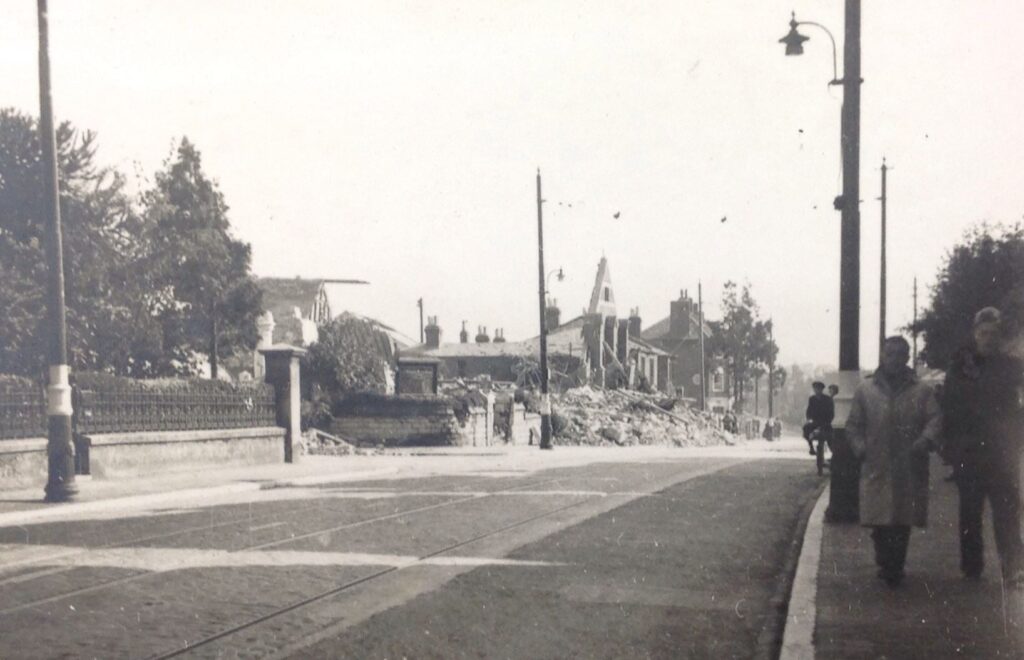
The robins I saw earlier might have been illusive, but the magpies in the cemetery weren’t shy in the least. I’m not a particularly superstitious person, but I make an exception for magpies, so I was glad to see a pair. You can never be too careful with magpies. Many years ago, on a trip to the supermarket a single magpie flew in front of our car as we pulled onto a large roundabout. The words of the old saying sprang into my head. At least the first words did. I’d got as far as ‘one for sorrow,’ when the car in front of us stopped dead for no apparent reason. There was no traffic in front of it. There was also no time to think ‘two for joy,’ or for Commando to brake. Luckily the accident was minor, no one was hurt, but ever since, Commando and I have saluted every magpie we see. Perhaps that’s why magpies crept into Plagued as bad omens.

Perhaps it was the two magpies who brought me the next interesting grave on my walk. It was certainly one I’ve never noticed before. It wasn’t the name, Jacques Theodore Barrett, that caught my eye, although it is a splendid name. Neither was it his wife, Asterie Genevieve, another wonderful name that deserves to be in a story. It was the name of Stanley Henry Cross, or rather the hospital ship Asturias, on which he died on 21 March 1917. This was a ship I’d come across when I was researching Plagued. The story is a sad one.

RMS Asturias was built in Ireland in 1908 for the Royal Mail Steam Packet Company, operating between Southampton and Buenos Aires. In 1914, she was drafted into the Navy as a hospital ship, bringing wounded home from battlefields in Gallipoli, Egypt and Salonika. It was a dangerous journey. On 1 February 1915, she was hit by a torpedo from a German U-boat, but the torpedo was a dud. In 1916, J.R.R. Tolkien came back to Blighty on her, suffering from trench fever during the Battle of the Somme. Her luck ran out on 20 March 1917 en-route from Avonmouth to Southampton. She was torpedoed by German U-boat UC-66. This time the torpedo wasn’t a dud and she was beached near Bolt Head. Luckily, she wasn’t packed with wounded at the time, but thirty-one died and a further twelve were missing. One of the dead was poor Stanley Henry Cross, who’d been working as a greaser on the ship.

A little further along the trail I found the ground carpeted with what I thought at first were snowdrops. A closer look told me they were probably wood anemones, but the effect was much the same. At this time of year, the flowers are another thing that draw me to the cemetery. Every week there seems to be something new springing up.

My next discovery was the grave of John Bertie and Myra Strange. The inscription was rather worn so there wasn’t much of a story, but the name Strange made me smile, because it was a name I’d chosen for a character in Land Fit For Heroes. Hopefully, John Strange was blessed with better looks than poor Sam in my book, who had bright red hair, a receding chin, eyes that looked in different directions and ears that looked as if his mother might have used them to carry him around. Don’t blame me. I may have created him, but he popped into my head looking exactly that way and insisted on staying that way no matter what I did. As it happens, I became quite fond of him, despite his looks.

I was still smiling and thinking about poor Sam as I headed towards the cemetery gate. The blossom on the blackthorn made my smile even wider. Spring had definitely arrived on the Common, even if the trees hadn’t quite got the idea yet. My morning walk had worked well as a distraction from my worries about Land Fit For Heroes, and I couldn’t help thinking that Jacques Theodore and Asterie Genevieve were telling me they had a story to tell.


If you like what I write, and you’re interested in my novels are available now on Amazon in paperback, on Kindle and via Kindle Unlimited. Check out my Amazon page here and my Goodreads page here. If you would like to help me keep writing, you can now buy me a virtual coffee by clicking on the little orange coffee cup at the bottom right.