
Known locally as the Ditches, Southampton’s East Street and Canal Walk play an important part in my latest novel, A Dish Best Served Cold. East Street dates back to the days of the medieval town when it led from English Street (now the High Street) to Bag Row (now St Mary’s Street) and linked the medieval town with the Anglo-Saxon settlement of Hamwic. Of course, modern-day East Street is nothing like the street in my novel. The Southampton blitz saw to that.

Originally, East Street was bisected by the medieval town walls and residents would have passed through the East Gate to get from one end of the street to the other. The gate was smaller than the Bargate, but was defended by a heavy door, portcullis, and a bridge crossing the town ditch. The bridge was rebuilt in 1670 using stone from the demolished Southampton Castle. Above the gate was a chapel dedicated to St Mary. In Tudor times, East Street was famed for brothels, known as stews, because each had a heated room for vapour baths. The Corporation tolerated the stews until December 1544, when a series of fights and violent incidents finally outweighed the money they made from fining the prostitutes and the customers who came from outside the town. The brothels were closed, and the women banished.
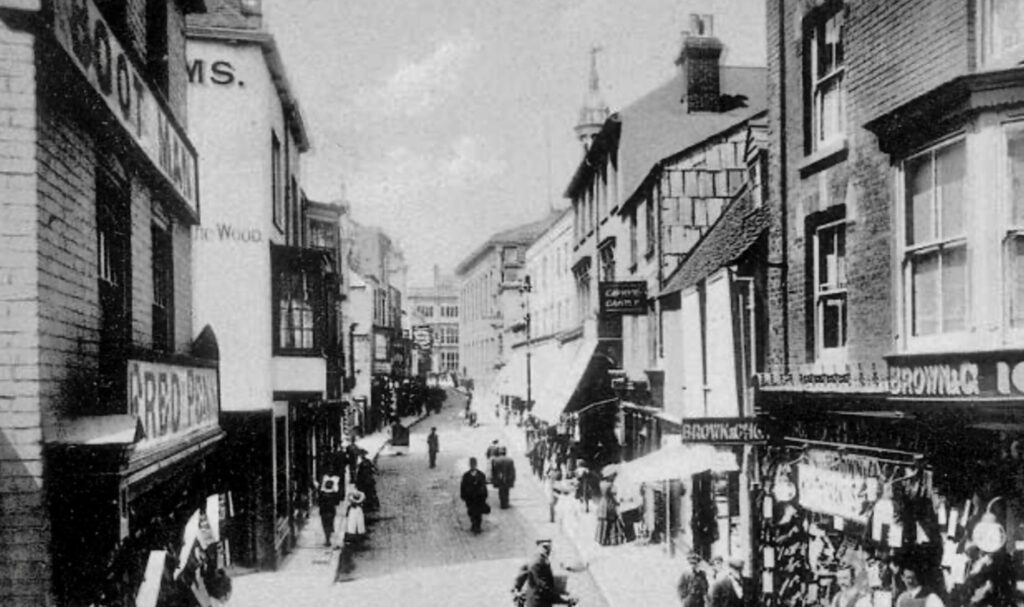
In 1749, a spring called Chalybeate Water was discovered, and Southampton became a fashionable spa town. Increasing traffic saw East Gate demolished in 1775, but the memory of it remained. Into the nineteenth century, the part of East Street that had once been within the town walls was still called Upper East Street. Over the next hundred years, East Street became a popular place to shop. Pleasant two and three-story buildings lined the street, with the most elaborate being at the top end, nearest the High Street. One of the first silent film cinemas opened at 79 and 80 East Street in 1909. Called the Picture Palace, it became the Standard Electric Theatre the following year and later the Standard Cinema. A second cinema opened in 1911 at 113a East Street in a former Baptist chapel. Both had closed by 1935, unable to compete with the larger, more luxurious cinemas on the High Street. Even so, East Street remained a hive of activity.

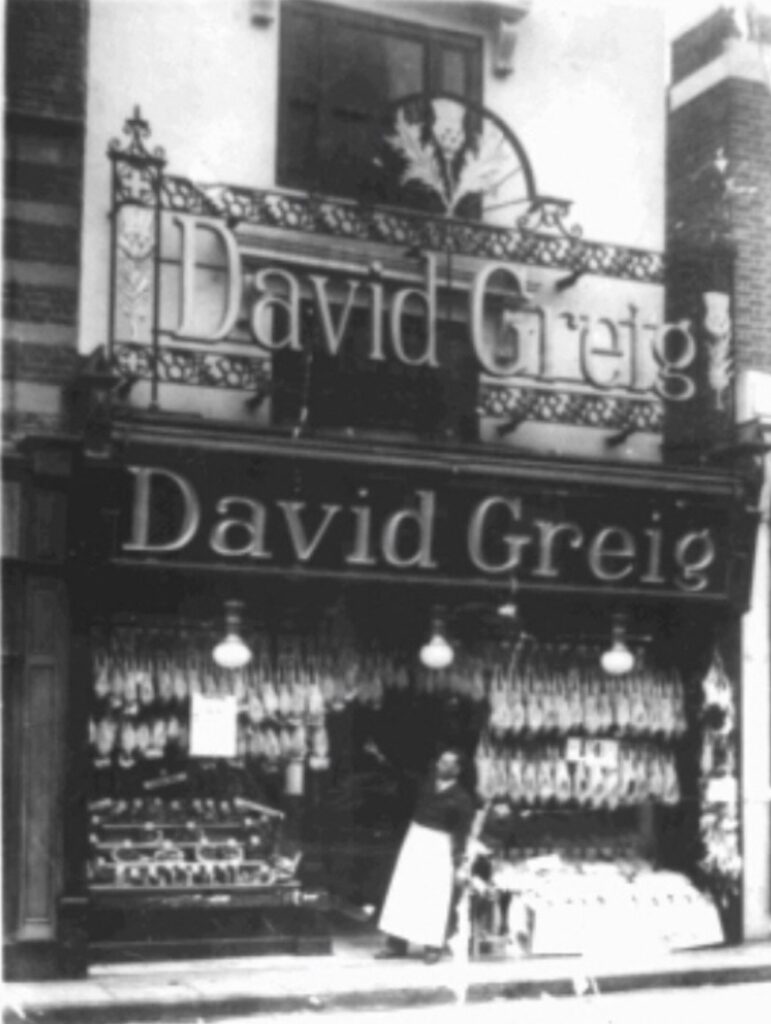
There were shops of every kind: tailors, bootmakers, grocers, butchers, sweet shops, bakers, watchmakers, chemists, fishmongers and just about anything else you could possibly want. Each Saturday afternoon, shoppers crowded the street looking for a bargain either in the shops or on the hawkers’ barrows outside. Amongst the shops was a Woolworth’s store and a Mark’s and Spencer Penny Bazaar boasting nothing over a penny. At the bottom of the street, Edwin Jones was the first Southampton department store and a local institution.
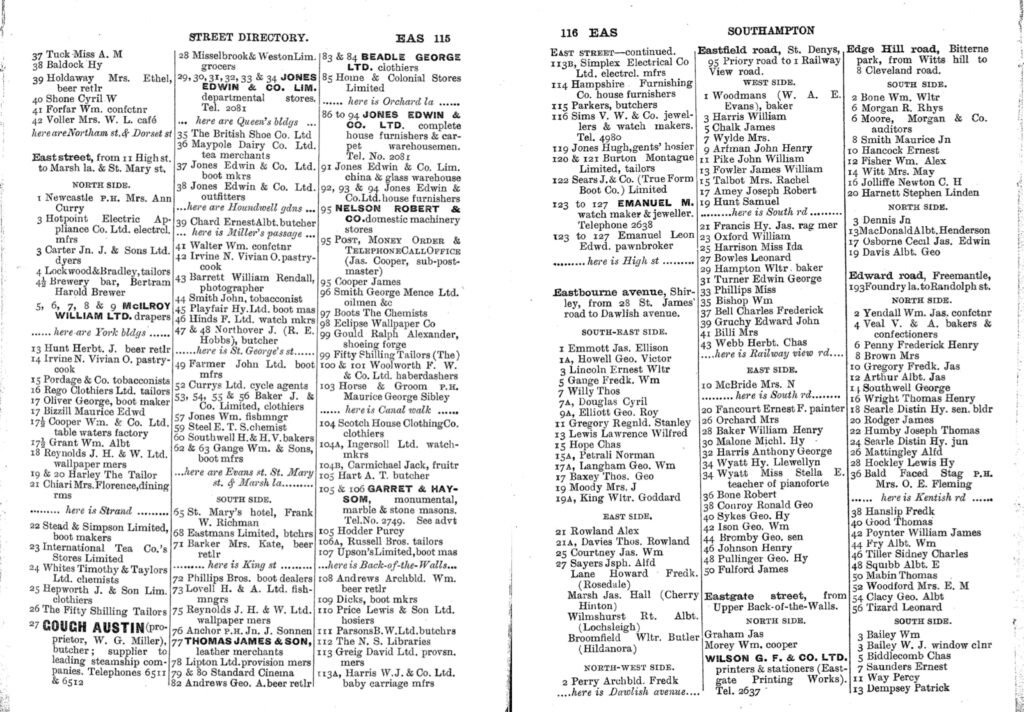


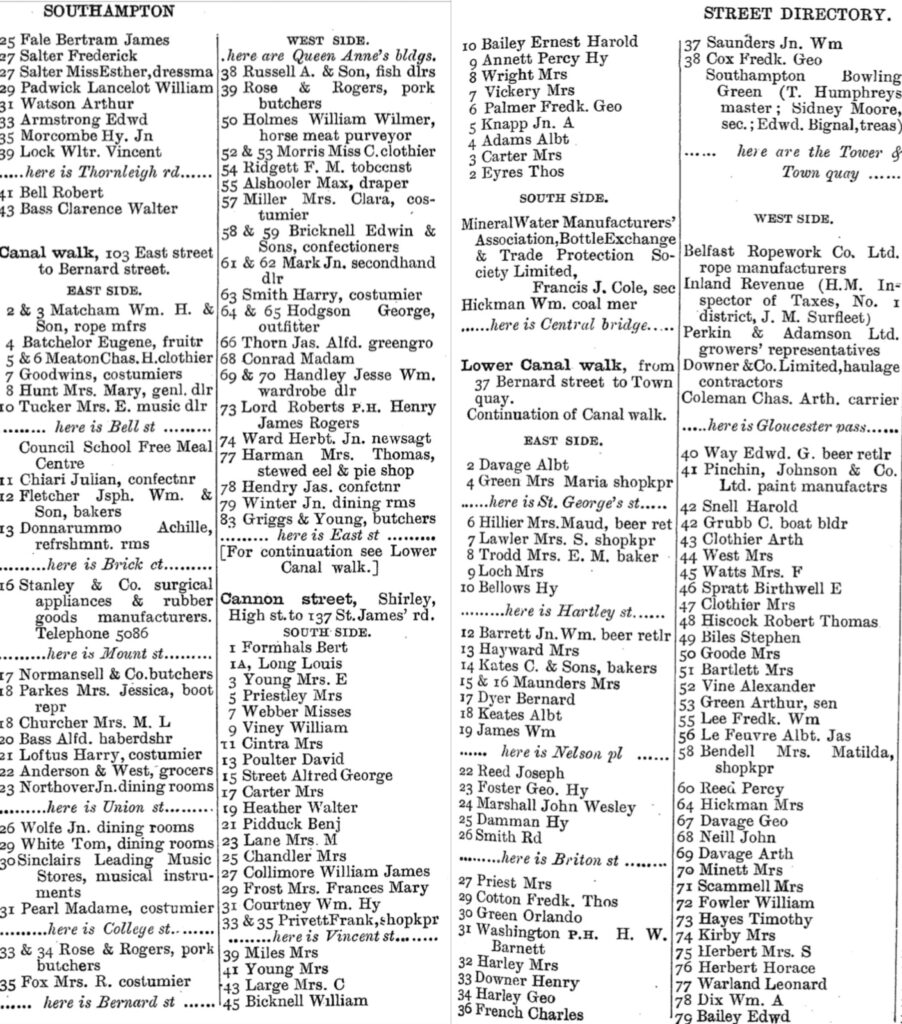
Running off of East Street, Canal Walk had its own collection of small but distinctive businesses. This narrow road runs the full length of the medieval walled town, where the old moat or town ditch used to be. Hence the name, the Ditches. In the late 1700s, there were plans to convert the town ditch into part of a canal linking Salisbury and Southampton. The plan included a tunnel under the Marlands branching south towards the docks and east to Northam. Building work began in 1795, but costs rocketed, and the project was abandoned in 1809. The remains of the canal were built over, leaving nothing but the name. For a while, Canal Walk was a fashionable neighbourhood, but by the mid-1930s, working-class families had converted most of the houses into businesses.
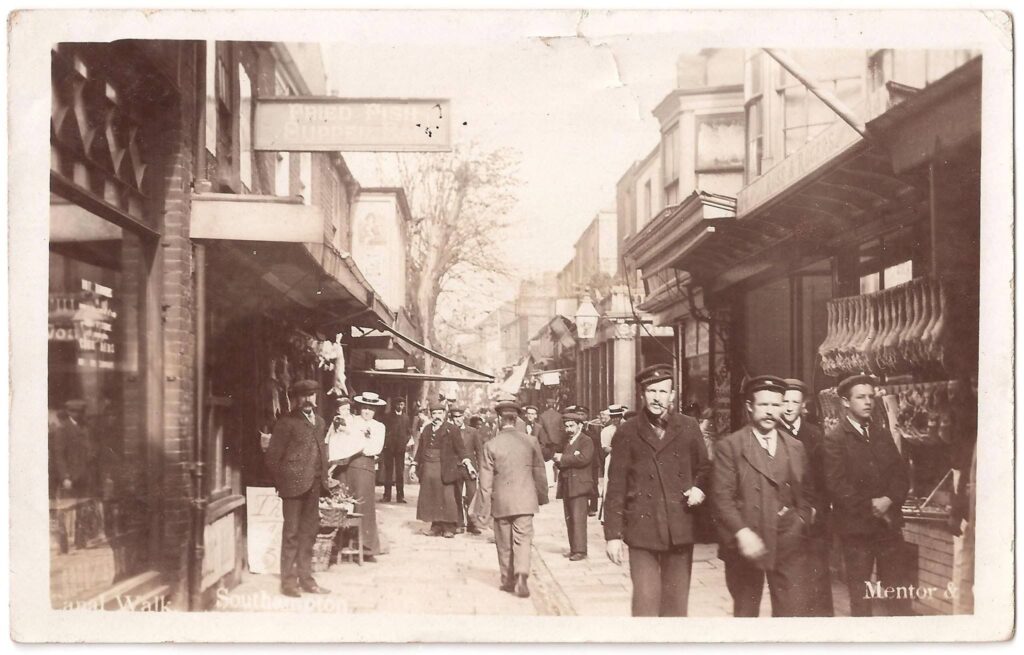
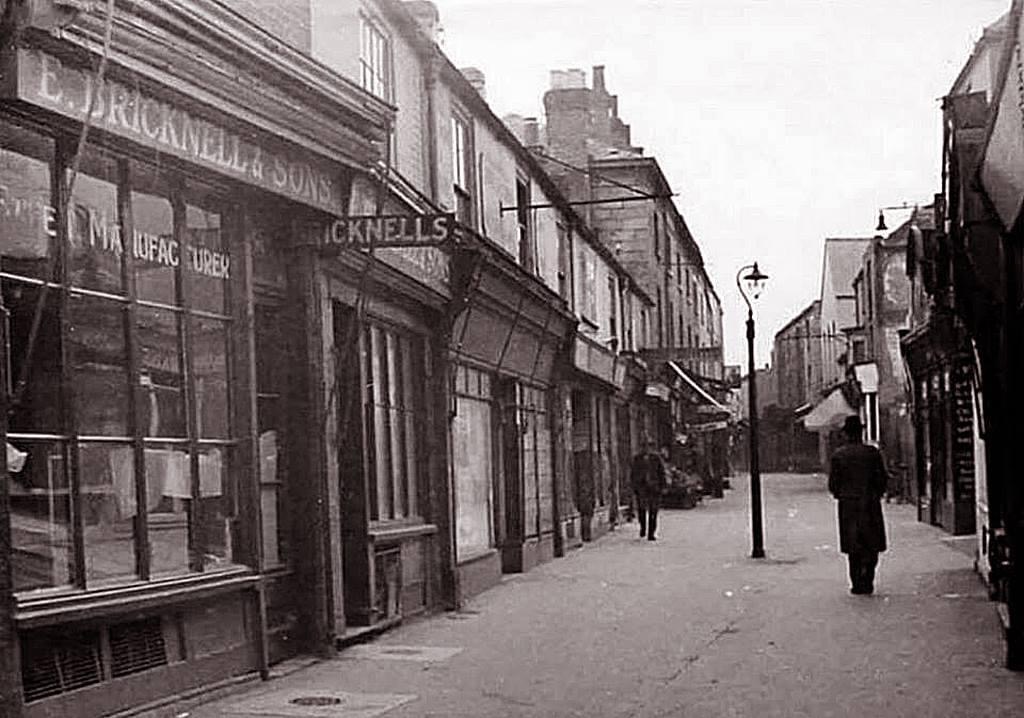
Being a port, Southampton was always cosmopolitan. People came on ships in search of a better life. The Ditches and East Street became home to many immigrant families. In the late 1920s and early 1930s, some of these families were Jews, trying to escape the horrors unfolding in Germany. Southampton had had Jewish residents since medieval times. By the nineteenth century, between fifty and a hundred Jewish people were living in the town, they worshipped in a converted room at 2 Middle East Street. In 1838, Southampton elected Britain’s first Jewish town councillor, Abraham Abraham. Another influential Jewish family were the Emanuels, who owned a jeweller’s shop on the corner of High Street and East Street opposite All Saints’ Church.

The Emanuel family and this shop feature in A Dish Best Served Cold, although Old Man Emanuel and his mastiff are figments of my imagination, as is another Jewish resident, Yaffie Goldstrom. The real Emanuel family were influential in setting up the congregation on Middle East Street and establishing the first synagogue in Albion Place in 1865.

In the first three decades of the twentieth century, the Jewish population tripled. By 1930 it had increased to three hundred, mainly because of migration from other areas of the country, particularly the East End of London. Life in the East End was difficult for immigrants. The rise of fascism in the early 1930s made things especially difficult for Jews. While Mosley’s Blackshirts created havoc in London, his British Union of Fascists never had a large following in Southampton. Although they had headquarters on The Avenue, there were no major clashes between them and the Jewish community. London Jews saw Southampton as a safe place, and as things in Europe worsened, more Jewish families arrived. This period of political change and these cosmopolitan streets are the backdrop for A Dish Best Served Cold.

If you like what I write, and you’re interested in my novels are available now on Amazon in paperback, on Kindle and via Kindle Unlimited. Check out my Amazon page here and my Goodreads page here. If you would like to help me keep writing, you can now buy me a virtual coffee by clicking on the little orange coffee cup at the bottom right.
I remember my Dad telling me that everyone went to East Street on Christmas Eve to buy their meat for Christmas Day and the street was a blaze of lights from all the shops.(1920s and 30s) It was very busy with a lovely atmosphere and the shops stayed open into the evening. You could also buy your Christmas Tree there as it was traditional to decorate the tree on Christmas Eve – not before! Then take it down on Twelfth Night.
Even in my childhood, East Street was a bustling, busy place. Not so much now.