
Seventh Daughter, the third book in my historic fiction series, is currently being prepared for publication and should be available shortly. The story is set in the summer of 1931 when helping a neighbour unleashes a chain of events that threatens to tear the close-knit but impoverished Northam Street community apart. A few of the characters will be familiar to anyone who has read Plagued and Land Fit For Heroes. One new character is mentioned several times, although he doesn’t make an appearance. Most residents of Southampton will recognise his name, Thomas Lewis, but how many know his story? I think it is about time I got round to telling it.
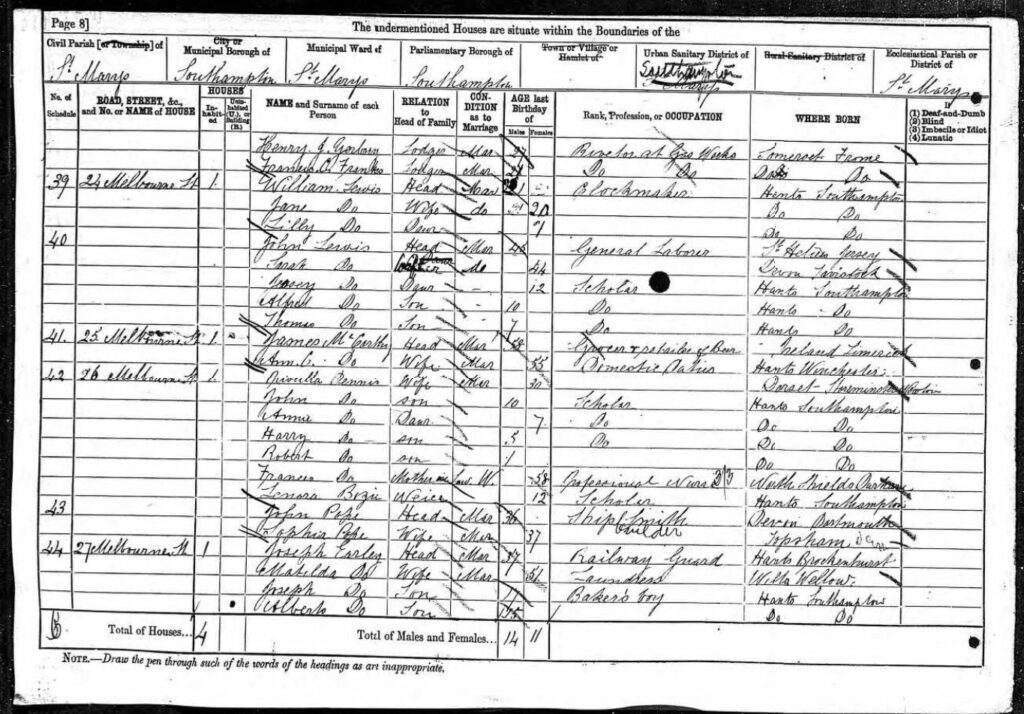
Thomas Lewis was born into a working-class Southampton family on 12 December 1873. He was the youngest son of John Fallaize Lewis, a dock labourer of St Hellier, Jersey and Sarah Lewis of Tavistock Devon. The family lived at 45A Melbourne Street — the same street Percy, Lennie and Laura lived on in Land Fit For Heroes. Sandwiched between the railway line and the gasworks, it was not a salubrious address. By 1881 the family had moved a few doors down the road to 24 Melbourne Street, a little further from the gas works but still not the nicest of places.

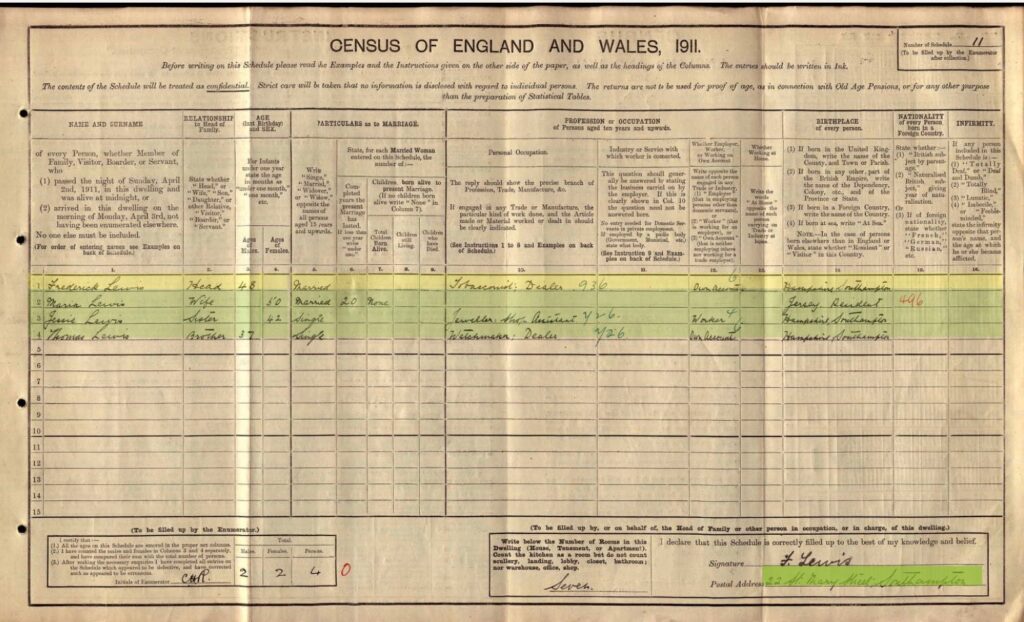
Frederick, the fourth of John and Sarah’s nine children, was born in 1862. He became a tobacconist and jeweller. At the age of eleven, Thomas became an apprentice watchmaker. By 1891, Thomas was living with Frederick at 19 St Mary’s Street, close to the corner of Chapel Road. The brothers shared the accommodation with Frederick’s wife, Maria, and lodgers, Fred Hartnell, a confectioner, his wife Fanny, and their son, Ernest. Later, Thomas and Frederick’s parents moved into 19 St Mary’s Street, and by 1901, the brothers had moved to number 22. By this time, Frederick owned the tobacconist shop, and Thomas was a watchmaker and an employer. The three-story buildings opposite St Mary’s Church were a step up from Melbourne Street, and Thomas, or Tommy to his friends, was an ambitious man.

In the late 1880s, Tommy became involved with Britain’s first socialist political party, the Social Democratic Federation. Then, in 1901, he was elected Southampton’s first Labour Party councillor, representing the St Mary’s Ward. He also played a prominent role in developing trade unionism in the town. He helped form branches of the Dockers’ Union, the Ship Stewards’ Union (for people serving aboard British merchant ships), the Shop Assistants’ Union (the second-largest union of retail workers), and the National Sailor’s and Firemens’ Union (for merchant seafarers). By 1910, it looked as if the councillor for St Mary’s might make the leap to become a member of parliament. The Southampton Trades Council selected Tommy to contest the Southampton constituency in the January General Election. Until 1911, Members of Parliament were unpaid, as it was assumed that they would have independent means. Tommy was, by then, a watchmaker and dealer, but he was still living in St Mary’s Street with his brother Frederick and was by no means a rich man. Eventually, he had to withdraw due to a lack of funds.
Being unable to stand as an MP did not quell Tommy’s political ambitions. In 1911, aged 37, he was part of a revolt against the National Sailors’ and Firemen’s Union (NSFU). It was claimed that they were reckless and extravagant with funds, members had no control over the organisation, and the leading officials were unaccountable. A new union, the British Seafarer’s Union (BSU), was formed in Southampton on 6 October 1911. Tommy became the president. In August 1912, a second branch of the BSU was established in Glasgow. The NSFU countered by denying the allegations made by the BSU and claimed that the new union were a product of the political ambitions of the leading officials, Tommy Lewis and Manny Shinwell.

He may not have been able to stand for parliament, but Tommy was still politically active. After the sinking of the Titanic in 1912, surviving crew members travelled from New York to Plymouth on the SS Lapland. When they arrived, the Board of Trade detained them. They were to be allowed no contact with their families or the press until they had given dispositions. Tommy Lewis and Arthur Cannon of the Seafarers’ Union were refused access to the men. Undeterred, they hired a small boat and, through a megaphone, told the men not to speak until they had union representation. The board of Trade backed down, and Tommy and Arthur helped the men return to their homes. Tommy also represented the men during the British investigation into the sinking.

Tommy still had political aspirations, and when the first regular salary of £400 was introduced for MPs in 1911, it opened the door for him. An annual salary of £400 may not sound like much, but average earnings were less than £100 at the time, and it certainly enabled men without means to stand for election. This was exactly what Tommy did in 1918, 1922, 1923 and 1924. Each time he was unsuccessful. Finally, in the 1929 general election, he and Ralph Morley became Southampton’s first Labour MPs in the two-seat Southampton constituency.

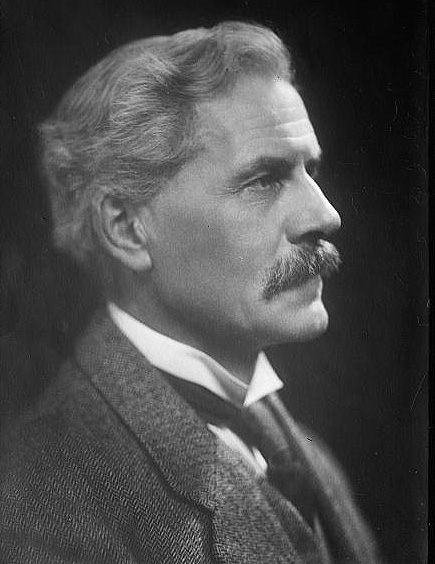
Things were not all rosy, however. The 1929 general election was often called the ‘Flapper Election,’ because it was the first in which women aged 21 to 29 were allowed to vote. It resulted in a hung parliament. Liberal, David Lloyd George won 59 seats, Conservative, Stanley Baldwin, won 260 and Labour’s Ramsay MacDonald, won 287. MacDonald became Prime Minister, but Lloyd George held the balance of power. It was never going to be plain sailing and things came to a head in 1931.

By 1931, the government had been battling the Great Depression for two years. Times were hard for ordinary working-class people, and MacDonald faced an uphill battle. The cabinet became deadlocked over the budget crisis that August. Other Labour members refused to support budget cuts, especially a cut in the unemployment benefit. When the Labour government collapsed, the King encouraged MacDonald to form a National Government, a coalition of all the political parties, to deal with the crisis. No one expected it to last more than a few weeks.
This was the political situation at the beginning of Seventh Daughter. It was also why Tommy Lewis was mentioned so frequently. Ordinary people were badly affected by the government’s decisions, and they were divided in their opinions. Even husbands and wives didn’t necessarily agree. Albie was a docker — ‘To his mind, Tommy Lewis was one of them, his father had been a docker after all, and Albie would sooner give his vote to someone who knew what it was like for working men like them.‘ Daisy saw things differently — ‘It didn’t seem fair that hardworking men like Albie and Dan should struggle while men like Tommy Lewis walked around in their crisp, white shirts and jangled money in their pockets. The dockers all loved Tommy because his father had been one of them, and he’d started the Dockers Union. Unlike them, he didn’t come home every night with an aching back and stiff shoulders from hefting around sacks of spuds, coal, or whatever else had come in on a ship. He spent his days pushing bits of paper about and making speeches. One day, the council would probably erect a bloody great statue to Tommy Lewis or name a park, or something, after him. No one would remember Albie Joyce, Dan Painter, or any of the other men who kept food in the shops and coal in the grates.‘

When the Gold Standard was abandoned, things went from bad to worse for the government. For those who don’t understand the Gold Standard, the following conversation between Albie and Sam explains it better than I can.
‘It means the value of our money is linked to gold.’ Albie wiped the spokes of one of the pram wheels with an oily rag. ‘So, in theory, you could take your pound note to the bank and ask for its value in gold.’
‘Why would you want to do that?’ Sam sat with his paintbrush poised and surveyed the upturned chassis of the pram with a look of concentration. He had a smear of black paint on his cheek.
‘Well, people did. Rich people got scared about the depression and started going to banks with their paper money, demanding gold. It got so bad the Bank of England was running out, so now they’ve abandoned the Gold Standard.’
‘Oh.’ Sam began painting again. ‘I don’t suppose it makes much difference to men like us, though, do it? None of us has spare money to turn into gold, and you can’t eat it, wear it, or burn it on the fire.’
The Conservatives pressed for the National Government to fight an election as a combined unit. MacDonald thought this was probably the best way to stay in power, and his supporters from the Labour Party formed a National Labour Organisation to support him. The Liberals were sceptical about an election and had to be persuaded. Tommy Lewis was amongst the Labour MPs who refused to follow MacDonald into a coalition with the Conservatives. Despite this, the election went ahead on 27 October and saw a landslide victory for the National Government. Both Tommy Lewis and Ralph Morley lost their seats. Despite this setback, Tommy stayed active in local politics.

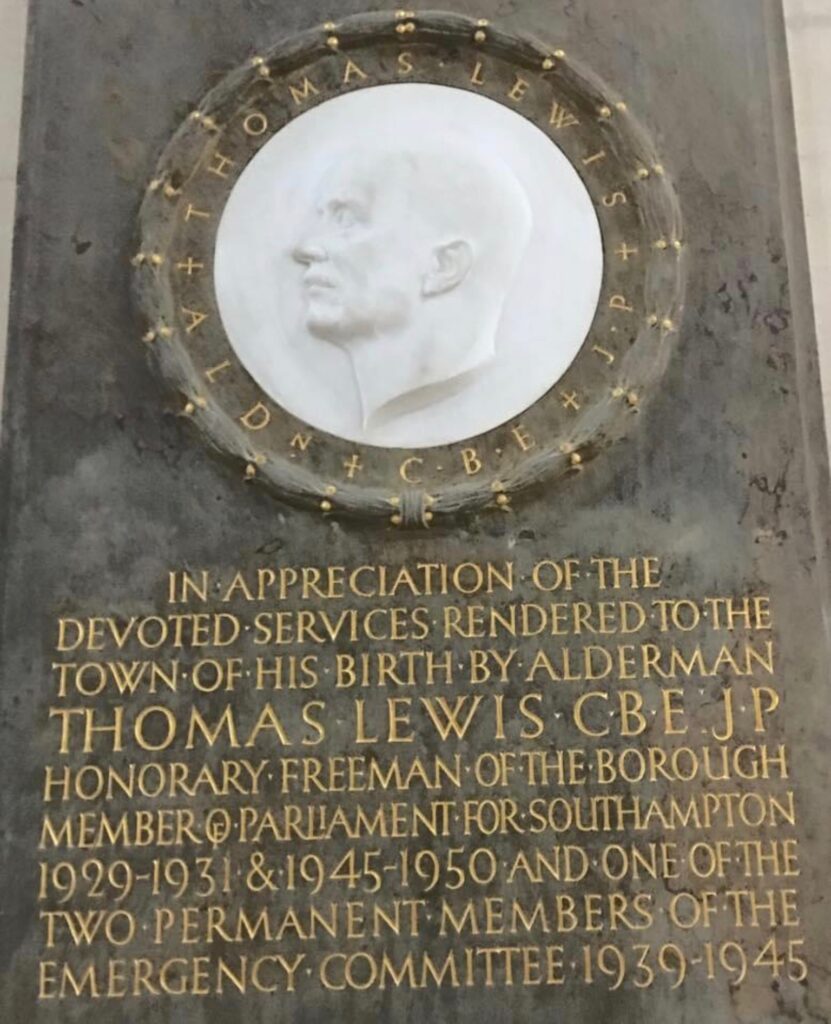
In 1939, Tommy finally left St Mary’s and moved to 8 Brighton Road, off The Avenue near the Stag Gates. He lived with his brother Frederick and sister, Jessie and was listed as a friendly society trustee. During World War 2, Tommy became a permanent member of the Emergency Committee. He was elected in the Labour landslide that followed the victory. By then, he was 72. He retired from national politics in 1950 and was awarded a CBE. He had served on the Southampton town council for sixty years, was an Alderman and an Honorary Freeman of the borough. A portrait plaque was also erected in the Civic Centre in his honour.
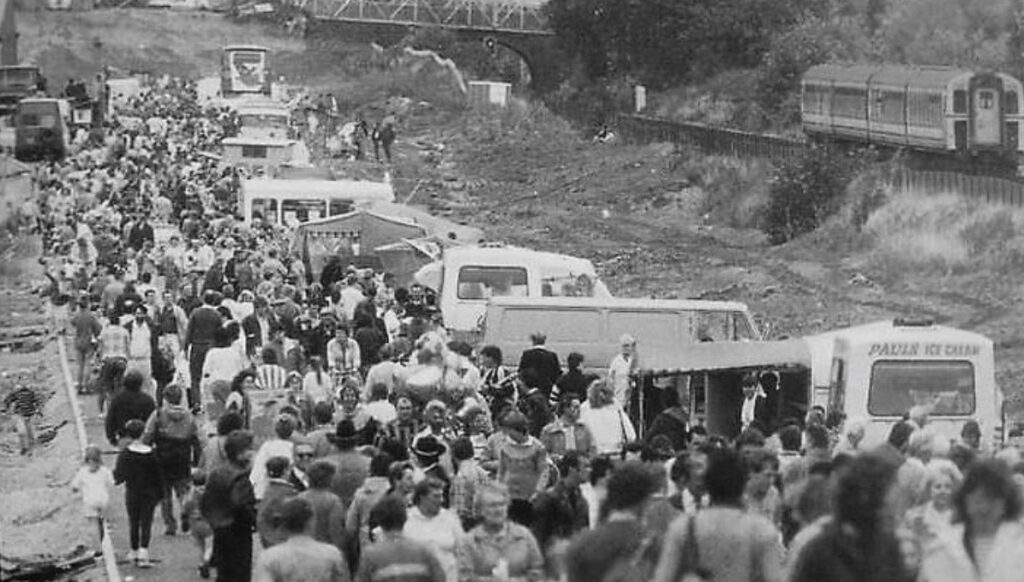
Frederick Lewis died in 1947, and Jessie followed in 1951. Tommy moved to 66 Alma Road, where he lived until his death on 28 February 1962. The people of Southampton still know his name, even if they may not know his story. In the 1960s, Southampton Council wanted to build an extension to the M27. After twenty years of discussions and arguments, the plans were downgraded, and the A335 was built between Stoneham Way and Bevois Valley Road. It was finally opened in August 1988. The council name it Thomas Lewis Way after Tommy Lewis. Before it was officially opened, local residents held a street party on the empty road. I think Tommy Lewis might have approved.
If you like what I write, and you’re interested in my novels are available now on Amazon in paperback, on Kindle and via Kindle Unlimited. Check out my Amazon page here and my Goodreads page here. If you would like to help me keep writing, you can now buy me a virtual coffee by clicking on the little orange coffee cup at the bottom right.
It was lovely to read. Thank you. He was my great great Uncle.
Thank you. I’m glad you enjoyed it. It was interesting researching him and he will be mentioned a few times in my forthcoming book.
Thank you. This was so interesting. I’m Beth’s cousin and Tommy Lewis was my great great Uncle too. It may be interesting to know that his brother my great great Grandfather William Lewis was the Mayor of Southampton during the outbreak in 1940. He has his portrait in the Southampton council offices to this day. William was a jeweller too and lived in St Marys Road I believe. Both brothers will have been very tenacious and determined men as well as strong advocates for the people of Southampton. There will have been lots of facinating conversations between them I’m sure.
Oh to have been a fly on those walls!