
A cold, damp blanket of fog hung over Southampton on 11 January. As I crossed Cobden Bridge, I heard the haunting sound of distant fog horns and watched a lone gull circling. It felt as if he and I were alone on the river. Of course, we were far from alone, but walking in the fog imparts a feeling of splendid isolation. The water hanging in the air muffles the hum of traffic, and fellow travellers appear, like spectres out of the gloom, then disappear again as soon as they’ve passed. I’d planned to walk along the river, but the lack of visibility made me change my mind. Instead, I thought I might check out a few locations from my work in progress. St Denys was a key feature, so I walked across the bridge.
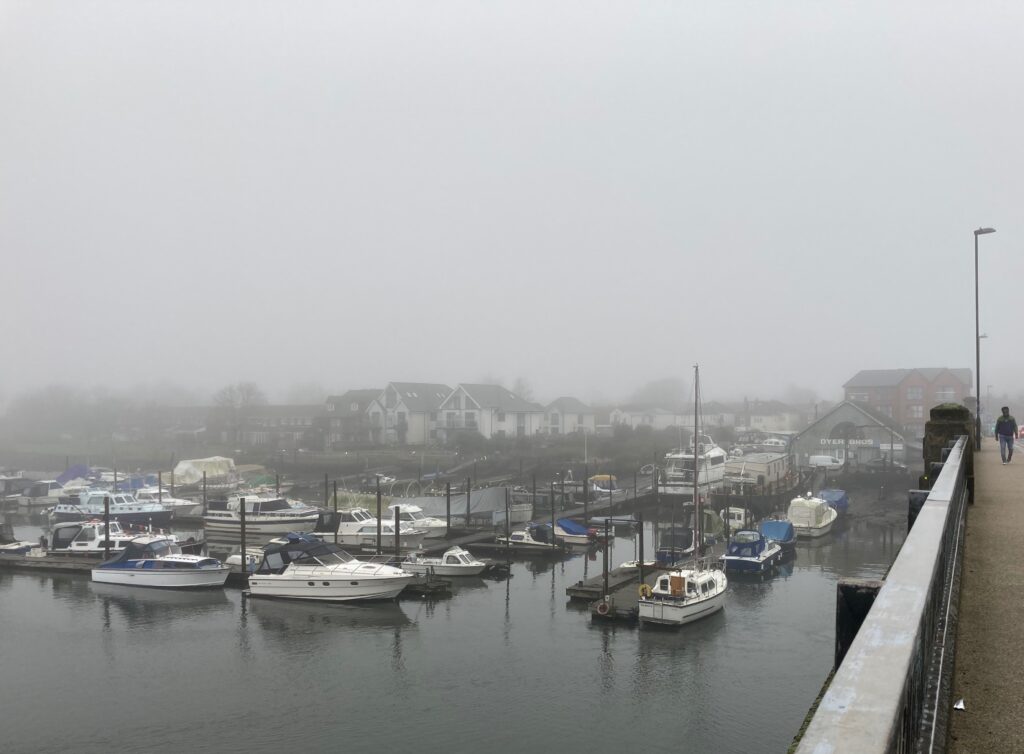
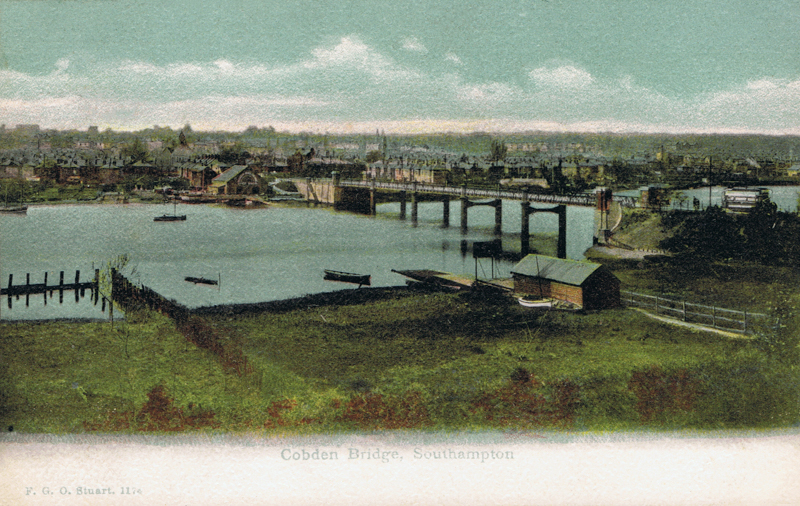
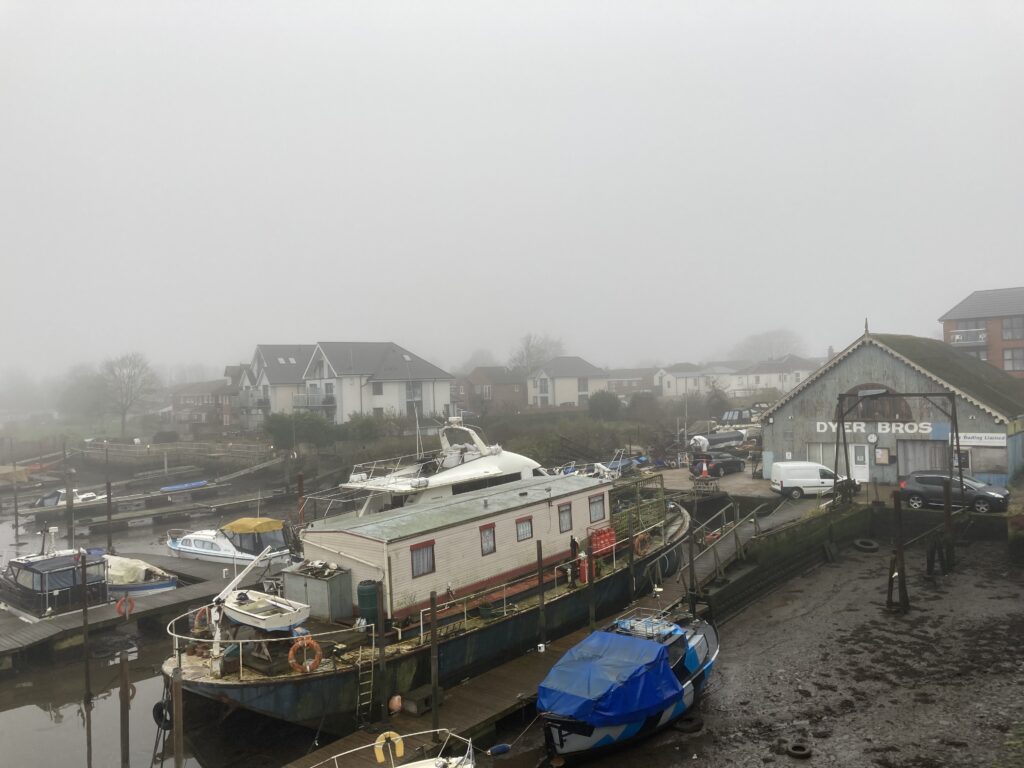
Once, this was my walk to work, so I’ve come this way countless times in all weathers. I was unlikely to see anything new, but even familiar sights can sometimes trigger ideas. The houses on the riverbanks were cloaked in fog, and the little boats didn’t look as enticing as usual. Even the blue of Dyer’s Boatyard looked grey. Surprisingly, the boatyard has been there longer than the current bridge. The Dyer Brothers opened their first boatyard in 1856 near Northam Bridge. They built up a successful business, building and hiring rowing skiffs. In 1903, when the new Southampton to London railway line was built, they were forced to move to their current location. As tastes changed and rowing skiffs became less popular, they added pontoons, and created a small marina offering moorings and boat repairs.
The Dyer family still own the boatyard, and they’re still going strong today. In fact, Dyer’s may be the oldest boatyard in Southampton. Catching a glimpse of the big blue boat shed always made me smile on my walks to work. I’ve always loved its slightly dilapidated look, and it became the inspiration for Bert Porter’s boat shed in Plagued and Land Fit For Heroes, even though the setting was Shamrock Quay rather than St Denys.
Without really thinking about where I was going, I let my feet take me onto Priory Road. For a while, I walked mindlessly, thinking about the story I was in the middle of writing and not really taking any notice of my surroundings. Then I spotted a strange thing. A mass of pigeons had gathered on one particular section of the terrace roof near the railway bridge. As I watched, more pigeons joined the throng. I couldn’t help wondering what was so enticing about that particular bit of roof, as all the other roofs were pigeon free. I suppose I’ll never know the answer.
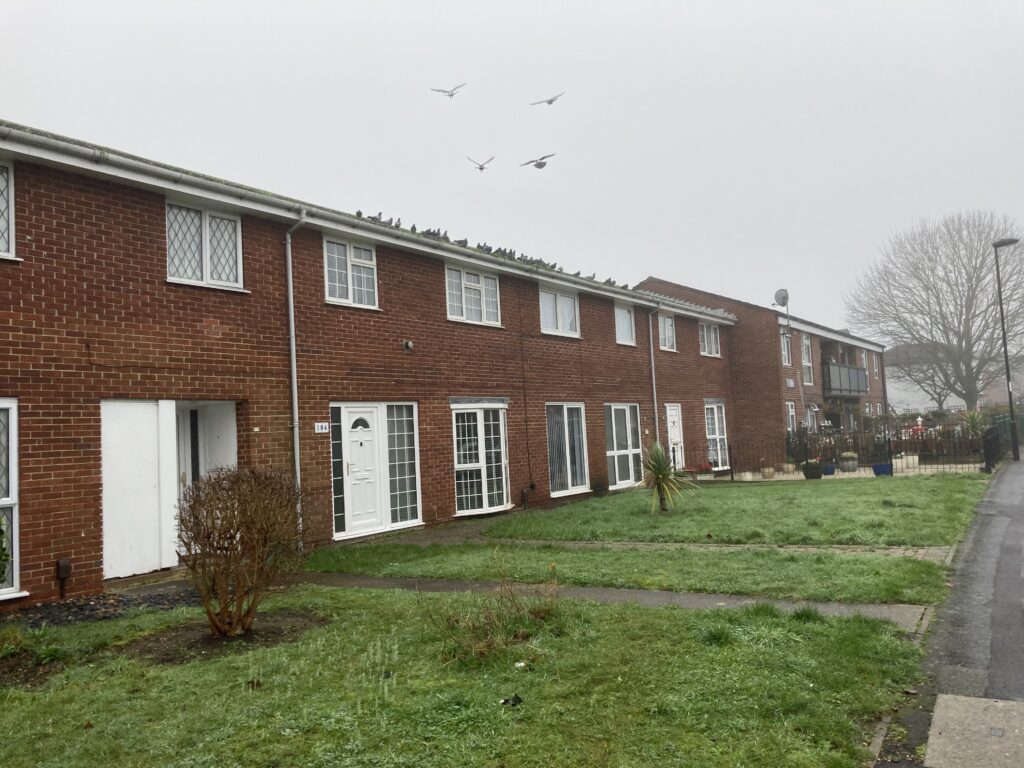
A while ago, I told the story of Norman Brewer and his friend Brian Vaughan rescuing a mother and child from a bombed house during the Southampton blitz. These modern terraces are built where the bombed houses would have been, so I imagine they were built to replace them.
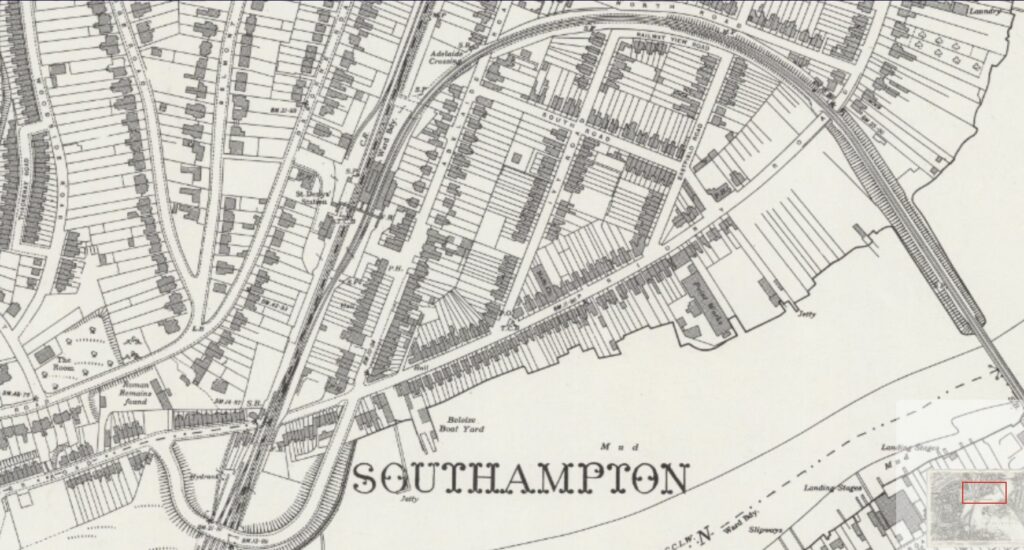
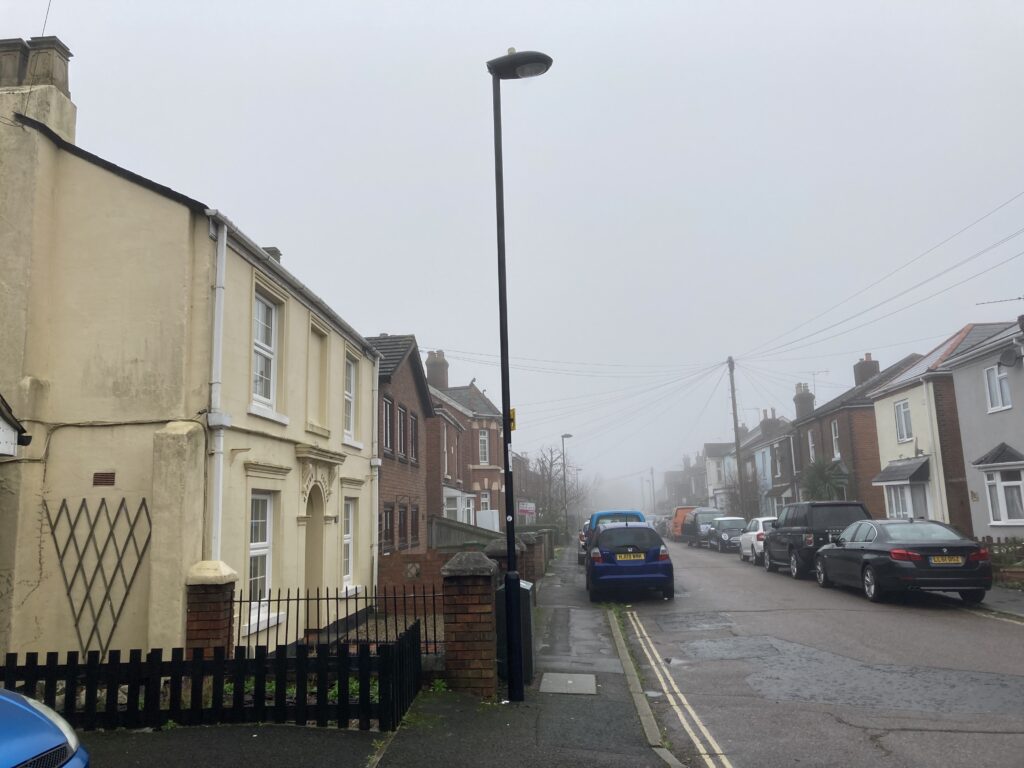
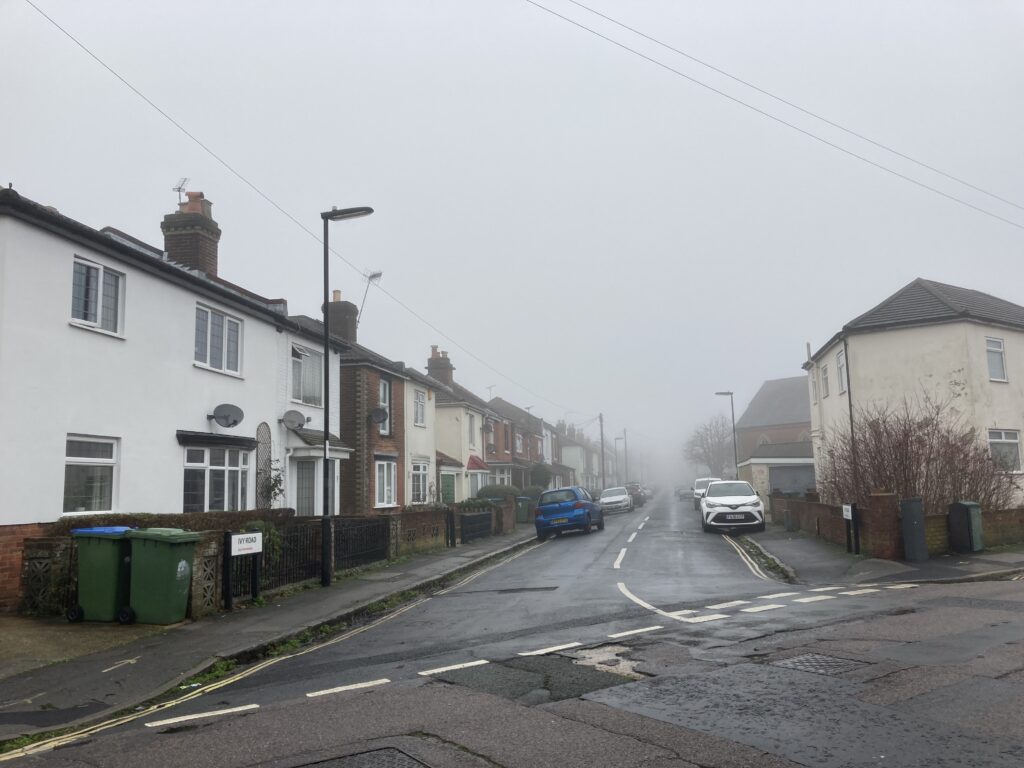
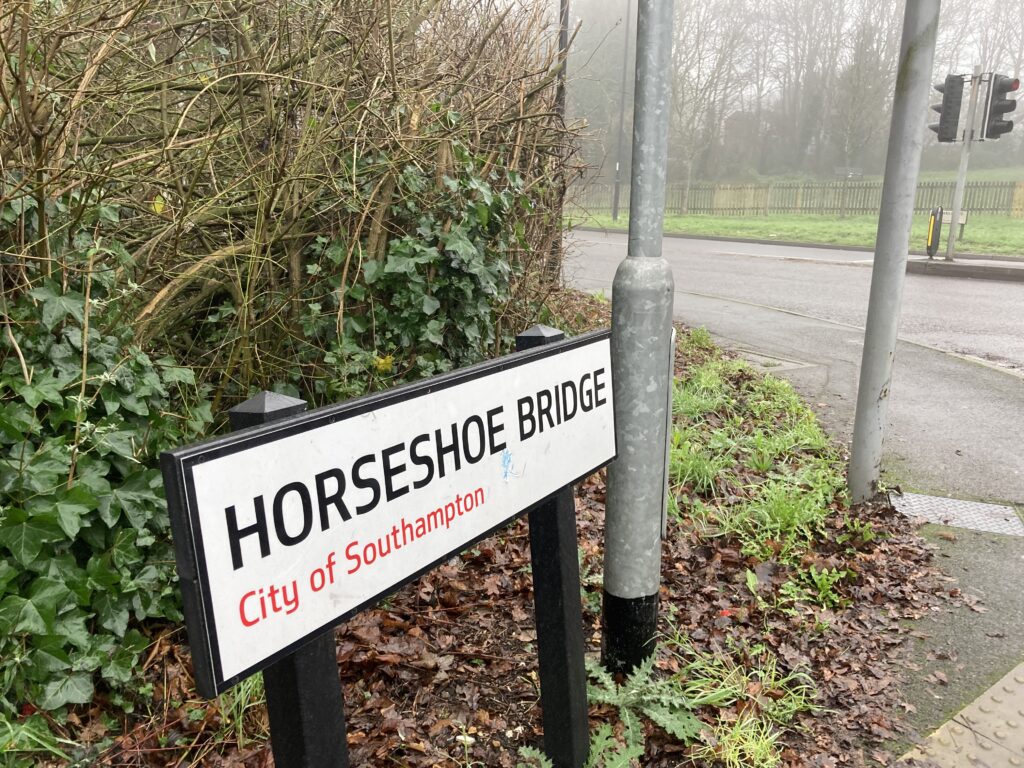
Most of the houses in Priory Road are much older. The street is a strange mixture of large villas and humble cottages. A look at the old OS Maps tells me that most of them have been there since at least the 1890s. Horseshoe Bridge first appears on the 1910 map. Before then, there was a little stretch of shore between the end of Ivy Road and Adelaide Road. I wonder how the people living opposite felt about losing their river view?
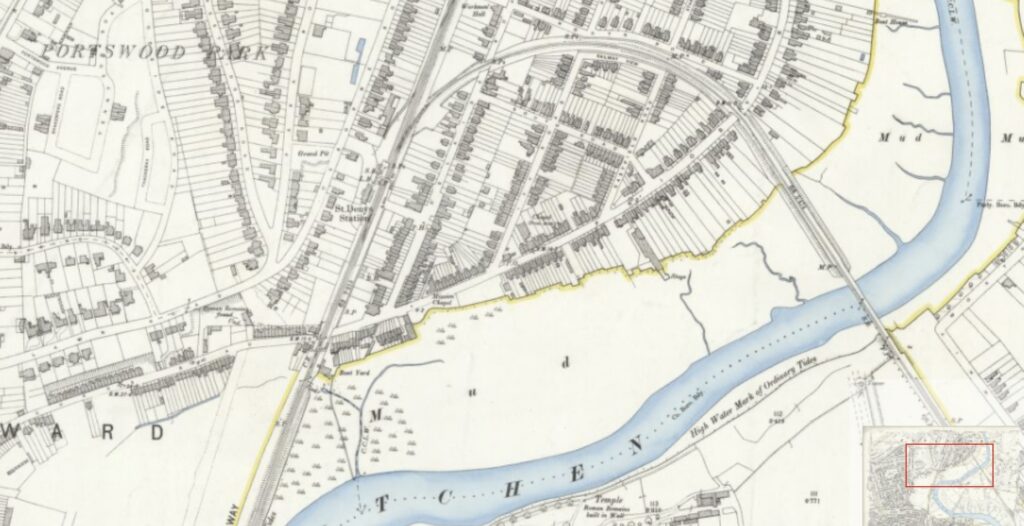
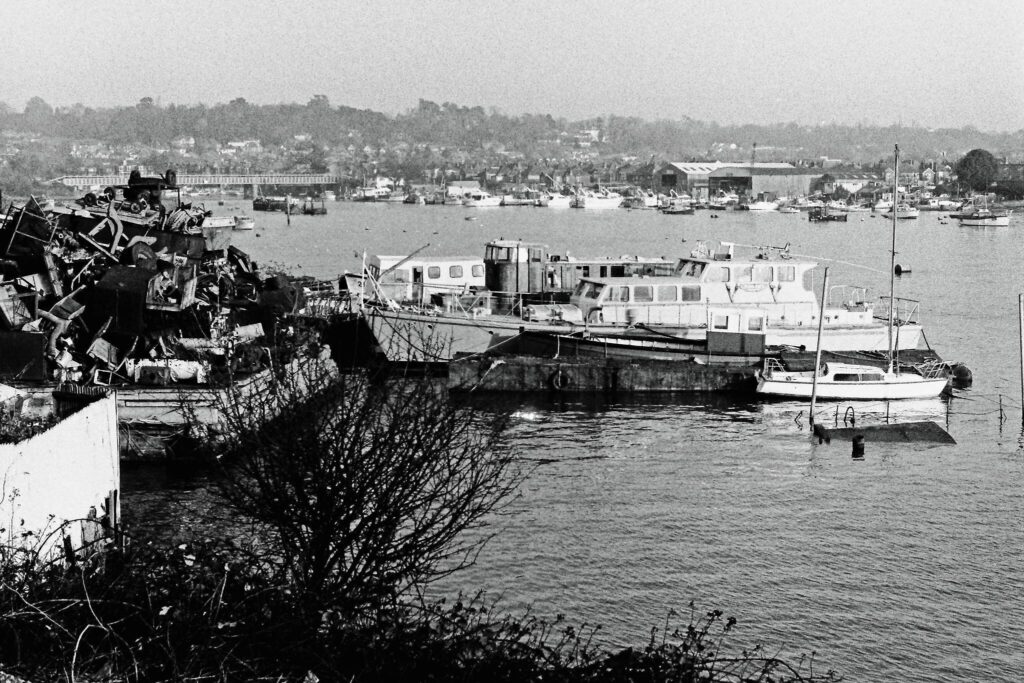
There was also a boatyard, roughly where the Millennium Flats are today. It was called the Belsize Boatyard, and I planned to feature it in my work in progress. From what little information I can find, it was more scrap yard than boat yard, but, as I’m writing fiction, I suppose I can be allowed a little poetic licence.
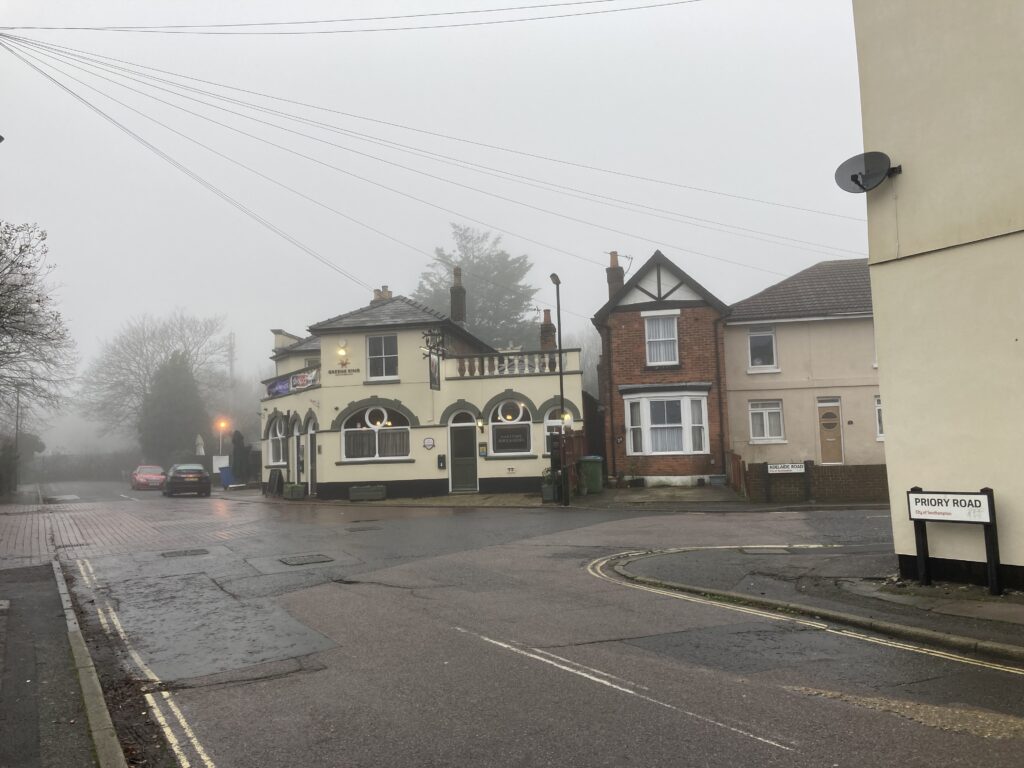
There is nothing left of the Belsize Boatyard, so I contented myself with a photograph of the Junction Inn instead. This was the pub where Thomas, Joe and Bert drank in Plagued. I’m told the internal fixtures havent changed much since those days, although I’ve never been inside myself. It was built in the 1860s on the corner of Priory Road and Adelaide Road, and was originally called the Wareham Arms. In around 1878, the name was changed to the Junction Inn, probably because the nearby railway station is the junction of the London to Weymouth line and the Portsmouth line. There have been a few recent changes of ownership, but it is still a pub today. One of these days, I might even have a drink there.
Leaving the Junction Inn behind, I continued on to Horseshoe Bridge. The fog still hadn’t lifted, and when I looked out over the river, there was nothing much to see. At this point, I was tempted to abandon my walk and head back along the boardwalk towards home. There are some advantages to walking in the fog, but stunning river views are not one of them.
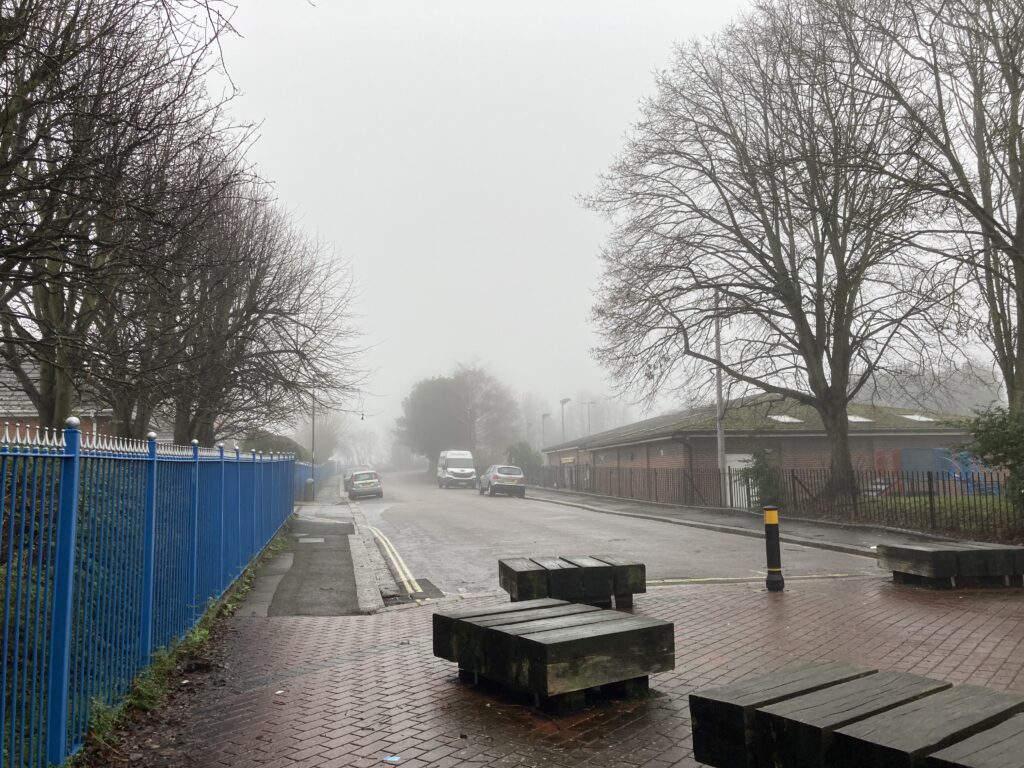
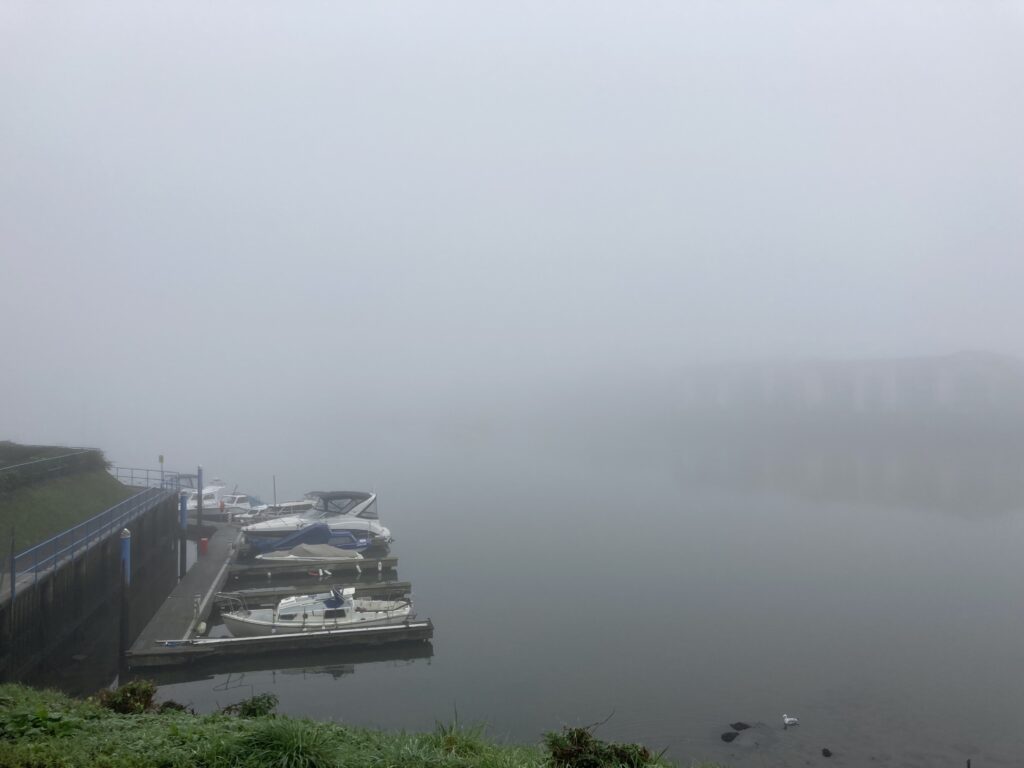
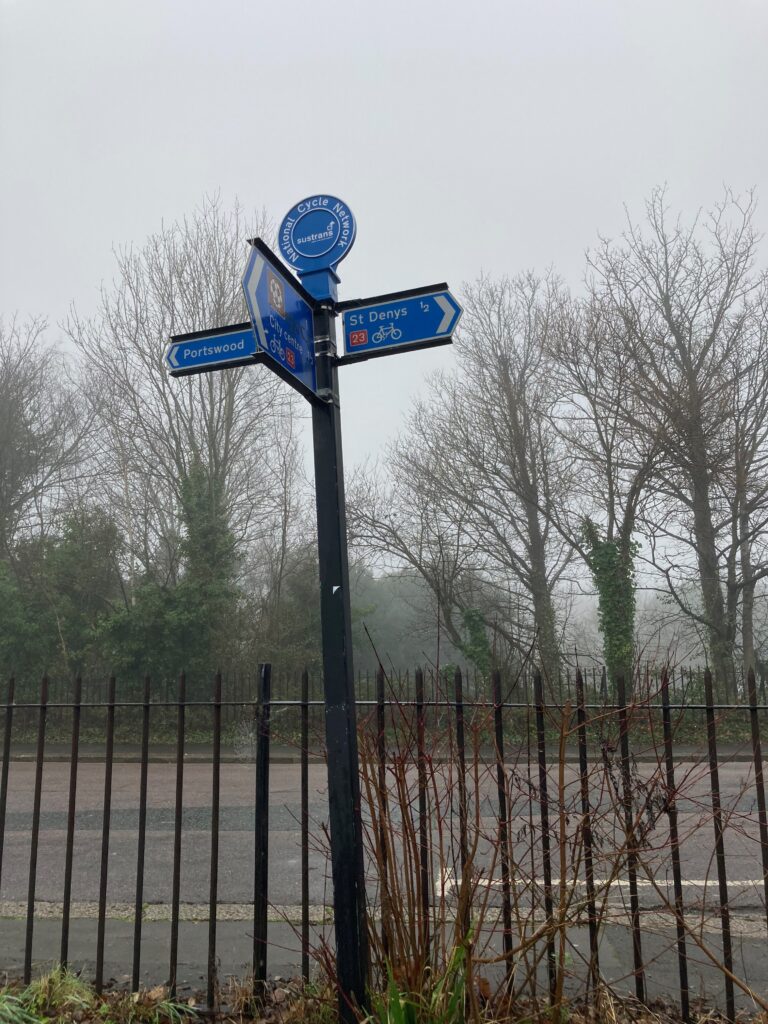
I dithered at the top of the slope. The cycleway sign seemed to be pointing out my options, but none of them was appealing. In the end, I decided to ignore the sign and keep going forwards. Horseshoe Bridge was set to feature in my work in progress, so maybe standing on it would inspire me?
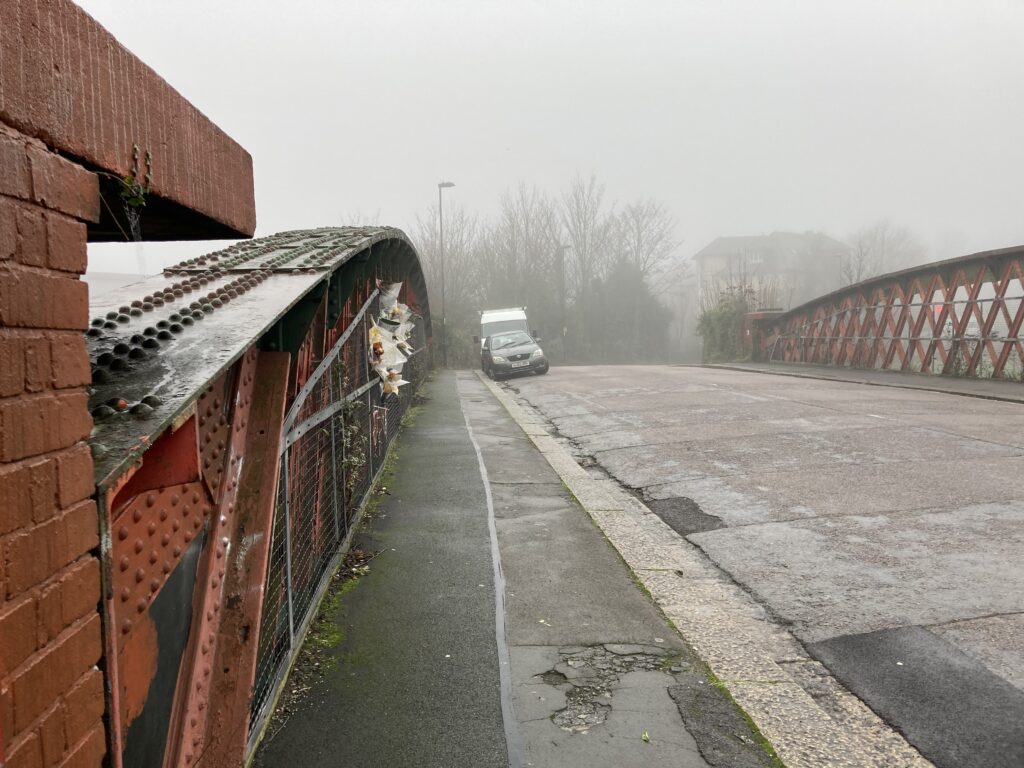
As bridges go, it isn’t the prettiest, although I suppose there is a certain charm to the criss-cross struts and all those domed rivets. As a feat of engineering, it is something to be admired, even if it isn’t aesthetically pleasing. Today there were flowers tied to the middle of the bridge, probably a tribute to the young man whose body was found on the tracks below at the end of December. Looking down at the rails, I wondered how the unfortunate young man came to be there and why. The railway line is fenced off on both sides, so he can hardly have been taking a short cut.
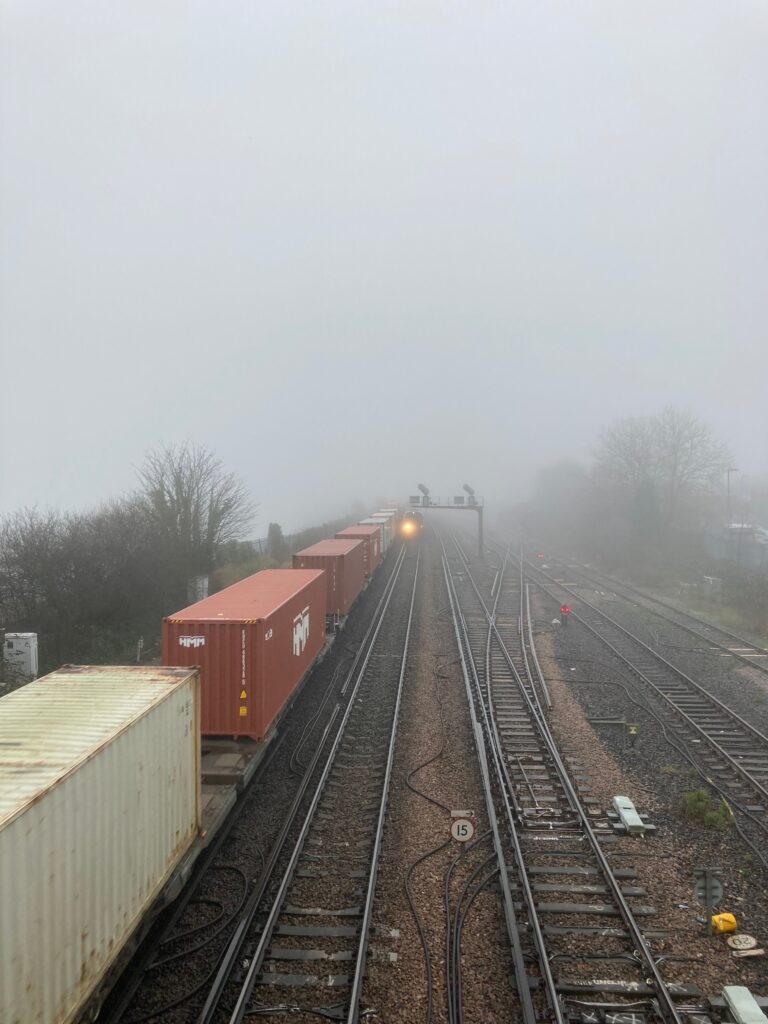
A train came rumbling below, so I stayed a little longer to watch it. It was a long goods train filled with containers, probably heading for the docks. An interminable number of containers had passed beneath me, and I was thinking about moving again, when I saw a dim light coming towards me through the fog. It took a moment or two to work out that it was a train. This is a busy stretch of line.
Priory Road initially led directly to Dukes Road. When the railway came, the two were divided by a level crossing and a small footbridge. As far as I can tell by looking at the maps, it was similar to the arrangment at Mount Pleasant. As this route connected St Denys with Bevois Valley, the advent of the motorcar must have made it a busy crossing. I imagine this was why the road bridge was built.
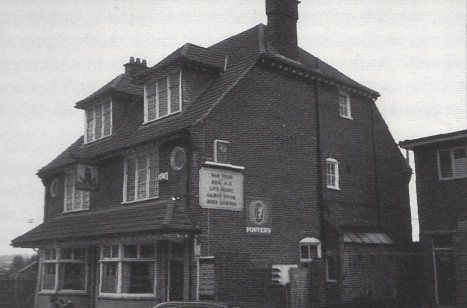
Until the 1980s, Dukes Road remained much as it always had, terraced houses with a scrap yard and the ubiquitous pub on the corner. The pub was called the Waterloo Arms, and it first opened its doors in 1876. In the 1960s, the fortunes of the pub and the residents of Dukes Road changed. Southampton Council decided to build an extension to the M27. Twenty years of arguments, consultations and uncertainty for the residents followed. Eventually, the plans were downgraded, and the A335 was finally built. It was named Thomas Lewis Way after Tommy Lewis, Southampton’s first Labour Councillor. The houses of Dukes Road, along with many others along the route between Bevois Valley and Swaythling, were subject to compulsory purchase orders and demolished. The road opened in 1989. The Waterloo Arms limped on until 1992.
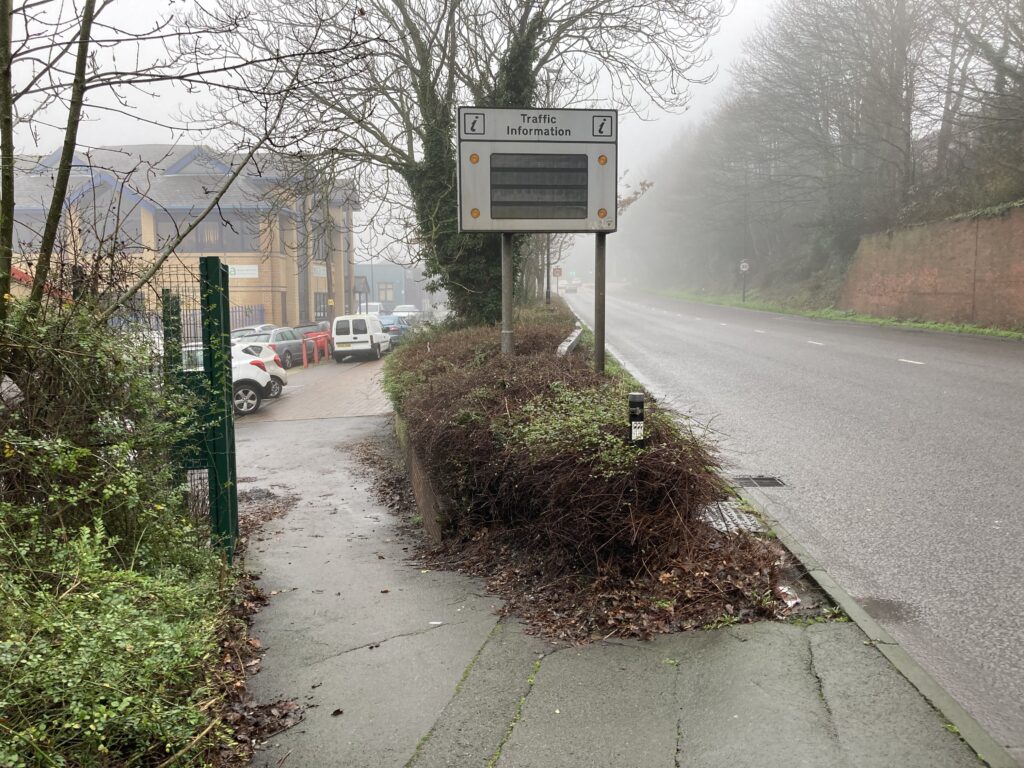
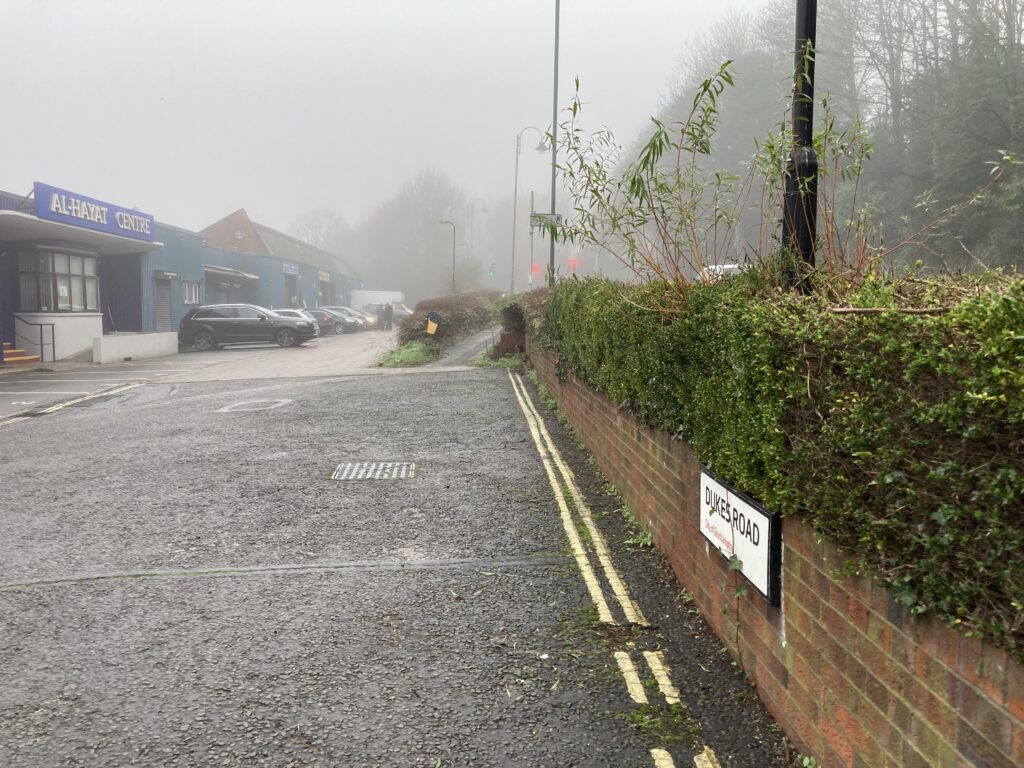
Today there is little left of Dukes Road. There are no houses and not much in the way of road. In fact, all that remains is a handful of small businesses, the name and a few memories. It seems a sad end to what was a typical working-class street. I can’t help wondering what Tommy Lewis, the son of a dock labourer from St Mary’s Street and a staunch supporter of the working classes, would make of it?
If you like what I write, and you’re interested in my novels are available now on Amazon in paperback, on Kindle and via Kindle Unlimited. Check out my Amazon page here and my Goodreads page here. If you would like to help me keep writing, you can now buy me a virtual coffee by clicking on the little orange coffee cup at the bottom right.
Great story. Reminds me of growing up in the St. Denys area From 1945 to 1960’s. I lived two doors away from the Railway pub on Osborne Road now all under that Tommy Lewis Way. I can remember playing around under the Horseshoe Bridge and the Belize boat yard and walking through to that movie theatre (which became a TV News station) alongside the river. Belsize had a lot of scrap war materials which I think was owned by the Smith family who lived on the corner of Belmont and Portswood Roads. I also lived on Priory Close.
Thank you. I lived on Belmont Road for a while. It was before Thomas Lewis Way, and when I came back after it was built, I could hardly get my bearings.
Hi Marie
Tell me do you have any stories about the history of Northam at all? 🙂
There are lots of posts about Northam. If you type it into the search bar you will find them. My first two books are also set in Northam. There is a link to my Amazon page at the end of each post. I hope this helps.
I lived in North Road 1949 to 1961 then Ivy Road until 1964. Loved living in St Denys so many fond memories. We used to go crabbing down “The Tide” in Priory Road where the prefabs were until the disease of Polio broke out. Used to go to the Station jumping up and down on the walkover bridge in the steam from the trains and taking train numbers. Spent many an hour in The Junction Inn when a lady Doris and her son ran it back in the 60s. Conservative club on St. Denys Road, learnt to dance there with Elizabeth Webb school of dancing. Went to the school (not my favourite years) Not many people owned cars in those days, I suppose we were lucky as we had a sideway and back garden that took a few cars. Sad to read some of the stories on St Denys Rocks about the parking and the smells that the now residents have to put up with. I wouldn’t of missed living there in 1950s for anything.
We lived in the prefabs in st denys drive. Crabing on the wall by the slipway. Swimming every day in the 6 weeks holidays being covered in calamine lotion.
Great days just moved back and the change was surprising. We used to stand on station bridge when the steam trains came through.
I miss the steam trains.
Hello Carole My name is john jewell i lived across the river in Bitterne park & went to school there untill 1959 !
many of my early years were spent in st denys at the station getting train numbers & waiting for the trains to cover us in steam & grit , Belsize boatyard was Heaven for a boy like me ? i was facinated by Boats , wrecks & the surroundings, & we swam a lot adjacent to the boatyard ,
I had on or two friends that i used to play with from st denys !! but for the life of me ? i cannot remember their names ,
Strangly enough when i first married we bought a house in Priory rd a lovely detached 1900s c House just at the back of Watsons Couches with Ferrymans premises at the river end where the rowing club used to be !! it was a lovely time there the communanty spirit was alive & the locals wer all long time residents , with BESTS fish & chip shops on the main portswoos rd what could be better ,
My Mums sister was Elizabeth Webb school of dancing. & she relocated from Lower shirley where her main dance studio was located with her husband Jack ! her daughter Diana was part of the Elizabeth Webb formation Team , & they were featured on television many times & toured all over the place & danced before the Queen with other formation Teams on T V , Elizabeth’s main studio was in the upper avenus at Basset & to see the dancers & there fabulous costumes Practing their moves /steps was fascinating let alone seeing the Seemsters sewing all the dresses etc as a young lad in the mid 1950s it was magicial
So when in around 1958 ish I attended her school of dancing in St Denys Learning to dance it was great fun , she said to me & my mum if he keeps pratcing he will get ther ??………NO he did not Really !! So Carol Hayball we could have been dance Partners, Great days .
Amazing read .
My Grandmother Mrs Thorn lived at number 4 Adelaide road I spent always a week in the summer holidays with her. about 1956.
Other times of the years my mother Joan took myself and my two sisters to visit our grandmother and her garden back on to the railway line.
We sisters always climbed up on the garden wall and wave to the train driver (steam) he always blew his whistle.
My Great grandmother lived I believe number 32 Priory road.
such great memories.
Glad to have brought back some good memories.
Horseshoe Bridge was constructed (1902-1904) for the proposed trams because the Board of Trade had refused permission for them to use the level crossing – as it turned out the trams never materialised.
Thank you. That’s interesting.
Hi
A friend of my husbands sent us the link to your site as she, like myself lived in st denys
My husband bitterne park, then later st.denys. I lived in 3 Railway view road from 1962 till 68 age 7….its lovely little garden and cosy house.
I remember my Polish neighbours who had dried sausages hanging up in the kitchen. My 1st day at school and walking home after day 1 saying ” that’s it I have been once I don’t have to go back ” But after, I still remember the school dinners and homemade salad cream which I can still taste!!
North Road was opposite us and remember a friend we used to visit as my mum used to do Tupperware and Avon cosmetics so we would deliver and have demonstration parties. Someone might remember her Dawn Lambird?
There was a wood shop on the corner of priory road I think that I would go with my dad and loved the smell of the cut timber and still do . The coal merchants on the main road we would go and pay the bill where everything was coated in dust ! Not nice when it was wet…..
Getting on the train and going over the bridge was great as my nan lived in Woolston loved the train journey and looking out the windows that used to side down….
The walk over the river I still think of to go to bitterne park and Belsize boat yard and the house boats which fascinated me as a small child.
I remember a lady called Mrs Penny and Mrs Audrey Tilley but not many others.
What prompted me to right this after receiving it was my mum passed away last week, my dad in October so this is a lovely way of remembering my great early childhood in a warm friendly environment St. Denys!!! Just love your work x
Glad to bring some good memories in your time of grief. Apologies for the late reply.
Hello Hayley.
I remember Belsize boatyard from the 1960s.The company that I worked for did the electrical work on the boats for them.I was a very young apprentice then. As for Dukes road, I remember taking my driving test from the driving test centre that was there then. And later on after qualifying as a driving instructor taking my own pupils there
for there half an hour of hell. Those were the days, I must say very happy ones.
Thanks for sharing.